
Biopharma SHAKTI and Health Sector Reforms
- 02 Feb 2026
In News:
The Union Budget 2026–27 places health at the centre of India’s development strategy, aligning with the broader goals of capacity building, inclusive growth, and economic resilience. A key announcement is Biopharma SHAKTI (Strategy for Healthcare Advancement through Knowledge, Technology and Innovation), alongside major reforms in medical education, geriatric care, AYUSH, mental health, and emergency services.
Biopharma SHAKTI: Towards a Global Biopharma Hub
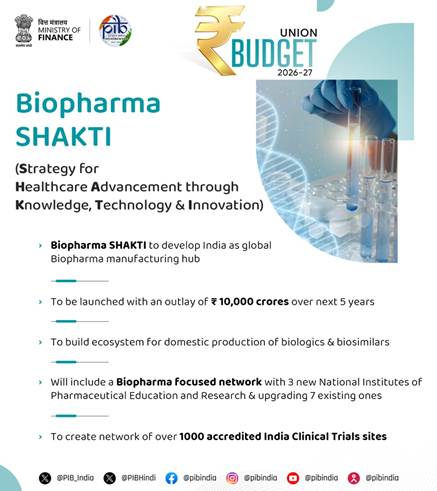
Biopharma SHAKTI aims to position India as a global manufacturing hub for biologics and biosimilars, with an outlay of ?10,000 crore over five years.
Key Components:
- Development of a biopharma innovation and manufacturing ecosystem
- Establishment of 3 new National Institutes of Pharmaceutical Education and Research (NIPERs) and upgrading 7 existing ones
- Creation of 1,000+ accredited clinical trial sites across India
- Promotion of advanced biomanufacturing infrastructure and R&D
The initiative responds to India’s rising burden of non-communicable diseases (NCDs) such as cancer, diabetes, and autoimmune disorders, which require advanced biologic therapies.
- Biologics are complex medicines derived from living organisms, often expensive and technologically demanding to produce.
- Biosimilars are highly similar, cost-effective alternatives that expand access to life-saving treatments while maintaining safety and efficacy.
Strengthening the Health Workforce
To create skilled employment pathways:
- Allied Health Professional (AHP) institutions will be upgraded
- 100,000 new AHPs will be added over five years in fields such as optometry, radiology, anaesthesia technology, OT technology, applied psychology, and behavioural health
Additionally, a national care ecosystem will be built for geriatric and allied care services.
- 1.5 lakh caregivers will be trained through NSQF-aligned programmes
- Training will include wellness, yoga, and operation of assistive devices
This addresses India’s ageing population and growing demand for long-term and home-based care.
Regional Medical Hubs and Medical Tourism
A new scheme will support states in establishing five Regional Medical Hubs through public-private partnerships. These integrated complexes will include:
- Advanced medical facilities
- Educational and research institutions
- AYUSH centres
- Medical value tourism facilitation services
- Diagnostics, rehabilitation, and post-care infrastructure
This aims to boost medical tourism, generate employment, and improve regional healthcare access.
Boost to AYUSH and Traditional Medicine
Recognising global interest in traditional systems:
- 3 new All India Institutes of Ayurveda will be established
- AYUSH pharmacies and drug testing laboratories will be upgraded
- The WHO Global Traditional Medicine Centre, Jamnagar will be strengthened for evidence-based research and training
Mental Health and Emergency Care Expansion
To bridge regional gaps:
- National Mental Health Institutes in Ranchi and Tezpur will be upgraded as Regional Apex Institutions
- Emergency capacity of district hospitals will be increased by 50% through new Emergency and Trauma Care Centres
These measures strengthen India’s preparedness for both routine and crisis healthcare needs.