
Antarctic Ozone Hole: Early Closure in 2025
- 07 Dec 2025
In News:
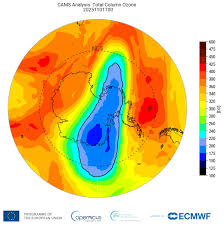
In 2025, the Antarctic ozone hole closed earlier than usual, with closure recorded on 1 December, marking one of the smallest ozone holes in the past five years. The early closure has been seen as a strong sign of long-term recovery of the ozone layer, despite the backdrop of record global temperatures.
What is the Antarctic Ozone Hole?
- The Antarctic ozone hole refers to the seasonal thinning of the stratospheric ozone layer over Antarctica during the austral spring (September–November). Scientists define the ozone hole as regions where ozone concentration falls below 220 Dobson Units (DU).
- It is not a literal hole but an area of severely reduced ozone levels in the stratosphere, first discovered in 1985.
Why Does the Ozone Hole Form Over Antarctica?
Several unique atmospheric conditions combine to intensify ozone depletion in the region:
1. Polar Vortex:During the Antarctic winter, a strong polar vortex traps cold air, preventing mixing with warmer air from lower latitudes.
2. Polar Stratospheric Clouds (PSCs):Extreme cold leads to PSC formation. These clouds facilitate chemical reactions that activate chlorine and bromine from human-made chemicals such as chlorofluorocarbons (CFCs) and halons.
3. Return of Sunlight:When sunlight returns in spring, it triggers rapid chemical reactions that destroy ozone molecules, producing the ozone hole.
2025 Ozone Hole Highlights
- The ozone hole reached a maximum area of just over 21 million sq km, significantly smaller than the record 29 million sq km in 2006.
- It closed earlier than usual, marking the second consecutive year of relatively small ozone holes.
- Scientists attribute this trend to declining levels of ozone-depleting substances (ODS) and favourable atmospheric conditions.
What is Ozone?
Ozone (O?) is a gas made of three oxygen atoms and exists in two layers:
|
Layer |
Type |
Role |
|
Stratosphere (15–30 km) |
Good ozone |
Absorbs harmful UV radiation |
|
Troposphere (near surface) |
Bad ozone |
Pollutant, contributes to smog |
Global average ozone concentration is about 300 DU.
Impacts of Ozone Depletion
- Increased UV-B radiation causes skin cancer, cataracts, and immune suppression
- Damages crops, forests, and marine phytoplankton
- Alters atmospheric circulation patterns in the Southern Hemisphere
Global Response
- Montreal Protocol (1987):A landmark global treaty phasing out ozone-depleting substances. It is the first UN treaty with universal ratification.
- Kigali Amendment (2016):Targets hydrofluorocarbons (HFCs)—not ozone-depleting but potent greenhouse gases.
These actions are estimated to prevent up to 0.5–1°C of global warming by 2050.
Outlook
If current trends continue, scientists estimate ozone levels could return to pre-1980 levels around:
- 2040 globally
- 2045 in the Arctic
- 2066 in Antarctica