
Urban Fire Safety in India
- 14 Jun 2026
In News:
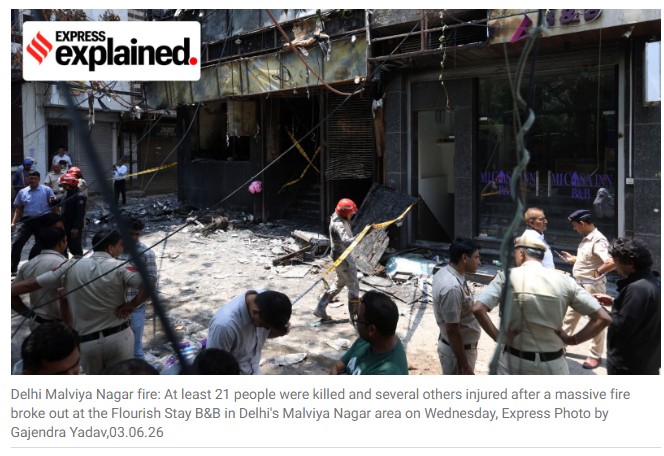
Recent fire tragedies, including the devastating blaze at a guest house in Delhi's Malviya Nagar and a hospital fire in Bihar, have once again drawn attention to the growing fire safety crisis in India's urban areas. These incidents are not isolated accidents but symptoms of deeper structural weaknesses in urban planning, building regulation, and emergency response systems.
Fire Safety: A Persistent Urban Risk
India continues to witness a significant number of fire-related deaths every year. According to NCRB data, nearly 60% of fire fatalities occur within residential buildings, making homes the most vulnerable spaces despite being perceived as safe environments. Hospitals, shopping complexes, hotels, and other commercial establishments also account for a substantial share of casualties.
The recurring nature of such incidents points towards systemic shortcomings rather than individual lapses.
Why Are Urban Fires Becoming More Frequent and Deadly?
One of the primary reasons is the absence of basic fire safety infrastructure in a large number of residential and mixed-use buildings. Smoke detectors, sprinkler systems, fire alarms, emergency exits, and evacuation plans are either missing or poorly maintained.
Another major concern is the widespread conversion of residential buildings into commercial establishments such as guest houses, hostels, and hotels without corresponding upgrades in safety infrastructure. Such unauthorized modifications increase occupancy while compromising evacuation and firefighting capabilities.
Electrical faults remain the leading cause of urban fires. Aging wiring systems, overloaded circuits, poor maintenance, and increasing dependence on electrical appliances create a constant fire hazard. LPG leakages due to defective equipment and unsafe handling practices further aggravate the risk.
The challenge is compounded by India's dense urban settlements. Narrow roads, congested neighbourhoods, illegal constructions, and inadequate access routes often delay the arrival of fire engines and hamper rescue operations.
Understanding the Nature of Fire Hazards
Fire-related deaths are often caused not by burns but by smoke inhalation and toxic gases. As noted by the National Institute of Disaster Management (NIDM), oxygen depletion and poisonous fumes released from burning materials are responsible for a majority of fatalities.
High temperatures can also trigger secondary explosions due to the expansion of gases, fuels, and combustible substances. Consequently, even a localized fire can rapidly escalate into a major disaster.
Recognizing this, the National Disaster Management Authority (NDMA) categorizes fire as a human-induced disaster, emphasizing that most fire incidents are preventable through proper planning and compliance.
Regulatory and Institutional Framework
Fire services are a State subject under the Constitution and have also been included as a municipal responsibility under Article 243W and the Twelfth Schedule. Therefore, the primary responsibility for fire prevention and emergency response lies with State Governments and Urban Local Bodies (ULBs).
India already possesses a comprehensive regulatory framework through the National Building Code (NBC), 2016, prepared by the Bureau of Indian Standards (BIS). The code provides detailed provisions relating to fire-resistant construction, smoke management, evacuation systems, electrical safety, periodic audits, and modern firefighting technologies.
However, the challenge lies not in the absence of regulations but in weak implementation and poor enforcement.
Key Challenges
A major governance gap exists in the enforcement of building and fire safety norms. Unauthorized constructions, illegal land-use conversions, and inadequate inspections continue to undermine safety standards.
Fire services across many states remain under-equipped and understaffed. Recognizing this deficiency, the 15th Finance Commission recommended ?5,000 crore for strengthening fire services and emergency response infrastructure. Nevertheless, significant shortages persist in equipment, manpower, training, and high-rise firefighting capabilities.
Rapid urbanization presents another challenge. The growth of high-rise buildings, vertical cities, and mixed-use developments demands sophisticated firefighting technologies and specialized response systems, which many urban centres still lack.
The Way Forward
Addressing urban fire risks requires a multi-pronged strategy. Strict enforcement of the National Building Code and regular fire safety audits must become mandatory for residential, commercial, and institutional buildings. Unauthorized building conversions should attract stringent penalties.
Fire services require substantial modernization through investment in advanced equipment, high-rise rescue systems, early warning technologies, and professional training. Public awareness campaigns, evacuation drills, and community-based preparedness programmes can help create a culture of fire safety.
Urban planning must also integrate disaster-risk reduction principles by ensuring wider access roads, adherence to zoning regulations, and fire-resilient infrastructure in rapidly expanding cities.
Conclusion
Urban fire disasters are largely preventable. Their recurrence reflects failures in regulation, planning, enforcement, and preparedness rather than a lack of legal provisions. As Indian cities continue to expand vertically and horizontally, strengthening fire safety systems must become an integral component of urban governance. Building resilient cities will require coordinated action by governments, municipal authorities, builders, businesses, and citizens alike. Without systemic reforms, the cycle of tragedy, outrage, and temporary corrective action is likely to continue.