
Aravalli Hills
- 02 Jun 2026
In News:
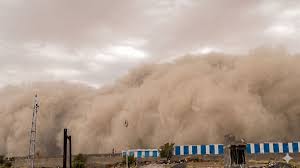
A massive dust storm that recently swept through Churu district in Rajasthan, affecting Hanumangarh, Sri Ganganagar, Bikaner, Nagaur, Alwar, and Sikar, has once again highlighted the critical ecological role of the Aravalli Range as a natural barrier protecting northern India from dust storms originating in the Thar Desert. However, increasing degradation of the Aravallis due to mining, deforestation, urbanisation, and land-use changes is weakening this protective shield, raising concerns about air quality, climate, and ecological stability.
Dust Storms in Northern India: Climatic Background
Dust storms are a regular pre-monsoon phenomenon (April–June) across northwestern India. They are driven by intense heating, dry atmospheric conditions, and strong south-westerly and westerly winds that transport dust from the Thar Desert and even parts of the Middle East.
According to the India Meteorological Department’s (IMD) Climate Hazards and Vulnerability Atlas of India (1981–2010):
- Parts of northwest India fall within the highest dust-storm frequency category.
- These regions experience 0.89–1.55 dust-storm days annually.
- Delhi records about 2.5 dust-storm days in June, the highest frequency in the country for that month.
Aravalli Range: India’s Natural Dust Barrier
Stretching between the Thar Desert and the densely populated Indo-Gangetic Plains, the Aravalli Range functions as a natural environmental shield.
During the pre-monsoon season, dust-laden winds moving eastward encounter the Aravallis, lose momentum, and deposit much of their sand and dust before reaching Delhi, Haryana, Punjab, and Uttar Pradesh.
Evidence of this protective role can be seen in the form of “obstacle dunes” located on the western slopes of the Aravallis. These sand deposits, along with desert-type vegetation, indicate where dust particles are intercepted by the mountain range. Dense vegetation further enhances this protection through a “natural scrubbing effect”, trapping dust and reducing its transport into the plains.
Alarming State of Degradation
The ecological integrity of the Aravallis is under severe threat.
Key Findings
- A 2018 Forest Survey of India (FSI) assessment found that 31 out of 128 Aravalli hills in Rajasthan had completely disappeared due to human activities.
- Significant loss of hills with elevations between 200–600 metres has been recorded in Naraina, Kalwar, Kotputli, Jhalana, and Sariska.
- A 2009 Wildlife Institute of India (WII) study identified 12 major gaps in the Aravalli range, many of which have widened due to forest degradation and inadequate vegetation cover.
Major Drivers of Degradation
The Environment Ministry’s Aravalli Restoration Framework identifies several causes:
- Mining of red silica, granite, and other minor minerals.
- Deforestation and vegetation loss.
- Urbanisation and construction activities.
- Encroachments and land-use changes.
- Excessive grazing and pastoral pressure.
These gaps now function as corridors through which dust can move freely into northern India.
Environmental Consequences
The weakening of the Aravalli barrier has far-reaching implications:
- Increased frequency and intensity of dust storms in Delhi, Punjab, Haryana, and Uttar Pradesh.
- Higher particulate matter concentrations and worsening air quality in the National Capital Region (NCR).
- Potential alterations in local and regional rainfall patterns due to changes in vegetation and topography.
- Changes in solar radiation scattering, affecting surface temperatures, agriculture, public health, and regional climate systems.
Scientists have emphasized the need for long-term monitoring of dust frequency and dust load over northern India, as the full climatic and environmental consequences of Aravalli degradation are still being understood.