
Women’s Political Participation in India
- 15 Mar 2026
In News:
Women’s political participation refers to the involvement of women in electoral and governance processes, including voting, campaigning, political mobilization, and holding elected office. In recent decades, India has witnessed a significant transformation in women’s electoral participation, with female voter turnout reaching near parity with men in the 2019 and 2024 Lok Sabha elections. However, despite this progress, a participation–representation gap persists, as women remain underrepresented in legislative bodies.
Key Trends in Women’s Political Participation
1. Electoral Turnout: The Silent Revolution
Women’s participation in voting has risen dramatically over time.
- The gender gap in Lok Sabha turnout narrowed from 11.2% in 1967 to almost zero in 2019 and 2024.
- In several state assembly elections since 2011, women’s turnout has surpassed men’s by about 2% on average.
This trend reflects increasing political awareness, improved voter registration, and targeted outreach by electoral authorities.
2. Legislative Representation
Despite strong voter participation, women remain underrepresented in legislative bodies.
- In the 2024 Lok Sabha, women hold 74 seats (about 13.6%), slightly lower than the 78 seats recorded in 2019, which was the highest ever.
- Women candidates also remain a small share of total contestants, despite an increasing number of women entering elections.
This demonstrates a clear gap between political participation as voters and representation as policymakers.
3. Candidature and Electoral Success
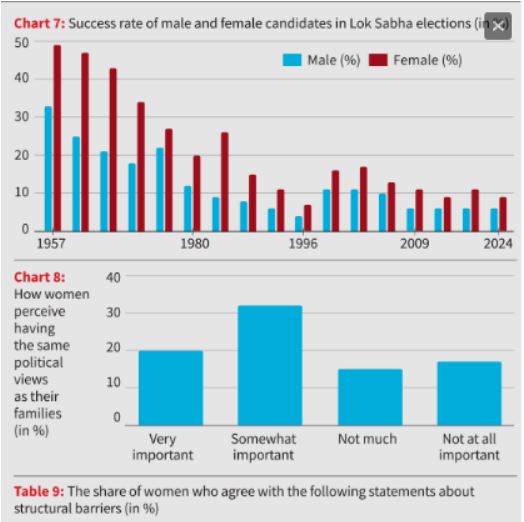
While fewer women contest elections, data shows that their success rate is relatively higher.
- In the 2024 elections, about 9% of women candidates won, compared to around 6% of male candidates.
This challenges the common assumption among political parties that women candidates are less “electable”.
Dimensions of Women’s Political Participation
1. Campaign Participation
Women are increasingly involved in political campaigning, including rallies and door-to-door canvassing.
Participation in election meetings has increased to around 16%, indicating that women are gradually moving from private spaces into the public political arena.
2. Grassroots Leadership
Reservation in local governance has significantly expanded women’s political presence.
The 73rd and 74th Constitutional Amendment Acts mandate 33% reservation for women in Panchayati Raj Institutions (PRIs) and Urban Local Bodies, with some states increasing it to 50%.
Today, India has over 1.4 million elected women representatives in local governments, creating a strong pipeline for future political leadership.
3. Independent Voting Behaviour
Women voters increasingly exercise independent political choices rather than voting according to family preferences.
- In 2024, about 50% of women reported voting independently, reflecting growing political autonomy.
4. Issue-Based Voting
Women voters are increasingly influenced by policy-oriented welfare schemes rather than traditional caste or party loyalties. For example, welfare programmes such as direct benefit schemes targeting women have significantly shaped electoral outcomes in several states.
Initiatives to Promote Women’s Political Participation
1. Nari Shakti Vandan Adhiniyam (128th Constitutional Amendment Act): This legislation provides 33% reservation for women in the Lok Sabha and State Legislative Assemblies, aiming to improve representation in higher legislatures.
2. Reservation in Local Governance: The 73rd and 74th Constitutional Amendments institutionalised women’s representation at the grassroots level, transforming local governance.
3. Electoral Participation Initiatives: The Systematic Voters’ Education and Electoral Participation (SVEEP) programme by the Election Commission of India promotes voter awareness, especially among women and marginalized groups.
4. Political Literacy Initiatives: Political literacy clubs in schools and colleges aim to encourage young women’s engagement with democratic institutions and public policy.
Challenges to Women’s Political Representation
1. The Electability Myth
- Political parties often hesitate to nominate women candidates, believing they are less likely to win elections.
- In the 2024 elections, women accounted for around 10% of total candidates, despite having higher success rates.
2. Patriarchal Social Norms: Deep-rooted gender norms often limit women’s participation in public life and require them to seek family approval before entering politics.
3. Domestic Responsibilities: Women frequently face a double burden of household work and caregiving, leaving less time and resources for political engagement.
4. Criminalisation and High Cost of Politics: The increasing role of money and muscle power in elections creates barriers for women candidates, who often have fewer financial and political resources.
5. Information and Digital Access Gap: In some regions, lower literacy levels and limited access to digital political discourse hinder women’s ability to engage fully with political processes.
Way Forward
- Timely implementation of women’s reservation in Parliament and state legislatures after delimitation.
- Internal party reforms, including voluntary quotas for women candidates and leadership positions.
- Capacity-building programmes to help women leaders from Panchayats transition to higher political offices.
- Ensuring a safe political environment, including stricter action against harassment and defamation of women leaders.
- Economic empowerment, as financial independence enables women to participate more effectively in politics.
Conclusion
India has made remarkable progress in closing the gender gap in voter turnout, marking a democratic transformation in political participation. However, true gender equality in politics requires bridging the gap between participation and representation. Structural reforms like the Women’s Reservation Act, combined with social change and institutional support, are essential to ensure that women are not merely voters but equal participants in shaping India’s governance and policy-making.