
The Strait of Hormuz: A Historical Chokepoint of Imperial Power and Energy Security
- 30 Apr 2026
In News:
In April 2026, the Strait of Hormuz re-emerged as the primary flashpoint in the escalating West Asia conflict. Following US-Israeli strikes, Iran restricted passage through the waterway, prompting a naval blockade by the Donald Trump administration. While these events are contemporary, they represent the latest chapter in a long history of imperial competition over a maritime chokepoint that controls the world’s energy pulse.
Strategic Geography: The Gateway of Trade
Connecting the Persian Gulf with the Gulf of Oman and the Arabian Sea, the Strait of Hormuz has historically linked the economies of India, Persia, Arabia, and East Africa. Its control has always dictated the flow of global wealth, shifting from spices and silk in the 16th century to petroleum in the 20th and 21st centuries.
The Era of Colonial Rivalry (16th – 18th Century)
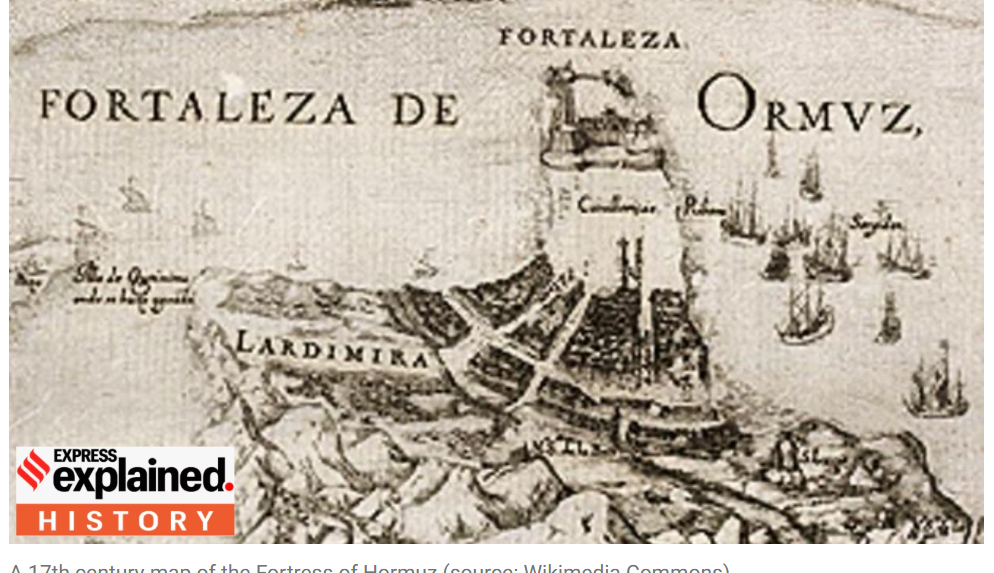
1. Portuguese Dominance (1515–1622): The Portuguese Empire, led by its quest for "Spice and Soul," recognized the strait's value early. In 1515, they seized Hormuz Island, establishing the Castelo de Nossa Senhora da Conceição. Their model was one of direct military dominance, turning the island into a fortified toll point to tax trade routes. However, this high-cost militarized approach eventually became unsustainable.
2. The Dutch Interlude: By the 17th century, the Dutch East India Company (VOC) challenged the Portuguese. Operating as a quasi-sovereign power, the Dutch dominated trade from Bandar Abbas. Their decline in the 18th century—driven by corruption, high administrative costs, and the Fourth Anglo-Dutch War—created a power vacuum that the British were quick to fill.
3. The Anglo-Safavid Alliance: The turning point for British influence occurred in 1622 when the English East India Company allied with the Safavid ruler, Shah Abbas I, to expel the Portuguese, ending nearly a century of Iberian control.
British Hegemony and the "Trucial" Model
To safeguard maritime routes to British India (specifically Bombay), the United Kingdom adopted a more sophisticated and cost-effective model of control than the Portuguese.
- Suppression of Maritime Tribes: In 1809 and 1819, Britain launched naval campaigns against the Al Qawasim (Al Qasimi) confederation—a powerful maritime Sunni tribal group—accusing them of piracy to justify the destruction of their fleets.
- The Trucial System: Rather than direct colonization, Britain established a Treaty System with local Arab rulers. These sheikhdoms became known as the Trucial States (the precursors to the modern United Arab Emirates).
- Indirect Control: Under this arrangement, local rulers maintained internal autonomy while Britain controlled their foreign policy and defense. This ensured the strait remained a secure British corridor for the flow of Indian resources and British manufactured goods without the burden of heavy administration.
The 20th Century: The Pivot to Energy Security
At the dawn of the 20th century, the strategic value of the Strait of Hormuz underwent a fundamental shift from trade protection to energy security.
- The Oil Breakthrough: In 1908, George Bernard Reynolds discovered oil at Masjed Soleyman in Persia—the first major commercial strike in the region.
- The State Stakeholder: Recognizing oil as the future of naval power (transitioning from coal to oil under Winston Churchill), the British government acquired a 51% stake in the Anglo-Persian Oil Company (established 1909) by 1914.
- End of an Era: Britain maintained its treaty-based dominance until 1971, when it formally withdrew from the region, leading to the independence of the Trucial States and the modern geopolitical configuration of the Gulf.
Conclusion
The Strait of Hormuz has evolved from a 16th-century spice toll-gate into a 21st-century energy jugular. The current 2026 naval blockade is not an isolated event but a continuation of a 500-year-old struggle to control the world’s most vital maritime "choke." Understanding this history is essential for navigating the complex geopolitical landscape of modern West Asia.