
The Rise and Fall of Paytm Payments Bank: A Landmark Shift in Indian Fintech Regulation
- 26 Apr 2026
In News:
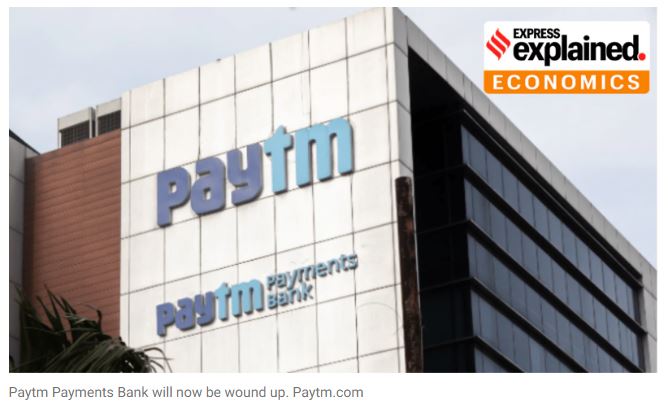
The Reserve Bank of India’s (RBI) decision to cancel the banking licence of Paytm Payments Bank Limited (PPBL), marks a watershed moment in the oversight of India’s digital finance ecosystem. This move, coming more than two years after the initial regulatory curbs, underscores the central bank's unwavering stance on governance and "Chinese wall" separation between fintech innovations and traditional banking discipline.
Understanding the Payments Bank Model
Payments banks were conceptualized as a niche banking category to drive financial inclusion by catering to low-income groups, small businesses, and the migrant labor force.
- Operational Scope: They are permitted to accept demand deposits (currently capped at ?2 lakh per customer) and offer remittance services.
- Restrictive Mandate: Unlike universal banks, they are strictly prohibited from lending or issuing credit cards.
- Safety Net: To safeguard depositors, they must invest at least 75% of their demand deposits in Government Securities (SLR-eligible) with maturities up to one year.
The Road to Cancellation: A Timeline of Scrutiny
The downfall of PPBL was not sudden but the result of a multi-year supervisory struggle regarding "persistent non-compliance."
- 2018 (Initial Red Flags): RBI audits identified critical gaps in KYC (Know Your Customer) compliance. Major violations included a single PAN being linked to thousands of accounts and transactions exceeding regulatory limits, raising severe money laundering alarms.
- March 2022: The RBI formally barred the bank from onboarding new customers.
- October 2023: A significant monetary penalty of ?5.39 crore was imposed for continued lapses.
- January–February 2024: Citing "material supervisory concerns," the RBI prohibited fresh deposits, top-ups in wallets, FASTags, and NCMC accounts.
- April 24, 2026: The final blow—the total cancellation of the banking licence and the initiation of winding-up proceedings before the High Court.
Legal Foundations of the RBI’s Action
The RBI invoked several stringent provisions of the Banking Regulation (BR) Act, 1949 to justify this unprecedented step:
- Section 22(4): Provides the power to withdraw a licence if a bank fails to meet stipulated conditions.
- Section 22(3)(c) & (e): The RBI concluded that the management’s character was prejudicial to public interest and that no "useful purpose" would be served by allowing the entity to continue.
- Section 5(b) and Section 6: These sections effectively prohibit PPBL from conducting any banking or related business with immediate effect.
A primary concern was the lack of an independent "Chinese wall" between PPBL and its parent entity, One97 Communications, which led to significant conflicts of interest and regulatory bypass.
Strategic Impact and Future Outlook
1. For the Paytm Ecosystem: One97 Communications has since moved to a "partner-bank-driven model," forging emergency alliances with entities like Axis Bank and Yes Bank to ensure that the Paytm UPI app remains functional. While the parent company is "legally ring-fenced," the cancellation complicates its path toward obtaining future licences (like an NBFC or a mobile wallet licence).
2. For the Fintech Industry: The "Paytm Case" serves as a stern warning that innovation is not a license for non-compliance. The fintech sector must now institutionalize independent compliance functions that are strictly decoupled from the aggressive growth mandates of their parent tech firms.
3. For Consumer Protection: The RBI has assured that PPBL maintains sufficient liquidity to repay all depositors in full. Most users have already migrated to rivals like PhonePe and Google Pay, but the process of winding up under High Court supervision ensures a structured exit that protects the "sanctity of the ledger."
Conclusion
This episode highlights the Security-Development Nexus in the financial sector. For a "Viksit Bharat" (Developed India), financial stability is as crucial as financial inclusion. The RBI’s action demonstrates that institutional credibility is paramount; even the most popular market players must adhere to the prudential norms that ensure the safety of the Indian banking system.