
Kharg Island: Strategic Oil Hub and Its Role in the West Asia Conflict
- 16 Mar 2026
In News:
Recent U.S. airstrikes on military installations at Kharg Island, Iran’s principal oil export terminal in the Persian Gulf, have heightened geopolitical tensions in West Asia. Although the attack reportedly avoided oil infrastructure, analysts warn that instability around the island could disrupt global energy markets and push crude oil prices sharply higher.
Geographical Location and Features
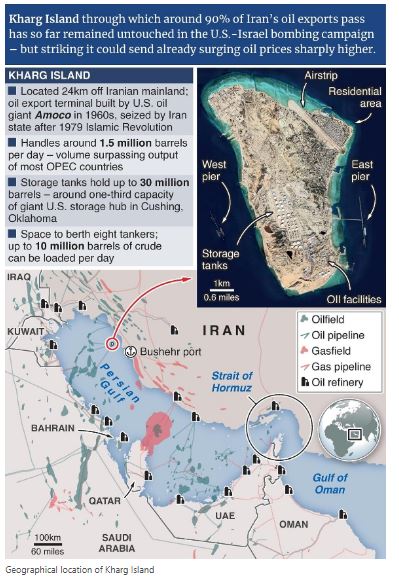
Kharg Island is a small coral island situated in the northern Persian Gulf, approximately 25–30 km off the Iranian mainland coast.
- Size: Around 8 km long with an area of roughly 20 sq. km
- Terrain: Dominated by industrial infrastructure such as oil storage tanks, export terminals, pipelines, and an airstrip
- Strategic Waters: Located near deep-water zones, allowing large oil tankers to dock
Historically referred to as the “Pearl of the Persian Gulf”, the island has long been linked with regional maritime trade. Over centuries it experienced Dutch and British influence before emerging as Iran’s central oil export hub.
Strategic Importance for Iran
1. Core Energy Export Terminal: Kharg Island is the primary hub for Iran’s crude oil exports, handling about 90% of the country’s oil shipments. The island functions as the final terminal for pipelines carrying crude oil from major Iranian oil fields.
2. Connectivity with Major Oil Fields: The island is connected through pipelines to key oil fields such as:
- Ahvaz
- Marun
- Gachsaran
These fields form part of Iran’s major hydrocarbon-producing regions, making Kharg Island a critical node in the national energy network.
3. Deep-Water Advantage: Much of Iran’s coastline is too shallow for very large crude carriers (VLCCs). Kharg Island’s proximity to deeper waters allows supertankers to dock and load crude oil efficiently, giving it a major logistical advantage.
Key Energy Infrastructure on Kharg Island
Kharg Island hosts extensive oil and petrochemical facilities managed by Iran’s energy sector.
Important installations include:
- Large crude oil storage tanks
- Oil export jetties for supertankers
- Pipeline terminals connected to inland oil fields
- Petrochemical and LNG storage facilities
Major operational entities include:
- Falat Iran Oil Company – producing roughly 500,000 barrels of crude oil per day
- Kharg Petrochemical Company
- Large-scale oil storage infrastructure
The island also maintains approximately 18 million barrels of storage capacity, allowing Iran to maintain export continuity during disruptions.
Scale of Oil Exports
Kharg Island plays a central role in global energy supply:
- Average exports: Around 1.5 million barrels of crude oil per day
- Recent increase: Exports reportedly rose to nearly 3 million barrels per day in early 2026 amid rising regional tensions.
Given this scale, any disruption could have significant implications for global oil markets.
Impact on Global Energy Markets
Kharg Island’s central role in Iran’s oil exports makes it a critical chokepoint in the global energy supply chain.
Potential Consequences of Disruption
- Sharp rise in global oil prices
- Increased volatility in energy markets
- Supply concerns for oil-importing countries
Energy analysts warn that escalation around the island could push global crude prices toward $150 per barrel, depending on the scale of disruption.
Geopolitical Context
The recent strike represents a major escalation in tensions involving Iran and Western powers. While the attack targeted military facilities, oil export infrastructure was reportedly avoided to prevent destabilizing global energy markets.
Historically, major powers have often avoided direct strikes on oil export facilities in the Persian Gulf, recognizing the potential impact on global economic stability.
Conclusion
Kharg Island remains one of the most strategically important oil export terminals in the world. Its role as the primary outlet for Iran’s crude oil exports gives it immense geopolitical and economic significance. Escalating tensions around the island highlight the fragility of global energy supply chains and underscore the broader connection between regional conflicts in West Asia and global energy security.