
Harvesting Value: India’s Strategic Shift to High-Value Crop Diversification
- 22 Apr 2026
In News:
The Union Budget 2026-27 marks a watershed moment in Indian agriculture, moving away from a cereal-centric approach toward a regionally differentiated strategy for High-Value Crops (HVCs). By focusing on the unique agro-climatic strengths of the coastal, North Eastern, and Himalayan belts, the government aims to transform farmers from subsistence growers into global agri-entrepreneurs.
Understanding High-Value Crops (HVCs)
High-value crops include horticultural produce such as fruits, vegetables, spices, medicinal plants, and aromatic woods. They are "high value" because they yield significantly higher net returns per hectare compared to staples like paddy or wheat.
Horticulture: The New Economic Nucleus
- GVO Contribution: Horticulture now accounts for approximately 37% of the Gross Value Output (GVO) within the agricultural crops sub-sector.
- Growth Trajectory: With a growth rate of 4.45% over the last decade, horticulture is the fastest-growing segment of Indian agriculture.
- Global Leadership: India is the world’s largest producer of onions and shallots (22.42% global share) and ranks second globally in the production of vegetables, fruits, and potatoes.
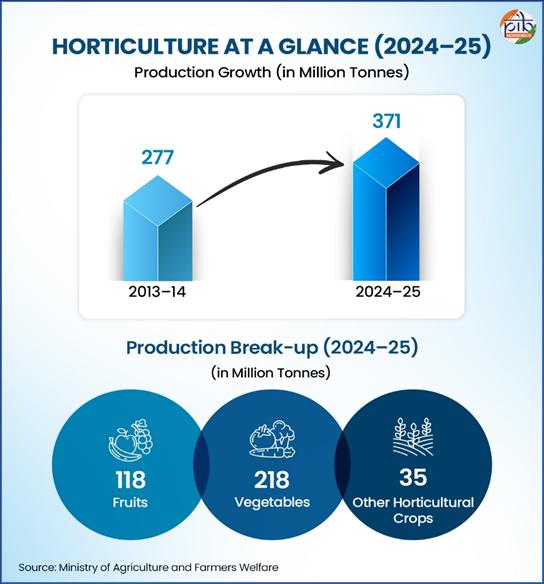
- Output Milestone: Total horticultural production reached a record 370.74 million tonnes in 2024-25.
Regionally Anchored Diversification Strategies
The 2026-27 strategy leverages specific geographic advantages to maximize export potential:
1. The Coastal Frontier (Coconut, Cashew, Cocoa)
- Coconut: India is the world’s second-largest producer, supporting 30 million livelihoods. The focus is on replacing senile (aging) plantations with high-yielding varieties.
- Cocoa Intercropping: To optimize land use, cocoa is being promoted as an intercrop in coconut and arecanut groves, utilizing the 40-50% sunlight penetration that otherwise goes to waste.
- Export Value: In 2024-25, cashew and cocoa exports combined for a staggering USD 664.75 million.
2. The North Eastern Hub (Agarwood & "Oud")
- Agarwood Dominance: India hosts 150 million agarwood trees, with 90% in the North East.
- Economic Potential: Tripura alone targets an annual turnover of ?2,000 crore by tapping into the global luxury fragrance (Oud) market, aligned with CITES export quotas.
3. The Himalayan and Hilly Regions (Nuts and Fruits)
- High-Density Cultivation: Promoting high-density orchards for Walnuts, Almonds, and Chilgoza (Pine nuts) in Jammu & Kashmir and Himachal Pradesh to double tribal incomes and leverage the high demand for dry fruits.
The Multi-Dimensional Impact of Diversification
- 5F Framework Alignment: The strategy supports the Farm-to-Foreign chain, ensuring value addition at every step.
- Employment Generation: HVCs are labor-intensive, creating year-round employment in rural areas, particularly for women and tribal communities.
- Nutritional Security: Diversification improves the availability of micro-nutrients, addressing hidden hunger.
- Agro-Processing Linkages: HVCs provide the raw materials for a booming food processing industry, including virgin coconut oil, fermented cocoa, and spice extracts.
Structural Challenges and Roadblocks
Despite the potential, the transition faces several hurdles:
- Perishability & Infrastructure: Horticultural crops have a short shelf-life, necessitating a robust Cold-Chain Infrastructure to prevent massive post-harvest losses.
- High Gestation Periods: Perennial crops like sandalwood or agarwood require several years before providing returns, creating a capital gap for small farmers.
- Climate Change: Hilly regions face shifting snowfall patterns, while coastal areas are vulnerable to increasing cyclonic frequency, both of which threaten HVC yields.
- Phytosanitary Standards: To penetrate EU and US markets, Indian produce must meet stringent chemical residue and quality standards.
The Way Ahead: Towards "Viksit Bharat"
To ensure the success of this diversification, the government is focusing on:
- Digital and Geospatial Mapping: Using satellite data to monitor orchard health and predict yields.
- Farmer Producer Organizations (FPOs): Organizing the 10 million small-scale coconut farmers into FPOs to achieve economies of scale.
- Brand Building: Positioning "Indian Sandalwood" and "Indian Cashew" as premium global brands by 2030.
- Mission for Integrated Development of Horticulture (MIDH): Strengthening post-harvest management and modernizing nurseries through institutional support from boards like the Coconut Development Board.
Conclusion
The shift toward high-value crop diversification is a move from subsistence to surplus. By integrating regional agro-climatic strengths with global market demands, India is not just securing its food systems but is also empowering its farmers to become pivotal players in the global value chain. This strategy is essential for achieving the vision of a USD 5 trillion economy and a prosperous, developed India by 2047.