
The Anti-Defection Law and the Merger Clause: Addressing the "Twin Test" and Constitutional Gaps
- 28 Apr 2026
In News:
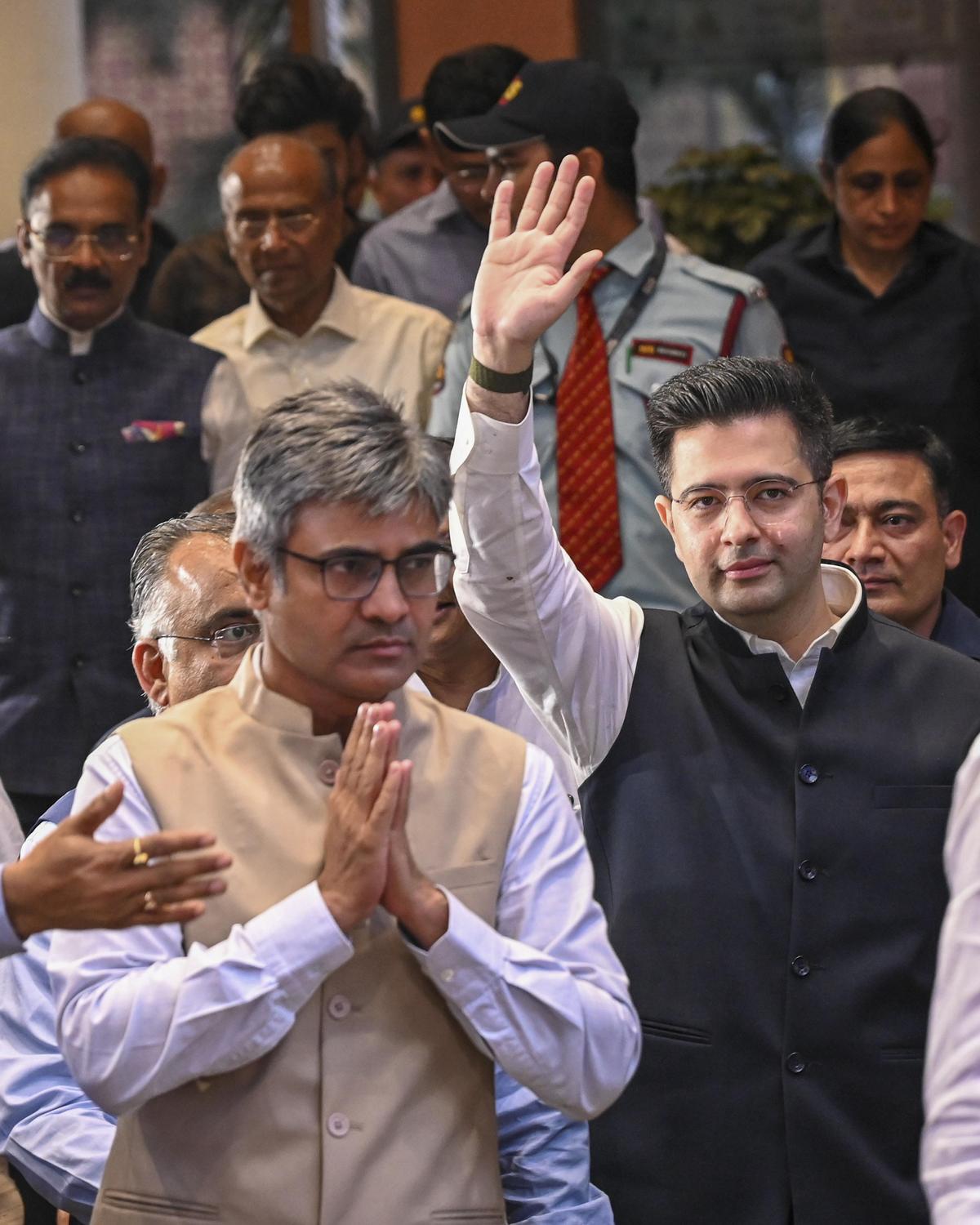
In a major political development, seven former Members of Parliament (MPs) from the Aam Aadmi Party recently joined the Bharatiya Janata Party, invoking the "merger" provision of the Tenth Schedule. This move has reignited a critical constitutional debate: can a group of legislators claim a valid merger independently, or must such a merger originate from the organizational wing of the political party?
Historical Context: From "Aaya Ram, Gaya Ram" to the Tenth Schedule
- The Anti-Defection Law was born out of the political instability of the 1960s and 70s. Between 1967 and 1972, India witnessed nearly 2,000 cases of defection, with approximately 50% of legislators switching sides—some multiple times—toppling established governments.
- To curb this "Aaya Ram, Gaya Ram" culture, the 52nd Constitutional Amendment Act, 1985 introduced the Tenth Schedule. The law was further tightened by the 91st Constitutional Amendment Act, 2003, which deleted the "split" provision (allowing 1/3rd of a party to defect) and retained only the "merger" clause to prevent mass shifts for personal gain.
The "Twin Test" for a Valid Merger
Under Paragraph 4 of the Tenth Schedule, legislators are protected from disqualification only if they satisfy a specific "Twin Test." Simple numerical strength in the House is insufficient; the law demands a dual-layered process:
- Organizational Merger (The Origin): There must first be a formal merger of the original political party (the broader organizational entity) with another party.
- Legislative Adoption (The Numbers): Following the party-level merger, at least two-thirds of the members of its legislature party (the elected MPs or MLAs) must agree to and adopt that merger.
Crucially, the Supreme Court has clarified that a group of legislators cannot "engineer" a merger on their own to ward off disqualification proceedings if the parent political party remains a separate entity.
Grounds for Disqualification and Exceptions
The law provides four primary grounds for removing a member from the House:
- Voluntary Resignation: Formally resigning or conduct that implies giving up membership.
- Defying the Whip: Voting or abstaining contrary to party directions without prior permission.
- Independent Members: Joining any political party after being elected as an independent.
- Nominated Members: Joining a political party after the initial six-month grace period.
Exceptions:
- The 2/3rd Merger: As detailed above.
- Presiding Officers: Speakers or Chairmen can resign from their party to maintain neutrality and rejoin after their tenure without penalty.
Judicial Interventions and the Role of the Speaker
The power to adjudicate defection cases rests exclusively with the Presiding Officer (Speaker/Chairman). However, this role has come under heavy scrutiny for perceived bias and tactical delays.
Key Supreme Court Rulings:
- Kihoto Hollohan v. Zachillhu (1992): Established that the Speaker’s decision is subject to judicial review in cases of mala fide intent or constitutional violation.
- KeishamMeghachandra Singh (2020): Directed that Speakers must decide disqualification cases within three months. It also suggested the creation of an independent tribunal to replace the Speaker as the adjudicator to ensure neutrality.
- Subhash Desai v. Governor of Maharashtra (2023): Explicitly held that the "original political party" and "legislature party" are separate. Protection under the merger clause is only available if the merger is initiated by the original party.
- Padi Kaushik Reddy v. State of Telangana (2025): The Court urged Parliament to re-examine the Speaker's role and implement reforms to ensure fair and timely adjudication.
Conclusion: The Road to Reform
While the Anti-Defection Law was intended to protect the mandate of the voters, the "merger" clause has increasingly become a loophole for mass defections. The shift from individual defections to "wholesale" defections threatens the spirit of the Tenth Schedule.
Strengthening the Anti-Defection Law to Uphold India's Democratic Integrity

- 28 Oct 2024
In News:
The Anti-Defection Law, introduced in 1985 through the 52nd Constitutional Amendment, aims to curb political instability caused by legislators switching parties for personal or financial reasons. While the law has helped maintain political stability, it faces several challenges, including delays in decision-making, potential bias in adjudication, and lack of transparency in party directives. These issues undermine its effectiveness in safeguarding democratic integrity.
Historical Context and Genesis
The issue of political defections, exemplified by the term "Aaya Ram, Gaya Ram," traces its origins to the 1960s when frequent party-switching destabilized governments. To address this, the Anti-Defection Law was enacted in 1985, disqualifying members who voluntarily gave up their party membership or defied party whips on critical votes. Initially effective in reducing defections, the law has faced challenges due to emerging loopholes, particularly regarding party "splits" and "mergers."
Gaps and Loopholes in the Current Law
One major loophole was the provision allowing a party split if one-third of its members defected, exploited until the 91st Amendment in 2003, which increased the threshold for mergers to two-thirds. Despite this change, defections continue, particularly through "mergers." Another issue is the role of the Speaker in deciding disqualification petitions. Given that the Speaker is often affiliated with the ruling party, their decisions are sometimes seen as biased, leading to delays in resolving defection cases. Additionally, the lack of transparency in issuing party whips has caused disputes regarding their legitimacy.
Proposed Reforms
To address these challenges, two key amendments are proposed:
- Fixed Time Frame for Decision-Making: A clear time frame—such as four weeks—should be established for the Speaker or an adjudicatory body to resolve defection cases. If no decision is made within this period, defecting members should automatically be disqualified.
- Transparency in Whips: Political parties should be required to make the issuance of whips public, either through newspaper publications or electronic communication, to ensure that members are fully informed of party positions on critical votes.
Ethical Concerns and Impact on Democracy
While the Anti-Defection Law was introduced to promote political stability, it has inadvertently stifled internal dissent within parties. Legislators are often forced to follow party lines, even when their personal convictions or constituents' interests conflict. This limits their freedom of expression and undermines the representative nature of democracy. Furthermore, the law has not fully curbed unethical practices such as "poaching" of members or defectors seeking personal gain, which continue to destabilize governments and erode public trust in the system.
The Way Forward: Political Will and Comprehensive Reforms
To strengthen the Anti-Defection Law, reforms must balance party discipline with individual freedoms. Key steps include:
- Independent Adjudication: Establishing an independent tribunal to handle defection cases can reduce political bias and expedite the decision-making process.
- Clear Timeframes: Setting a fixed timeline for resolving defection cases will prevent delays and ensure accountability.
- Transparency in Whip Issuance: Ensuring public notice of party whips will reduce ambiguity and disputes.
- Promoting Ethical Conduct: Strengthening ethical guidelines to discourage "poaching" and protect the integrity of the electoral process.