
Passive Euthanasia in India
- 13 Mar 2026
In News:
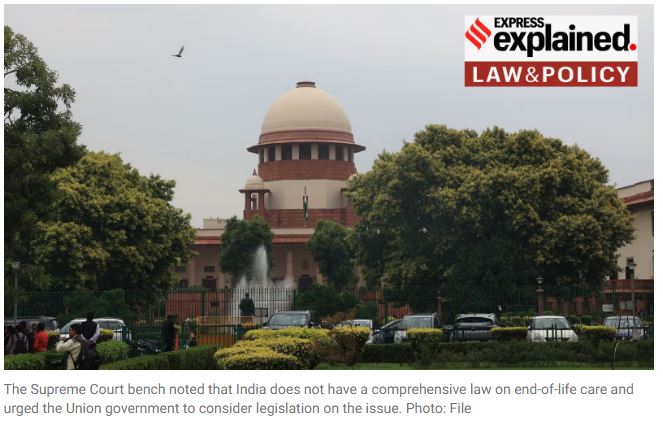
The Supreme Court of India recently applied its passive euthanasia framework for the first time to permit the withdrawal of life-sustaining treatment for Harish Rana, a 32-year-old patient who had remained in a persistent vegetative state for about 13 years. The decision marked a significant step in the practical implementation of the constitutional principle of “right to die with dignity” under Article 21.
The case highlighted the evolving legal framework governing euthanasia in India and renewed debate on the need for comprehensive legislation regulating end-of-life medical decisions.
Concept of Euthanasia
Euthanasia refers to the deliberate act of ending a person’s life to relieve extreme pain or suffering, usually in cases of terminal illness or irreversible medical conditions. It is often described as “mercy killing.”
Types of Euthanasia
1. Active Euthanasia
- Involves a direct action to cause death, such as administering a lethal injection.
- It remains illegal in India.
2. Passive Euthanasia
- Involves withholding or withdrawing life-sustaining treatment such as ventilators, feeding tubes, or medications, allowing death to occur naturally.
- Permitted in India under strict judicial guidelines and medical oversight.
Evolution of Euthanasia Jurisprudence in India
India’s legal position on euthanasia has developed through several landmark Supreme Court judgments.
- P. Rathinam v. Union of India (1994): The Court initially held that the Right to Life under Article 21 included the Right to Die, effectively decriminalizing suicide. This interpretation was later overturned.
- Gian Kaur v. State of Punjab (1996): A Constitution Bench ruled that the Right to Life does not include the Right to Die, but acknowledged that the right to live with dignity could extend to a dignified death in cases of terminal illness.
- Aruna Shanbaug Case (2011): In this landmark case involving a nurse in a prolonged vegetative state, the Court legalised passive euthanasia for the first time, subject to approval by the relevant High Court and medical boards.
- Common Cause v. Union of India (2018): The Court recognised the “Right to Die with Dignity” as a fundamental right under Article 21 and allowed individuals to issue Living Wills or Advance Medical Directives, specifying their wishes regarding end-of-life medical treatment.
- Supreme Court Guidelines Modification (2023): To simplify implementation, the Court relaxed earlier requirements by removing the mandatory countersignature of a Judicial Magistrate for living wills, making the process more practical.
Need for Comprehensive Legislation
Despite judicial guidelines, experts argue that India requires a dedicated statutory framework to regulate euthanasia.
- Clear Medical Criteria: Legislation could define distinctions between terminal illness and persistent vegetative states, preventing ambiguity in medical decision-making.
- Standardised Medical Boards: A law could establish uniform protocols for primary and secondary medical boards, ensuring consistency across hospitals and states.
- Legal Protection for Doctors: Medical practitioners often fear criminal liability under provisions such as abetment of suicide. Statutory clarity would provide legal immunity for actions taken in accordance with approved procedures.
- Role of Family Members: Legislation could formally define the decision-making authority of next of kin, particularly when patients are incapable of expressing consent.
- Simplified Procedures: A statutory framework could replace the current court-dependent process with an administrative mechanism, reducing delays and emotional stress for families.
Challenges in Implementation
- Risk of Misuse: There is concern that euthanasia could be misused against vulnerable groups, such as the elderly or disabled, for financial or property interests. Strict medical oversight remains necessary.
- Ethical and Religious Concerns: Many religious and cultural traditions view euthanasia as interference with the natural cycle of life, raising ethical debates between the sanctity of life and quality of life.
- Defining “Dignity”: The concept of dignity is subjective and difficult to codify in law, making consistent application challenging.
- Limited Palliative Care Infrastructure: India’s palliative and hospice care facilities remain limited, which may influence end-of-life choices if adequate pain management is unavailable.
- Judicial Inconsistencies: Different courts may interpret euthanasia guidelines differently, creating legal uncertainty and prolonged litigation.
Way Forward
To address these concerns, several policy measures have been suggested:
- Enacting a Medical Treatment of Terminally Ill Patients Law to provide a comprehensive legal framework.
- Establishing a digital national registry for Living Wills, ensuring quick access to advance directives during emergencies.
- Expanding palliative and hospice care services to provide compassionate end-of-life treatment.
- Training healthcare professionals on the ethical and legal aspects of end-of-life decisions.
- Conducting public awareness campaigns on living wills and patient rights.
Conclusion
The Supreme Court’s decision in the Harish Rana case marks a significant step in translating the constitutional right to die with dignity into practical application. However, reliance on judicial intervention for individual cases is neither efficient nor sustainable. A comprehensive legislative framework balancing ethical concerns, patient autonomy, and medical safeguards is essential to ensure compassionate and legally sound end-of-life care in India.
India–Finland Relations

- 10 Mar 2026
In News:
India and Finland have elevated their bilateral relationship to a “Strategic Partnership in Digitalisation and Sustainability” following high-level talks between the Narendra Modi and Alexander Stubb in New Delhi. This development marks a significant step in strengthening cooperation between India and the Nordic region, particularly in technology, sustainability, and global governance. The partnership also complements broader economic engagement between India and the European Union, including the recently concluded India–EU Free Trade Agreement (2026).
Key Outcomes of the India–Finland Talks
The bilateral discussions resulted in several institutional initiatives aimed at expanding cooperation in emerging sectors and economic engagement.
Institutional and Economic Initiatives
- A target to double bilateral trade by 2030.
- Establishment of a Joint Working Group on Digitalisation.
- Formation of a Joint Task Force on 6G telecommunications.
- Strengthening collaboration between the startup ecosystems of both countries.
- Creation of a consular dialogue mechanism to enhance people-to-people exchanges.
Agreements Signed
Three major agreements were signed in the areas of:
- Migration and Mobility – facilitating movement of skilled professionals, students, and talent between the two countries.
- Environmental cooperation – promoting sustainable development and environmental protection.
- Statistical collaboration – improving data exchange and policy research.
These agreements aim to promote economic exchanges, knowledge sharing, and sustainable growth.
Areas of Strategic Cooperation
1. Digital Technology and Emerging Technologies: The partnership emphasises cooperation in advanced technological domains such as:
- Artificial Intelligence (AI)
- 6G telecommunications
- Quantum computing
- Digital infrastructure
Both countries aim to promote secure, trustworthy digital ecosystems and resilient technological supply chains.
2. Sustainability and Circular Economy: Finland is globally recognised for its expertise in the circular economy, which focuses on resource efficiency and sustainable production systems.
Key initiatives include:
- Joint hosting of the World Circular Economy Forum in India.
- Expanded cooperation in clean energy, climate action, and environmental protection.
This collaboration aligns with India’s sustainable development goals and climate commitments.
3. Defence, Space, and Critical Technologies: India and Finland also agreed to enhance collaboration in:
- Defence and security technologies
- Space cooperation
- Semiconductors and critical minerals supply chains
Such cooperation is important for ensuring technological self-reliance and resilient global supply chains.
Examples of Existing India–Finland Cooperation
The partnership builds upon several existing areas of collaboration where Finnish technological expertise complements India’s large-scale implementation capabilities.
- Telecommunications: The Finnish company Nokia has played a significant role in India’s telecommunications sector, connecting millions through mobile network infrastructure.
- Infrastructure Development: Finnish architectural expertise contributed to the design and construction of the Chenab Rail Bridge, a landmark engineering project in India.
- Bioenergy Collaboration: India and Finland collaborated in establishing the bamboo-to-bioethanol refinery in Numaligarh, Assam, one of the largest such facilities in the world, contributing to renewable energy production.
Education and Mobility Cooperation
Finland’s globally reputed education system provides opportunities for deeper cooperation with India.
Key areas of collaboration include:
- Teacher training programmes
- School-to-school partnerships
- Research on future education models
- Facilitation of student and skilled worker mobility
Finland is increasingly becoming a preferred destination for Indian students and professionals.
Arctic and Polar Cooperation
Finland is an important partner for India in the Arctic region. Cooperation focuses on:
- Arctic and polar scientific research
- Climate change monitoring
- Sustainable resource management
This aligns with India’s India’s Arctic Policy, which emphasises scientific research and environmental protection.
Background of India–Finland Relations
India and Finland established diplomatic relations in 1949. Since then, bilateral engagement has expanded across trade, technology, and education.
- Bilateral trade: Approximately €1.5–2 billion annually, with Finland maintaining a slight trade surplus.
- Investment: More than 100 Finnish companies operate in India, including major firms such as Wartsila, Fortum, UPM, Lindstrom, and Ahlstrom.
Challenges and Way Forward
Despite growing engagement, several challenges remain.
1. Limited Trade Volume: Bilateral trade remains modest relative to potential. The India–EU FTA could expand trade and investment opportunities.
2. Geographical Distance and Market Awareness: Limited connectivity and awareness among businesses hinder deeper economic cooperation. Expanding startup and innovation partnerships could bridge this gap.
3. Technological Competition: Global competition in emerging technologies requires joint research and development initiatives to remain competitive.
4. Geopolitical Uncertainties: Ongoing global conflicts and shifting alliances could affect economic and technological cooperation.
Convergence on Global Governance
Both countries emphasised shared commitments to:
- Reform of global governance institutions
- Strengthening multilateralism
- Eliminating terrorism in all forms
- Restoring a rules-based international order
Conclusion
The elevation of India–Finland relations to a strategic partnership reflects the increasing importance of technology, sustainability, and innovation in modern diplomacy. By combining Finland’s technological expertise and educational excellence with India’s scale, market size, and economic growth, the partnership has the potential to deepen India’s engagement with the Nordic region, strengthen India–EU relations, and contribute to resilient global supply chains and sustainable development.
Ensuring Liquefied Petroleum Gas (LPG) Supply Amid the West Asia Crisis

- 08 Mar 2026
In News:
The ongoing geopolitical tensions in West Asia have raised concerns over disruptions in maritime trade routes, particularly through the Strait of Hormuz, a critical global energy transit corridor. For India, this development poses a significant risk to the supply of Liquefied Petroleum Gas, as a substantial portion of its imports transit through this route. In response, the Government of India has invoked emergency provisions to safeguard domestic LPG supplies for millions of households.
Government’s Emergency Measures
To mitigate potential supply disruptions, the government invoked powers under the Essential Commodities Act, 1955. The directive was issued under Section 3 of the Act and the Petroleum Products (Maintenance of Production, Storage and Supply) Order, 1999.
Key provisions of the emergency directive include:
- Domestic refiners must maximise LPG production.
- Propane and butane streams are to be used exclusively for LPG manufacturing.
- Refiners are prohibited from diverting these inputs to petrochemical production.
- All LPG produced must be supplied to public sector oil marketing companies (OMCs).
The three major OMCs responsible for distribution of LPG to households are:
- Indian Oil Corporation Limited
- Bharat Petroleum Corporation Limited
- Hindustan Petroleum Corporation Limited
These companies together supply cooking gas to more than 33 crore Indian households.
India’s LPG Demand–Supply Dynamics
India’s LPG demand has increased significantly due to expanding household consumption and welfare schemes such as the Pradhan Mantri Ujjwala Yojana.
Key statistics (2024–25):
- Total LPG consumption: ~31 million tonnes
- Domestic production: ~13 million tonnes
- Import dependence: ~58%
India imports most of its LPG from West Asian suppliers, including: Saudi Arabia, United Arab Emirates, Qatar, and Kuwait
The strategic importance of the Strait of Hormuz is evident as it carries:
- ~80% of India’s LPG imports
- ~40% of crude oil imports
- More than 50% of LNG imports
Any disruption in this route therefore poses a major energy security risk for India.
Diversification of Energy Supply Sources
To reduce dependence on West Asian suppliers, India has begun diversifying import sources.
A recent agreement with the United States will supply approximately 2.2 million tonnes of LPG in 2026, accounting for around 10% of India’s annual LPG imports, sourced from the US Gulf Coast.
India is also coordinating with global commodity traders such as:
- Vitol
- Trafigura
- ADNOC Trading
These partnerships aim to secure additional energy cargoes from alternative markets.
Energy Security and Strategic Reserves
India maintains strategic petroleum reserves (SPR) to cushion against external supply shocks. Key storage facilities include:
- Visakhapatnam Strategic Petroleum Reserve
- Mangaluru Strategic Petroleum Reserve
- Padur Strategic Petroleum Reserve
Current estimates indicate:
- Crude oil stocks sufficient for about 25 days of refinery operations
- Strategic reserves covering approximately one week of national consumption
- Additional fuel stocks (petrol, diesel, LPG) sufficient for around 25 days of domestic demand
Impact on Natural Gas and LNG Supply
India’s vulnerability is more pronounced in the Liquefied Natural Gas sector, as LNG storage is technically challenging.
India is the world’s fourth-largest LNG importer. Supply disruptions have emerged as Petronet LNG Limited issued force majeure notices to its supplier QatarEnergy and domestic gas off-takers.
In case of shortages, the government may reprioritise natural gas allocation to critical sectors, including:
- City gas distribution (CNG and PNG)
- Fertiliser production
- Power generation
Challenges for India
India faces several structural challenges in ensuring energy security:
- Limited domestic LPG production despite high refining capacity.
- LNG storage constraints, making stockpiling difficult.
- Price volatility in global energy markets during geopolitical crises.
- Continued import dependence on West Asia.
Way Forward
To strengthen long-term resilience, India must adopt a multi-dimensional energy strategy:
- Diversification of imports from the US, Africa, and Latin America.
- Expansion of strategic petroleum reserves and LNG storage infrastructure.
- Enhancement of domestic exploration and refining efficiency.
- Transition toward alternative energy sources, including biogas, compressed biogas (CBG), electric cooking technologies, and green hydrogen.
- Strengthening maritime security and diplomatic coordination to protect sea lanes of communication (SLOCs).
Conclusion
The government’s decision to invoke emergency provisions reflects a proactive effort to safeguard India’s energy security during a volatile geopolitical situation. While short-term measures such as maximising domestic LPG production and diversifying imports provide immediate relief, long-term resilience will depend on energy diversification, stronger strategic reserves, and accelerated transition to cleaner fuels. Strengthening these pillars is essential to insulate India’s economy and households from future global energy shocks.
State of the World’s Migratory Species Report

- 07 Mar 2026
In News:
Migratory species are vital components of global biodiversity and play an important role in maintaining ecological balance across ecosystems. However, recent assessments indicate that many migratory species are facing growing threats due to human activities and environmental changes. The latest interim update to the State of the World’s Migratory Species Report warns that nearly half of the world’s migratory species populations are declining, highlighting the urgent need for stronger international conservation efforts.
About the State of the World’s Migratory Species Report
The State of the World’s Migratory Species Report is a global scientific assessment that evaluates the conservation status, population trends, and threats facing migratory animals worldwide. The report is prepared under the Convention on the Conservation of Migratory Species of Wild Animals (CMS), an international treaty established in 1979 under the United Nations Environment Programme (UNEP). CMS provides a framework for international cooperation to conserve migratory wildlife and their habitats across national boundaries.
The first comprehensive global report was released in 2024, covering 1,189 species listed under CMS and analysing trends among more than 3,000 additional migratory species worldwide. The assessment relies on scientific data from sources such as the International Union for Conservation of Nature (IUCN) Red List, population monitoring studies, and peer-reviewed scientific literature.
Importance of Migratory Species
Migratory species contribute significantly to ecosystem functioning and human livelihoods. Migratory birds help in pollination, seed dispersal, and pest control, while marine animals such as whales and fish support marine food chains and nutrient cycling. Large migratory mammals distribute nutrients across landscapes and influence vegetation patterns.
These species also hold economic and cultural importance, supporting tourism, food systems, and traditional practices in many regions. However, migration makes species highly vulnerable, as the loss of even a single habitat along their migration route can disrupt entire ecological networks. Effective conservation therefore requires coordinated action across multiple countries and ecosystems.
Major Findings of the Latest Report
1. Declining Populations of Migratory Species
The report highlights worrying global trends in migratory wildlife populations. Approximately 49% of migratory species protected under CMS are experiencing population declines, while about 24% face a risk of extinction. Compared to earlier assessments, the proportion of declining species has increased by around five percentage points within two years, indicating an accelerating conservation crisis. Out of the 1,189 CMS-listed species, about 582 species show declining population trends.
2. Rising Extinction Risks
The assessment also notes that 26 migratory species have moved to higher extinction-risk categories on the IUCN Red List. Among them, 18 species are migratory shorebirds, highlighting severe threats to coastal and wetland ecosystems. Species affected include birds such as cranes and pelicans, ungulates such as wildebeest, freshwater fish species, and marine animals including sharks, rays, and sea turtles.
3. Habitat Loss and Overexploitation
The report identifies habitat loss and overexploitation as the most significant threats to migratory species. Activities such as urban expansion, agricultural development, infrastructure construction, overfishing, and hunting have disrupted migratory routes and degraded critical habitats.
Large infrastructure projects such as roads, railways, pipelines, and fences are increasingly blocking migration corridors, particularly for large terrestrial mammals in regions such as Central Asia. Since migratory species depend on multiple habitats across countries, the destruction of even one site along their migration pathway can jeopardise their survival.
4. Emerging Threat of Avian Influenza
Another emerging threat highlighted in the report is Highly Pathogenic Avian Influenza (H5N1). Disease outbreaks have caused large-scale mortality events among several migratory bird populations and have even affected marine mammals. Species impacted include African Penguins, Humboldt Penguins, Peruvian Pelicans, and Red-crowned Cranes. Marine mammals such as the South American Sea Lion and South American Fur Seal have also been affected, indicating the growing ecological impacts of disease outbreaks.
Conservation Progress and Key Biodiversity Areas
Despite these concerning trends, the report identifies several conservation successes. Seven migratory species listed under CMS have shown improvements in conservation status, including the Saiga Antelope, Scimitar-horned Oryx, and the Mediterranean Monk Seal. These cases demonstrate that coordinated international conservation measures can effectively restore threatened species populations.
The report also highlights the significance of 9,372 Key Biodiversity Areas (KBAs) that serve as critical habitats for migratory species. However, 47% of these areas currently lack formal protection, making them vulnerable to human pressures and habitat degradation.
Conclusion
The State of the World’s Migratory Species Report underscores the growing conservation crisis facing migratory wildlife. Declining populations, rising extinction risks, habitat loss, overexploitation, and emerging diseases collectively threaten the survival of many species. Addressing these challenges requires strengthened international cooperation, protection of migratory corridors and key biodiversity areas, and sustainable management of ecosystems. Ensuring the conservation of migratory species is essential not only for preserving biodiversity but also for maintaining ecological balance and supporting human livelihoods across the globe.