
Union Budget 2026–27: Charting India’s Path to Growth, Inclusion and Resilience
- 04 Feb 2026
In News:
The Union Budget 2026–27 was presented in Parliament by the Nirmala Sitharaman, marking her ninth consecutive Budget and the first to be prepared in Kartavya Bhawan. The fiscal blueprint is structured around three core duties or “Kartavyas” that reflect the government’s strategic priorities: accelerating and sustaining economic growth, building human capacities and fulfilling aspirations, and ensuring inclusive development across regions and communities. This framework signals an integrated approach to achieve Viksit Bharat by 2047 amid global uncertainties and domestic structural challenges.
Macro-Fiscal Framework and Priorities
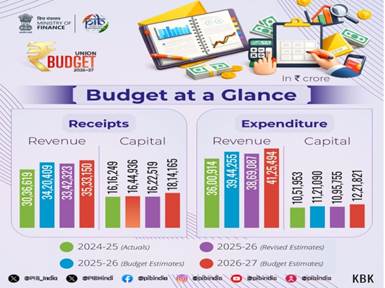
For the financial year 2026–27, the Budget projects total expenditure at ?53.5 lakh crore, with non-debt receipts estimated at ?36.5 lakh crore and net tax receipts at ?28.7 lakh crore. The fiscal deficit is targeted at 4.3% of GDP, marginally lower than the revised estimate of 4.4% for 2025–26, underscoring a continued commitment to fiscal consolidation. The debt-to-GDP ratio is projected to decline to 55.6%, indicating gradual improvement in fiscal metrics.
First Kartavya: Growth, Competitiveness and Infrastructure
The Budget places strong emphasis on strengthening India’s growth engine through investment-led strategies and sector-specific interventions. Public capital expenditure is significantly enhanced to ?12.2 lakh crore, reinforcing the infrastructure build-out across transport, logistics, waterways and urban connectivity. Seven high-speed rail corridors are proposed as growth connectors, while 20 new national waterways are slated to be operational in the coming five years.
Manufacturing and strategic sectors receive focused support. The Biopharma SHAKTI initiative, with an outlay of ?10,000 crore, aims to position India as a global biopharmaceutical hub. The India Semiconductor Mission 2.0 and expanded electronics components manufacturing scheme are designed to enhance technological sovereignty and supply chain resilience. Rare earth corridors in mineral-rich states will facilitate mining, processing and value chain development. Initiatives such as the Textile Expansion and Employment Scheme and Mega Textile Parks will boost traditional and technical textiles through cluster-based financing and technology upgradation.
Special focus is accorded to legacy industry revival, with targeted schemes to modernise 200 industrial clusters, and to developing Champion SMEs backed by a ?10,000 crore growth fund. Infrastructure risk mitigation funds and monetisation of CPSE real estate are expected to catalyse private investment.
Second Kartavya: Human Capital and Aspirational Growth
The second Kartavya underscores investment in human capital. A High-Powered Education–Employment–Enterprise Standing Committee will align skill development with employment outcomes, particularly in services and future sectors. New allied health institutions and regional medical hubs are proposed to strengthen healthcare capacity and position India as a medical tourism destination. Traditional systems of medicine will be reinforced with new institutes for Ayurveda.
Education infrastructure will be expanded with university townships near industrial corridors and girls’ hostels across districts to improve access and equity. Creative industries under the Orange Economy will be catalysed through AVGC labs in schools and colleges, targeting employment generation in animation, gaming and visual effects.
Third Kartavya: Inclusive Development and Last-Mile Participation
Inclusivity is central to the third Kartavya. Major schemes are unveiled to boost farm incomes, including integrated development of reservoirs, a Coconut Promotion Scheme and Bharat-VISTAAR, an AI-enabled multilingual platform to improve agricultural decision-making. Efforts to empower divyangjan through skilling initiatives and the expansion of mental health infrastructure, including NIMHANS-2, reflect a broader social inclusion agenda.
Regional disparities are addressed through targeted infrastructure in Purvodaya States and the North-East, including tourism circuits and e-buses to enhance sustainable connectivity. Fiscal transfers through the 16th Finance Commission amount to ?1.4 lakh crore, reinforcing cooperative federalism.
Conclusion
The Union Budget 2026–27 balances growth imperatives with inclusive outcomes, reinforcing infrastructure, manufacturing, human capital, and regional equity. Anchored in the Three Kartavyas, it strives to consolidate India’s macroeconomic stability while enabling citizens to actively participate in and benefit from the development process.