
Strait of Hormuz Crisis and Global Energy Security
- 24 Feb 2026
In News:
Rising tensions between the United States and Iran have pushed international oil prices to a six-month high, with Brent crude crossing $71 per barrel, over 12% higher in a month. Although recent nuclear talks in Geneva showed limited progress, the absence of a breakthrough and heightened American military presence in West Asia have intensified market anxiety. Any escalation, particularly involving the Strait of Hormuz, could significantly disrupt global energy supplies and destabilize the fragile global economy.
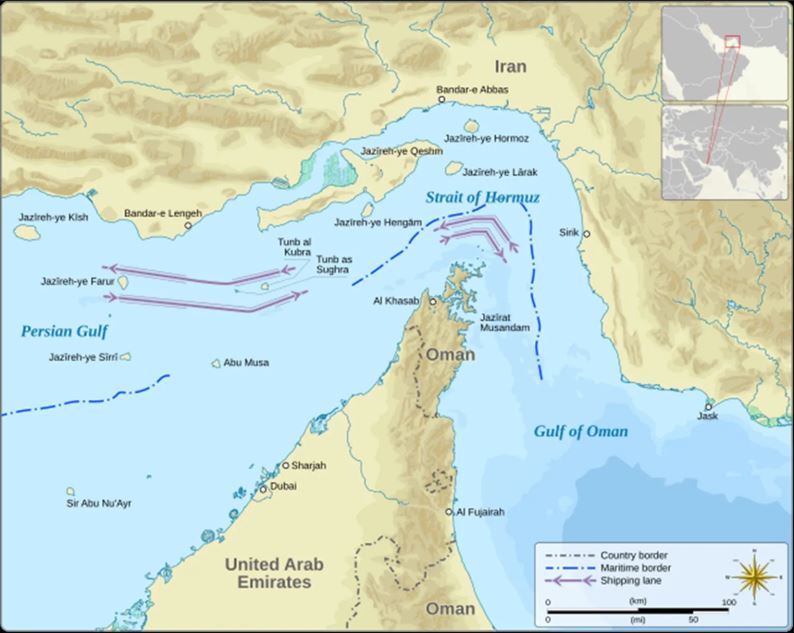
The Strait of Hormuz: A Strategic Chokepoint
- The Strait of Hormuz, a narrow waterway between Iran and Oman connecting the Persian Gulf to the Gulf of Oman and the Arabian Sea, is widely regarded as the world’s most critical oil transit chokepoint.
- Nearly one-fifth of global petroleum consumption and about 20% of global LNG trade pass through it daily-approximately 15 million barrels of crude oil. Major Gulf producers such as Saudi Arabia, Iraq, UAE, and Kuwait depend heavily on this route for exports.
- Oil markets fear that in the event of US military strikes, Iran may retaliate by disrupting shipping through the Strait. While Iran has frequently threatened to block the Strait, a complete blockade would be strategically risky. It could alienate China-its key oil buyer-damage ties with Oman, and invite international military retaliation. Nonetheless, if Tehran perceives an existential threat, escalation cannot be ruled out.
Limited Alternatives and Escalation Risks
Although some Gulf states possess bypass pipelines, their capacity is limited. Even at full utilization, nearly 9 million barrels per day (around 9% of global demand) would remain vulnerable during a major disruption. Additionally, threats extend beyond Hormuz. Proxy attacks from Yemen targeting vessels in the Bab el-Mandeb Strait-another key chokepoint linking the Red Sea and the Arabian Sea-add to systemic risks for global energy flows.
Possible Oil Price Scenarios
Experts outline four potential escalation scenarios:
- Targeted disruption of Iranian oil exports: Prices may rise by $10–12 per barrel due to supply gaps, particularly affecting China.
- Disruption of Strait of Hormuz flows: Prices could exceed $90 per barrel if up to 20% of global oil trade is throttled.
- Attacks on Iranian oil infrastructure: Prolonged supply loss could push prices beyond $100 per barrel.
- Wider regional conflict involving Gulf producers: Oil prices could surge past $130 per barrel, rivaling spikes seen during major geopolitical crises.
Thus, oil market volatility is now a central strategic variable in US-Iran calculations.
Implications for India
- India, the world’s third-largest crude oil consumer, is highly vulnerable. It imports over 88% of its oil requirements, amounting to nearly 2 billion barrels annually. Every $1 increase in crude prices adds approximately $2 billion to India’s annual import bill, exerting pressure on the current account deficit, inflation, and fiscal management.
- Crucially, more than 40% of India’s crude imports transit through the Strait of Hormuz. Any disruption would directly threaten India’s energy security, refinery operations, and broader economic stability. Higher oil prices could also weaken the rupee, increase fuel subsidies, and raise transportation and food costs.
Strategic Dilemma and Way Forward
The situation presents a complex dilemma. While confrontation may risk energy disruptions and price spikes, inaction could embolden geopolitical adversaries. For India, diversification of energy sources, expansion of strategic petroleum reserves, increased renewable energy adoption, and diplomatic engagement in West Asia remain critical policy priorities.
In conclusion, the Strait of Hormuz crisis underscores the interconnectedness of geopolitics and energy security. Even localized tensions in West Asia have global economic consequences, making stability in this maritime corridor vital not only for the region but for energy-dependent economies like India.