
India and the Indian Ocean: Reviving Leadership for Sustainable and Secure Ocean Governance
- 16 Dec 2025
In News:
The Indian Ocean is emerging as a defining arena of the 21st century, shaped by climate change, geopolitical competition, and the growing global push for sustainable ocean governance. At this juncture, India has both the opportunity and responsibility to revive its leadership role in shaping a cooperative maritime order guided by the principle: “From the Indian Ocean, for the World.”
Historical Foundations of India’s Ocean Leadership
India’s engagement with ocean governance is not new. During negotiations under the United Nations Convention on the Law of the Sea (UNCLOS), India supported small island developing states in advancing the principle of the “common heritage of humankind” for seabed resources beyond national jurisdiction. This reflected a broader strategic outlook articulated by leaders, who viewed the seas as central to India’s security, trade, and global engagement. India has thus long seen itself not merely as a coastal state, but as a maritime nation with regional leadership responsibilities.
Mounting Pressures on the Indian Ocean
Today, the Indian Ocean faces unprecedented ecological stress. Rising sea temperatures, ocean acidification, sea-level rise, and coral degradation threaten marine biodiversity and coastal livelihoods. Illegal, unreported and unregulated (IUU) fishing further strains fish stocks, directly impacting food security in littoral states. These environmental challenges intersect with intensifying geopolitical rivalries in the Indo-Pacific, where expanding naval presence and strategic competition add new layers of complexity.
Global Momentum for Ocean Action
International attention to oceans is rising. New blue finance commitments and global platforms such as climate negotiations and ocean conferences are foregrounding marine sustainability. Initiatives to mobilise billions of dollars for ocean protection, green shipping, and sustainable fisheries signal a shift toward integrating environmental stewardship with economic development. This creates space for India to align regional priorities with global sustainability agendas.
Security Through Sustainability
India’s maritime vision increasingly recognises that environmental degradation is a security issue. Threats such as extreme weather events, coastal erosion, and declining fish stocks destabilise vulnerable societies and can exacerbate conflict. India’s SAGAR (Security and Growth for All in the Region) doctrine reflects this integrated approach by linking maritime domain awareness, humanitarian assistance, disaster relief, and ecosystem protection. In this sense, sustainability becomes a pillar of regional stability.
A Leadership Imperative for India
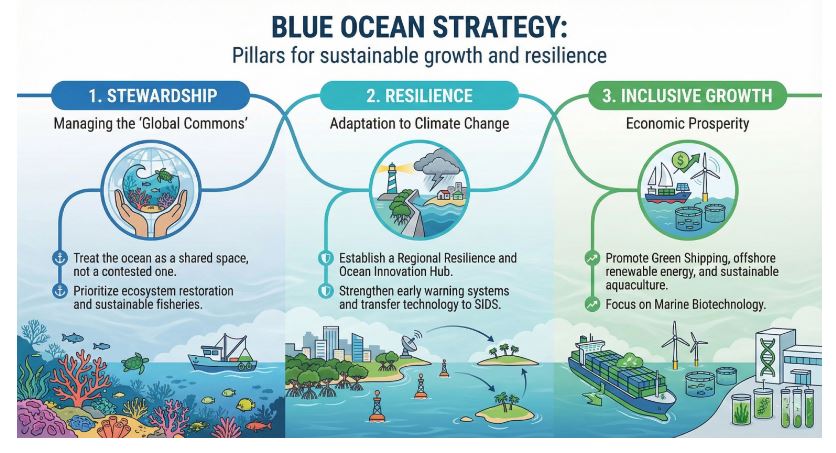
The coming years are pivotal, especially with new international legal frameworks for biodiversity beyond national jurisdiction and major global ocean summits on the horizon. India, as a leading Indian Ocean state and a prominent voice of the Global South, can translate diplomatic momentum into concrete regional initiatives. These could include championing innovative blue finance mechanisms, promoting green shipping corridors, and strengthening cooperative fisheries management under regional groupings.
Way Forward
To operationalise its leadership, India must act on multiple fronts. Institutionally, it should work to strengthen regional maritime cooperation frameworks and support long-term financing for sustainable ocean projects. Diplomatically, deeper partnerships with small island states and African littorals are essential. Domestically, reforms in fisheries management, expansion of marine protected areas, and climate adaptation for coastal communities are crucial. Investments in satellite-based ocean monitoring, early warning systems, and green port infrastructure will reinforce India’s credibility as a technology-driven maritime leader.
By embedding sustainability at the heart of its maritime strategy, India can shape the Indian Ocean as a zone of cooperation rather than contestation — truly advancing a vision of oceans that serve not only the region, but the world at large.