
India’s Nationwide HPV Vaccination Drive
- 25 Feb 2026
In News:
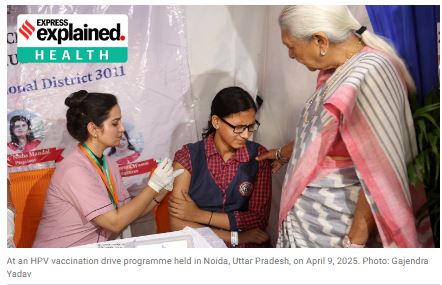
The Union Government is set to launch a nationwide single-dose HPV vaccination drive targeting 14-year-old girls to reduce the burden of cervical cancer in India. The campaign represents a major public health intervention aimed at preventing a vaccine-preventable cancer that remains a leading cause of mortality among Indian women.
Cervical Cancer Burden in India
- Cervical cancer is the second most common cancer among Indian women. India accounts for nearly 20% of global cervical cancer cases, with approximately 1.25 lakh new cases and 75,000 deaths annually.
- Nearly 90% of cervical cancer cases are caused by persistent infection with high-risk strains of the Human Papillomavirus (HPV), a common sexually transmitted infection. Among at least 14 cancer-causing strains, HPV types 16 and 18 account for nearly 70% of cases worldwide.
- Given that HPV-related cancers are largely vaccine-preventable, mass immunisation offers a transformative opportunity to reduce cancer-related morbidity and mortality.
Features of the Nationwide HPV Vaccination Drive
Target Group
- All 14-year-old girls across India
- Approximately 1.15 crore girls annually become eligible
Implementation Strategy
- 90-day nationwide campaign for rapid coverage
- Beneficiaries to book appointments via the U-Win digital platform, modelled on Co-Win
- Post-campaign integration into the Routine Immunisation Programme at Health and Wellness Centres
The focus on early adolescence ensures vaccination before sexual debut, when immune response is strongest and long-lasting.
Vaccine Choice and Supply Mechanism
Vaccine Used
- Gardasil, manufactured by MSD Pharmaceuticals
- Backed by strong global safety and efficacy evidence
Role of GAVI
- 2.6 crore doses to be supplied over two years
- 1 crore doses already delivered
Indigenous Vaccine – Cervavac
India’s domestically developed vaccine by the Serum Institute of India is currently not being used because:
- It is awaiting WHO prequalification
- ICMR is evaluating its effectiveness as a single-dose regimen
A transition to Cervavac may occur after regulatory approvals.
Why Single-Dose Vaccination?
In 2022, the WHO’s Strategic Advisory Group of Experts (SAGE) recommended a single-dose schedule for girls and women up to 20 years of age, citing “strikingly high efficacy” among 9–14-year-olds.
- Women above 21 years: Two doses (6 months apart)
- Immunocompromised individuals (e.g., HIV): Ideally three doses
The single-dose strategy enhances feasibility, reduces costs, and improves coverage in low- and middle-income countries.
Public Health Significance
1. Direct Cancer Prevention: Studies show HPV vaccines significantly reduce cervical cancer incidence, beyond merely preventing infection or pre-cancerous lesions.
2. Herd Immunity: Vaccinating girls reduces HPV transmission to boys, lowering risks of anal, penile, vaginal, vulvar, and throat cancers.
3. Global Evidence: Australia, which introduced HPV vaccination in 2007 (and extended to boys in 2013), saw:
- HPV prevalence drop from 22.7% to 1.5% among young women
- Significant decline even among unvaccinated older women
This demonstrates strong direct and indirect protection.
India’s Previous Experience
This is not India’s first HPV initiative:
- Sikkim (2018): Achieved over 95% coverage
- Punjab (2016): Over 97% coverage in initial districts
- Delhi (2016): Limited uptake due to hospital-based delivery model
These experiences underline the importance of accessibility and community mobilisation.
Conclusion
The nationwide HPV vaccination drive marks a decisive step toward cervical cancer elimination in India. By combining global evidence, digital platforms, GAVI support, and integration into routine immunisation, India is aligning with global best practices.
If effectively implemented with sustained awareness campaigns and equitable access, the initiative could significantly reduce mortality, ease healthcare burdens, and advance India toward the broader goal of preventive, women-centric public health transformation.