
Delhi Declaration 2026
- 03 Feb 2026
In News:
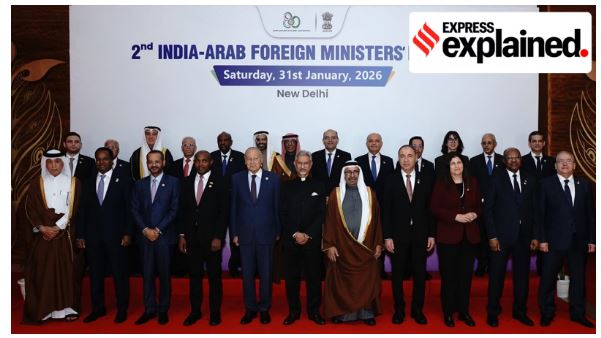
The Delhi Declaration emerged from the second India–Arab Foreign Ministers’ Meeting hosted by India, which brought together all 22 members of the League of Arab States a decade after their first ministerial dialogue. Convened amid intensifying regional rivalries and conflict, the declaration clarifies where India and Arab states align and where they prefer strategic silence. It underscores India’s calibrated West Asia policy: norm-based, stability-oriented, and carefully balanced across competing power centres.
Support for Sovereignty and Recognised Governments
A central theme is the reaffirmation of the sovereignty, unity, and territorial integrity of conflict-affected states such as Sudan, Libya, and Somalia. By rejecting external interference and backing internationally recognised governments, India and Arab partners signal a preference for order over fragmentation. This stance places New Delhi closer to the mainstream Arab position that favours reconciliation and state institutions, rather than legitimising parallel authorities or breakaway entities.
Yemen and Maritime Security
On Yemen, the declaration explicitly condemns attacks on Red Sea navigation and reiterates support for Yemen’s unity. The sharper language on maritime security reflects shared concern over trade disruptions and aligns India with a stability-first approach in a theatre marked by proxy competition. For India—heavily dependent on energy imports and sea lanes, secure shipping is a core national interest.
Cautious Engagement on Syria
The text is restrained on Syria, limiting references to counter-terrorism against the Islamic State. This mirrors India’s low-key, diplomatic engagement with evolving political realities in Damascus while avoiding premature endorsement of any faction. The emphasis remains on counter-terror cooperation and humanitarian stability rather than regime politics.
Israel–Palestine: Norms over New Frameworks
Instead of endorsing novel diplomatic architectures, the declaration backs the long-standing Arab Peace Initiative (2002), land for peace, with a Palestinian state based on pre-1967 lines alongside Israel. While supporting efforts to end violence in Gaza, India and Arab states stop short of embracing any new, sweeping blueprint. The reiteration of Palestinian sovereignty reflects continuity in India’s position, even as it maintains strong bilateral ties with Israel.
Strategic Silence on Iran
Notably absent is any direct reference to escalating U.S.–Iran tensions. This omission appears deliberate, allowing capitals to manage sensitive bilateral equations without public positioning. For India, which seeks to preserve energy ties and connectivity options while navigating sanctions exposure, discretion helps sustain diplomatic flexibility.
Economic and Institutional Pillars
Beyond geopolitics, the declaration advances cooperation across five institutional pillars—economy, energy, education, media, and culture, first framed in 2002. With India–Arab trade exceeding $240 billion, economic interdependence anchors the partnership. Energy security, diaspora linkages, and cultural exchanges add durable ballast to political dialogue.
What It Reveals About India’s West Asia Policy
The Delhi Declaration crystallises India’s approach: engage all sides, avoid zero-sum alignments, and privilege internationally recognised norms that reduce conflict spillovers. Partnerships remain transactional and compartmentalised, ensuring that deep bilateral ties do not translate into bloc politics. In a region of fluid rivalries, India positions itself as a steady, pragmatic actor—supporting sovereignty, maritime security, and incremental diplomacy while leaving space to manoeuvre on the most combustible fault lines.