
Death Penalty in India
- 05 Feb 2026
In News:
A decade-long empirical study (2016–2025) by the Square Circle Clinic in collaboration with NALSAR University of Law highlights deep systemic flaws in the administration of the death penalty in India. The findings have renewed debate on due process, fairness in sentencing, and the constitutional limits of capital punishment, making the issue central to discussions on criminal justice reform.
Legal and Constitutional Framework
The death penalty remains legally valid in India but is restricted to the “rarest of rare” cases under criminal law, now reflected in the Bharatiya Nyaya Sanhita. A Sessions Court’s death sentence must be confirmed by the High Court, and further appeal lies before the Supreme Court.
Constitutionally, the punishment has been upheld as compatible with Article 21 (Right to Life) provided the procedure is fair, just and reasonable. Challenges under Articles 14 and 19 have also failed, though courts have insisted on strict procedural safeguards. Clemency powers under Article 72 allow the President to pardon or commute death sentences.
Judicial doctrine has evolved through landmark cases. In Jagmohan Singh (1973), the constitutionality of the death penalty was upheld. In Bachan Singh (1980), the Supreme Court introduced the “rarest of rare” doctrine, later elaborated in Machhi Singh (1983). In Mithu v. State of Punjab (1983), mandatory death penalties were struck down as unconstitutional, reinforcing the need for judicial discretion and individualized sentencing.
Key Findings of the 2016–2025 Study
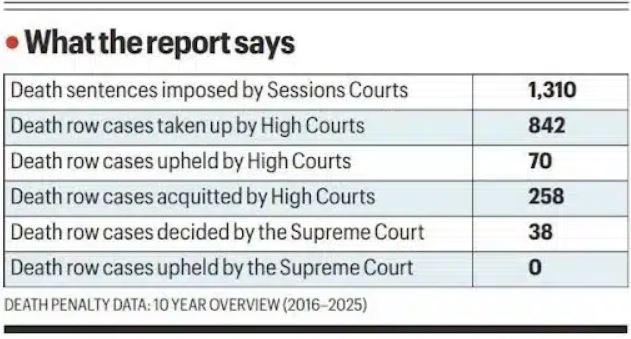
The study reveals a stark contrast between trial courts and appellate courts. Over the last ten years, trial courts imposed more than 1,300 death sentences, yet High Courts confirmed only about 70. Of these, the Supreme Court upheld none in the cases it decided. Instead, acquittals and commutations dominate appellate outcomes.
In 2025 alone, Sessions Courts awarded 128 death sentences in 94 cases. High Courts overturned nearly 90% of the sentences they reviewed. The Supreme Court acquitted accused persons in over half of the cases it decided that year. Such trends indicate not isolated errors but a systemic pattern of erroneous or unjustified convictions at the trial stage.
Despite low confirmation rates, India’s death row population stood at 574 persons as of December 31, 2025 — the highest since 2016. This paradox reflects frequent sentencing at the trial level combined with prolonged appellate processes.
Due Process and Evolving Supreme Court Jurisprudence
The Supreme Court has increasingly emphasised procedural safeguards in capital sentencing. In 2022, it mandated that trial courts must consider psychological evaluations, probation officer reports, and prison conduct records before imposing death.
In Vasanta Sampat Dupare v. Union of India (2025), the Court declared that sentencing hearings are an essential part of a fair trial under Articles 14 and 21. Non-compliance with the 2022 guidelines was treated as a constitutional violation, enabling reopening of sentencing even after appeals were exhausted. This marks a shift toward mitigation-centred and rights-oriented sentencing.
Persistent Failures at the Trial Court Level
The study shows that in 2025, Sessions Courts failed to comply with the Supreme Court’s sentencing guidelines in over 95% of cases. Sentencing hearings were often conducted on the same day as conviction or within a few days, leaving no time to gather mitigating evidence. This haste undermines individualized sentencing and increases the risk of wrongful convictions.
Emerging Concern: Life Imprisonment Without Remission
As appellate courts commute death sentences, they increasingly impose life imprisonment without remission or fixed long-term sentences. The report cautions that this category lacks a clear statutory framework and may be arbitrary. Such sentences, by removing the possibility of release, raise concerns about human dignity and the right to hope under Article 21.
Legislative–Judicial Disconnect
While the higher judiciary has grown cautious in confirming death sentences, legislative bodies have expanded the list of capital offences over the past decade. This divergence highlights tension between retributive legislative trends and rights-based judicial scrutiny.
Socio-Legal Patterns
Death row populations are concentrated in a few states, with Uttar Pradesh having the highest numbers, followed by Gujarat, Haryana, Maharashtra, Kerala, and Karnataka. Women constitute a small but notable proportion of death row inmates. Most death sentences arise from murder cases, including those involving sexual offences.
Way Forward
Reform must focus on strengthening trial-level due process, enforcing Supreme Court guidelines, improving legal aid, and building judicial capacity on mitigation and sentencing. A statutory framework is needed to regulate life imprisonment without remission. Aligning legislative policy with constitutional values of proportionality, fairness, and dignity is essential.
Conclusion
The study underscores that wrongful death penalty convictions in India are systemic rather than accidental. Although appellate courts increasingly act as safeguards of constitutional rights, persistent procedural lapses at the trial stage undermine justice. In a constitutional democracy, the legitimacy of capital punishment depends not merely on its legality but on scrupulous adherence to fairness, due process, and human dignity.