
Maternal Health in India: Bridging the Gap from Policy to Outcomes
- 01 Apr 2026
In News:
While India has achieved monumental success in reducing its Maternal Mortality Ratio (MMR), recent global studies highlight that the journey toward the 2030 Sustainable Development Goals (SDG) remains fraught with regional disparities and structural bottlenecks.
The Global and National Landscape: Recent Findings
A 2024 study published in The Lancet provides a sobering look at the current state of maternal mortality. Despite decades of rapid decline, the pace of progress globally has plateaued since 2015.
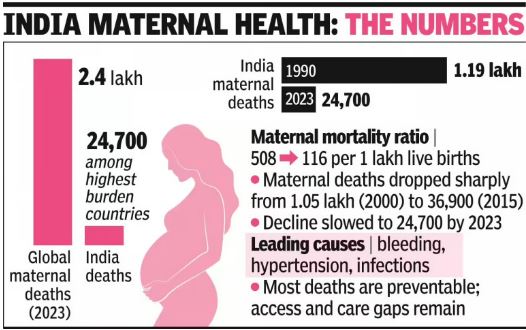
- The Global Burden: In 2023, approximately 2.4 lakh women died due to pregnancy or childbirth-related complications.
- India’s Position: India accounted for 24,700 of these deaths, roughly 1 in every 10 global maternal deaths. This places India among the high-burden nations alongside Nigeria, Pakistan, and Ethiopia.
- Causes of Mortality: Most deaths remain driven by preventable factors, including hemorrhage (excessive bleeding), hypertensive disorders (eclampsia), infections, and complications from pre-existing conditions.
Defining Maternal Mortality: Key Metrics
For administrative and policy purposes, India uses specific terminologies tracked under the Sample Registration System (SRS):
- Maternal Death: The death of a woman during pregnancy or within 42 days of termination, due to causes related to or aggravated by pregnancy, excluding accidental causes.
- Maternal Mortality Ratio (MMR): Number of maternal deaths per 1,00,000 live births.
- Maternal Mortality Rate: Number of maternal deaths per 1,00,000 women in the reproductive age group (15-49).
- Global Target (SDG 3.1): To reduce the global MMR to less than 70 per 1,00,000 live births by 2030.
India’s Progress: Successes and Regional Divergence
According to the National Family Health Survey-5 (2019-21), India has shown remarkable resilience in improving maternal outcomes.
Key Statistical Achievements
- MMR Decline: India’s MMR dropped from 130 (2014-16) to 97 (2018-20), successfully meeting the National Health Policy target of staying below 100 by 2020.
- Institutional Deliveries: A massive leap from 79% (2015-16) to 89% (2019-21). States like Kerala, Tamil Nadu, and Goa have achieved 100% institutional births.
- Rural-Urban Convergence: Even in rural pockets, institutional deliveries have reached 87%, significantly closing the gap with urban areas (94%).
The "Two Indias" Phenomenon
Progress remains highly uneven. While Southern states are nearing or have surpassed the SDG target of 70, states in the "BIMARU" belt, Uttar Pradesh, Bihar, and Madhya Pradeshcontinue to struggle with higher mortality ratios due to systemic lags.
Persisting Challenges
Despite a robust policy framework, several "last-mile" hurdles remain:
- High Out-of-Pocket Expenses (OOPE): Even in public facilities, families often pay for diagnostics and medicines, deterring the poorest from seeking timely emergency care.
- Socio-Cultural Barriers: Low female literacy, restricted autonomy in decision-making, and gender-based discrimination often delay the "three delays": delay in seeking care, reaching the facility, and receiving treatment.
- The New Risk Profile: Increasing instances of obesity, gestational diabetes, and hypertension, combined with delayed childbirth, are giving rise to more "high-risk" pregnancies.
- Infrastructure Gaps: Remote tribal and hilly terrains lack Emergency Obstetric Care (EmOC) and reliable blood storage units.
Government Framework & Innovations
The Government of India has launched a multi-tiered strategy to tackle MMR:
Central Schemes
- Janani Suraksha Yojana (JSY): A 2005 demand-side intervention providing cash incentives for institutional deliveries.
- PMMVY & Mission Shakti: Provides ?5,000 for the first child and an additional incentive for the second child if it is a girl, addressing both nutrition and sex ratio.
- PMSMA (9th of every month): Guarantees free, high-quality antenatal care (ANC) for all pregnant women in their 2nd/3rd trimesters.
- LaQshya: Focuses specifically on the quality of care in labor rooms and maternity OTs to prevent facility-based infections and complications.
State-Level Best Practices
- Tamil Nadu’s Referral Model: A gold standard in emergency obstetric care with a seamless ambulance and hospital linkage.
- Madhya Pradesh’s ‘Dastak Abhiyan’: Uses community health workers for early identification of high-risk pregnancies at the doorstep.
The Road to 2030
To reach the SDG target of 70 per 1,00,000, India must shift focus from "quantity" (number of deliveries) to "quality of care."
- Specialist Training: Expanding programs like LSAS (Anesthesia) and EmOC (Obstetric skills) for MBBS doctors to fill the gap of specialists in rural CHCs.
- Digital Tracking: Scaling the Reproductive and Child Health (RCH) portal for name-based tracking of every pregnant woman.
- Audit & Accountability: Strengthening Maternal Death Surveillance Reviews (MDSR) to identify why a death occurred and taking corrective local action.
The goal is to ensure that no woman loses her life while bringing another into the world—transforming maternal health from a privilege into a guaranteed right.