
India–Brazil–South Africa (IBSA) Dialogue Forum
- 26 Nov 2025
In News:
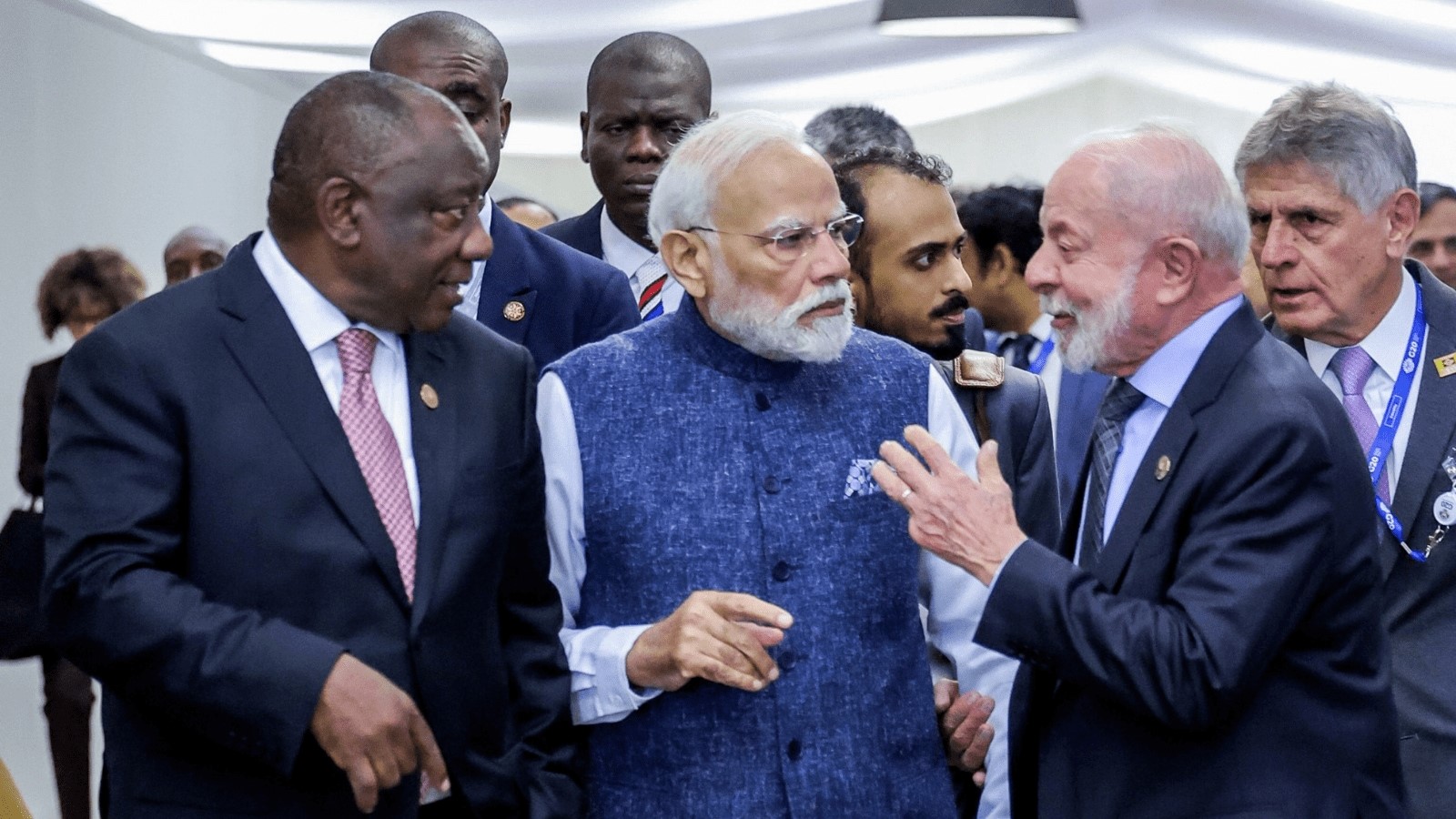
On the sidelines of the G20 Summit in Johannesburg, the leaders of India, Brazil and South Africa reaffirmed the relevance of the IBSA (India–Brazil–South Africa) Dialogue Forum at a time of global fragmentation, geopolitical churn and weakening multilateralism. Prime Minister Narendra Modi’s call for unified action against terrorism, reform of global institutions, and cooperation in climate-resilient agriculture and digital innovation underscored IBSA’s potential as a values-based Global South platform.
What is the IBSA Forum?
IBSA was formalised in 2003 through the Brasilia Declaration as a trilateral grouping of three large democracies from Asia, Africa and South America. It has no permanent secretariat or headquarters, operating through periodic summits, ministerial meetings and working groups.
Three pillars of IBSA cooperation are:
- Political consultation on global and regional issues.
- Trilateral sectoral cooperation through working groups and people-to-people forums.
- Development cooperation via the IBSA Trust Fund, established in 2004 and operational since 2006.
The IBSA Fund has supported around 50 South–South development projects in health, education, women’s empowerment, agriculture and renewable energy across more than 40 developing countries, especially Least Developed Countries (LDCs).
Key Outcomes and Proposals at the 2025 IBSA Meeting
At Johannesburg, India proposed several initiatives to reinvigorate IBSA:
- Unified push against terrorism: Calling for “no double standards,” India proposed institutionalising an NSA-level dialogue for regular security and counter-terrorism coordination.
- UN Security Council Reform: Leaders reiterated that existing global institutions do not reflect contemporary realities. As none of the IBSA countries is a permanent UNSC member, coordinated advocacy for reform was emphasised.
- Climate-Resilient Agriculture Fund: Building on the success of the IBSA Fund, India proposed a dedicated fund to support climate adaptation in agriculture.
- Digital Innovation Alliance: Sharing India’s Digital Public Infrastructure (DPI)-such as UPI, CoWIN, cybersecurity frameworks and women-led digital initiatives with other developing countries.
- Maritime and Defence Cooperation: IBSA’s practical security dimension is reflected in IBSAMAR, the trilateral naval exercise, whose 8th edition was held in 2024 off South Africa.
Strategic Importance of IBSA for India
- Voice of the Global South: IBSA allows India to project leadership without the structural dominance of China, unlike platforms such as BRICS or SCO.
- Advancing UNSC Reform: Collective advocacy by three regional powers strengthens India’s long-standing demand for a permanent UNSC seat.
- Soft Power and Development Diplomacy: The IBSA Fund exemplifies non-coercive, transparent South–South cooperation, enhancing India’s credibility as a development partner.
- Exporting Indian Solutions: DPI cooperation enables India to globalise its governance innovations in payments, health and digital inclusion.
Key Challenges
Despite its promise, IBSA faces several constraints:
- Agenda Overlap with BRICS: Many IBSA priorities UN reform, Global South development, climate action are also pursued within BRICS, which attracts greater political attention.
- Geopolitical Divergence: Variations in foreign policy outlooks, especially Brazil’s and South Africa’s relatively flexible stances towards China, limit strategic convergence.
- Low Economic Integration: Intra-IBSA trade remains modest due to weak logistics and similar economic profiles, creating competition rather than complementarity.
- Institutional Weakness: Absence of a permanent secretariat hampers continuity, monitoring and implementation.
Way Forward
To remain relevant, IBSA must:
- Focus on niche areas such as democratic governance, DPI, climate-resilient development and counter-terrorism.
- Establish a small permanent secretariat and an IBSA Business Council for continuity and economic engagement.
- Use IBSA as a coordinating caucus within BRICS to balance great-power dominance.
- Revitalise the IBSA Fund to showcase tangible outcomes of South–South cooperation.
Conclusion
In an era of geopolitical uncertainty and weakening multilateralism, IBSA offers a values-driven, democratic and inclusive alternative for Global South cooperation. If revitalised with focused agendas and stronger institutions, the forum can amplify India’s strategic influence while promoting equitable growth, global governance reform and human-centric development.
Why has South Africa taken Israel to the International Court of Justice? (Indian Express)
- 12 Jan 2024
Why is it in the News?
What is the case before the World Court?
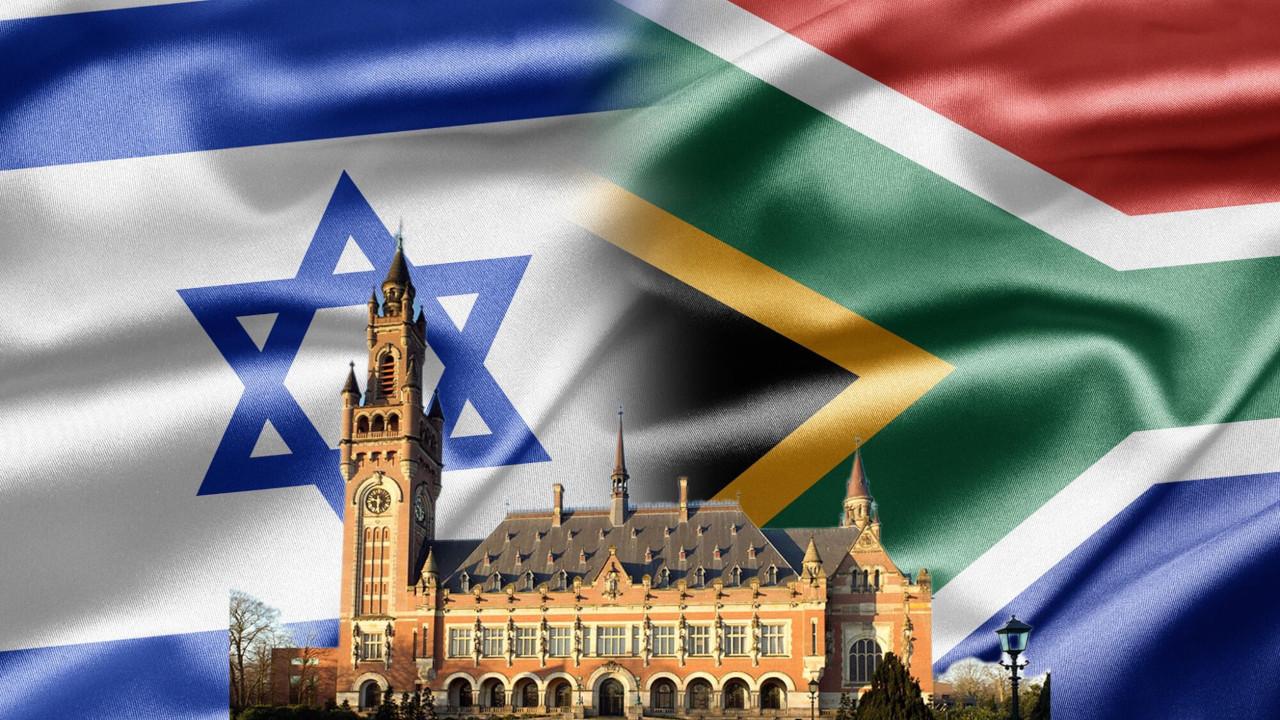
- South Africa brought a case against Israel to the ICJ on December 29, under the UN’s 1948 Genocide Convention.
- South Africa argued that Israel, in its ongoing Gaza assault, has transgressed from the provisions of Article 2 of the Convention.
- This article defines the term “genocide” to mean “acts committed with intent to destroy, wholly or partly, a national, ethnic, racial, or religious group”.
- The ICJ will eventually decide whether Israel is committing genocide or not — this may take years.
- But first, it will decide whether it has jurisdiction on this matter and whether the alleged acts fall under the 1948 Convention.
- South Africa has also sought interim relief for the Palestinians and asked the ICJ to order Israel to immediately suspend all military operations in Gaza, as an interim measure.
- While the court’s rulings are legally binding, it has no way to enforce them.
- Nonetheless, its opinions carry weight with the UN and other international institutions.
What is the International Court of Justice (ICJ)?
- The ICJ is the principal judicial organ of the United Nations that settles legal disputes between States in accordance with international law.
- Established in 1945 through the United Nations charter, the ICJ commenced its operations in April 1946.
- It is located at the Peace Palace in The Hague, Netherlands, distinguishing it from the other six principal UN organs situated in New York, USA.
- The ICJ specializes in settling legal disputes between states and providing advisory opinions on legal questions referred to by authorized United Nations organs and specialized agencies, all in accordance with international law.
Structure:
- Comprising 15 judges, elected for nine-year terms by the United Nations General Assembly and the Security Council, the Court ensures a simultaneous but separate voting process by these organs.
- To be elected, a candidate must secure an absolute majority of votes in both bodies.
- To maintain continuity, one-third of the Court is elected every three years, with judges eligible for re-election.
- The Court is supported by a Registry, its administrative organ, and operates in English and French as its official languages.
Regional Distribution of Judges:
- The 15 judges are distributed across regions as follows:
- Three from Africa.
- Two from Latin America and the Caribbean.
- Three from Asia.
- Five from Western Europe and other states.
- Two from Eastern Europe.
Indian Judges at ICJ:
- Four Indians have been members of the ICJ so far.
- Justice Dalveer Bhandari, former judge of the Supreme Court, has been serving at the ICJ since 2012.
Independence of Judges:
- In contrast to other international organizations' organs, the ICJ is unique in its composition, as it is not made up of government representatives.
- The Court's members are independent judges who, prior to assuming their duties, make a solemn declaration in open court, pledging to exercise their powers impartially and conscientiously.
Jurisdiction and Operations:
- The ICJ functions as a global court with a dual jurisdiction—addressing legal disputes between states submitted by them (contentious cases) and providing advisory opinions on legal questions referred to it by United Nations organs and specialized agencies (advisory proceedings).
- In contentious cases, only states that are members of the United Nations and have become parties to the Statute of the Court, or those that have accepted its jurisdiction under specific conditions, can participate.
- The judgments rendered in these cases are final, binding on the involved parties, and not subject to appeal.
- At most, there may be provisions for interpretation or, in cases of newly discovered facts, revision.
What is the Genocide Convention?
- The Convention on the Prevention and Punishment of the Crime of Genocide, commonly known as the Genocide Convention, serves as a foundational instrument in international law, officially defining the crime of genocide for the first time.
- According to the provisions of the Genocide Convention, genocide is deemed a crime applicable both in times of war and peace.
- This pivotal human rights treaty marked a historic milestone as the initial treaty adopted by the United Nations General Assembly on 9 December 1948.
- It symbolizes the global commitment to the principle of 'never again,' echoing the collective resolve of the international community in the aftermath of the atrocities witnessed during the Second World War.
- The definition of genocide outlined in the Convention has gained widespread acceptance on both national and international fronts, finding incorporation into significant legal frameworks, including the 1998 Rome Statute of the International Criminal Court (ICC).
- The Rome Statute, a pivotal development, introduced four core international crimes: genocide, crimes against humanity, war crimes, and the crime of aggression—all of which are explicitly stated to be exempt from any statute of limitations.
- Crucially, the Genocide Convention imposes on State Parties the responsibility to undertake measures for the prevention and punishment of genocide.
- This includes the enactment of relevant legislation and the punishment of perpetrators, irrespective of their status as constitutionally responsible rulers, public officials, or private individuals (Article IV).
- Both South Africa and Israel are parties to the Convention.
How often do such cases come before the ICJ?
This is not the first case the court will hear under the Genocide Convention.
- In 2022, Ukraine filed a case against Russia, and in 2019, the Gambia filed a case against Myanmar with respect to the Rohingya.
- The Myanmar case was the first time that a State invoked the court’s jurisdiction to seek redress for genocidal acts committed against the citizens of another state.
- The court agreed that the Gambia had standing to bring the case.
- Like the Gambia, South Africa has based its jurisdiction under obligations erga omnes partes — that is, as a party to the Convention, it can bring this case because of its community interest in preventing genocide.
What will happen now?
- South Africa’s case appears to meet the threshold for the court to make a provisional measures order.
- The Court must be satisfied it has prima facie jurisdiction; there is a “plausible” link between the rights asserted by South Africa and the measures it requests; and a risk of irreparable harm and urgency.
- That order will come within weeks and will have legal significance for all States that are parties to the Genocide Convention because such an order is binding on all States, even though the court lacks enforcement mechanisms.
- Israel has called the case “baseless” and a “blood libel”, and called on the international community to reject it.
- The United States, Hungary, and Guatemala have done so.
- Palestine has welcomed South Africa’s case, as have the 57 Organisation of Islamic Cooperation (OIC) countries, Malaysia, Turkey, Jordan, Bolivia, Venezuela, Mexico, Bangladesh, Namibia, Nicaragua, and some others.
- France has stated that it will support the court’s decision and India has not issued any statement.