
Analysis of Election Expenditure in India
- 30 Oct 2024
Overview
Election expenditure has become a pressing issue in modern democracies, with growing concerns about its implications for political integrity and fair competition. In India, the skyrocketing costs of elections—both in terms of candidate spending and political party expenditure—pose significant challenges to electoral transparency, governance, and equity.
Current State of Election Expenditure in India
The total expenditure on elections in India has risen dramatically in recent years. For the 2024 Lok Sabha elections, the total expenditure by various political parties is estimated to reach around ?1,00,000 crores. This is a significant jump from the ?9,000 crores spent in the 1998 general elections. The expenditure per vote has also risen substantially, from ?25,000 in 1951 to ?1,400 in 2024.
The election expenditure limits for individual candidates are capped by the Election Commission of India (ECI):
- ?95 lakh for larger states (Lok Sabha constituencies)
- ?75 lakh for smaller states
- ?40 lakh for legislative assembly elections in larger states
- ?28 lakh for smaller states
However, these caps apply only to individual candidates. Political parties are not subject to any expenditure limits, allowing them to spend unlimited amounts during campaigns. This discrepancy leads to considerable financial disparities between well-funded national parties and regional or smaller parties, undermining the principle of equitable competition.
Global Comparisons: Election Financing and Spending Limits
Election financing varies widely across democracies, with countries like the United States and the United Kingdom adopting specific limits and regulations to curb excessive spending.
- United States: U.S. elections are financed largely through contributions from individuals, corporations, and Political Action Committees (PACs). Notably, Super PACs—which can raise and spend unlimited funds—have exacerbated concerns over money's influence on political outcomes. The 2024 U.S. presidential election is expected to cost around $16 billion (approximately ?1,36,000 crores).
- United Kingdom: Political parties are subject to strict expenditure limits. Each political party is allowed to spend £54,010 for each constituency, with an overall cap of £35 million for contests across all constituencies. This is aimed at ensuring that elections are not swayed by wealth alone and that smaller parties have a fighting chance.
Despite these measures, the United States still faces issues with unlimited corporate donations and the growing influence of wealthy donors, highlighting the complexities in curbing money in politics.
Challenges Posed by Rising Election Expenditure
The rising costs of elections present multiple challenges in India, exacerbating corruption, unfair competition, and political inequality.
a) Political Corruption and Influence
Large election expenditures are often funded by corporate donations and other private entities, creating a nexus between politicians and donors. This can lead to a quid-pro-quo relationship, where politicians may prioritize the interests of their donors over public welfare. This undermines public trust in the political system.
b) Unaccounted Money and Illegal Practices
A significant portion of the election expenditure is unaccounted for. The Centre for Media Studies (CMS) reports that in the 2019 general elections, around 25% of the total expenditure was spent on illegally distributing cash to voters. This practice, coupled with the absence of strict regulations on third-party campaigners, enables the use of black money in elections, further skewing the electoral process.
c) Uneven Playing Field
The absence of limits on party spending creates a situation where well-funded national parties have an inherent advantage over smaller regional parties and independent candidates. This financial inequality reduces the ability of under-funded candidates to compete based on ideas and merit rather than financial muscle. Furthermore, the growing influence of digital advertising and media campaigns has further widened this gap, with larger parties investing heavily in digital platforms like Google and Facebook, marginalizing those without the resources to do so.
Proposed Reforms to Address Election Expenditure Issues
To address these challenges, several reforms have been suggested by experts, committees, and the Election Commission. These reforms aim to curb excessive spending, ensure fairness, and increase accountability in the electoral process.
a) Capping Expenditure by Political Parties
There is a pressing need to introduce expenditure ceilings for political parties, in addition to those imposed on individual candidates. According to the 2016 Electoral Reforms Report by the Election Commission, political party spending should be capped at a level not exceeding the total expenditure limit for all candidates fielded by the party. This would level the playing field, ensuring that the influence of money is curtailed during elections.
b) State Funding of Elections
Recommendations for state funding of elections have been made by the Indrajit Gupta Committee (1998) and the Law Commission Report (1999). The state could partially finance the campaigns of recognized political parties, ensuring that candidates are not solely reliant on private donations. However, this reform faces challenges in terms of feasibility and implementation, especially regarding the mechanism for allocation of funds.
c) Regulation of Third-Party Campaigners
India should follow the example of countries like Australia, where third-party campaigners are formally registered and required to disclose their funding sources. This would help in tracking illegal contributions and ensure that election spending is transparent.
d) Ban on Government Advertisements During Election Periods
The use of government advertisements by the ruling party during the run-up to elections often leads to an uneven playing field. A ban on government-funded ads during the six months before elections would ensure that the ruling party does not gain an unfair advantage through public resources.
e) Strengthening Electoral Oversight
An independent electoral oversight body could be established to oversee campaign financing and ensure that all parties comply with spending limits. This would include measures to audit party finances, track donations, and verify spending claims, making it more difficult for parties to evade rules or use black money.
Conclusion: The Need for Comprehensive Electoral Reforms
The rising costs of elections in India present significant challenges to the democratic process. While expenditure limits for candidates exist, the lack of restrictions on party spending creates financial inequalities that undermine fair competition. The increasing role of corporate donations, illegal cash distribution, and unregulated third-party spending further complicates the situation.
To ensure fair elections, it is crucial that India adopts reforms such as capping political party expenditures, state funding of elections, and stronger oversight mechanisms. These steps, coupled with bipartisan political will, could help create a more equitable, transparent, and accountable electoral system, fostering greater public trust in the democratic process.
By addressing these challenges head-on, India can work toward an election system that encourages political participation based on ideas and policies rather than financial clout, ultimately strengthening the foundations of democracy.
Analysis of Growing Economic Divide in India

- 29 Oct 2024
Overview
The Economic Advisory Council to the Prime Minister (EAC-PM)'s report titled "Relative Economic Performance of Indian States: 1960-61 to 2023-24" highlights an alarming trend of widening economic disparities across India's states, which is increasingly threatening the principles of federalism and national unity. The findings reveal significant regional imbalances in terms of contributions to the national income, per capita income, and overall economic development. This analysis delves into the key insights from the report and explores the broader implications for India's federal structure, governance, and policy approaches.
Key Insights from the Report
- Regional Economic Disparities:
- Western and Southern States' Dominance: States such as Maharashtra, Gujarat, Tamil Nadu, and Karnataka have consistently outperformed others. These states have benefited from higher private investments, better infrastructure, and a more business-friendly environment. They also enjoy proximity to international markets, especially coastal regions like Gujarat and Tamil Nadu, which have access to ports and export markets.
- Underperformance of Northern and Eastern States: On the other hand, northern states (with exceptions like Delhi and Haryana) and eastern states like Bihar, Odisha, and West Bengal lag behind in economic performance. These regions face challenges such as poor infrastructure, low levels of investment, and weak governance structures, which hinder their growth potential.
- Impact of Liberalization (1991):
- The 1991 economic reforms marked a shift toward market-oriented growth, benefiting states that were already more industrialized or had better urban infrastructure. Southern states, in particular, adapted well to the liberalized environment, attracting higher levels of private investment and expanding their economies.
- The liberalization process disproportionately favored urban centers like Delhi, Mumbai, Chennai, and Bengaluru, where investments were channelized into growing service sectors, technology, and industries, creating a feedback loop of wealth accumulation in these hubs. Meanwhile, the hinterland remained underdeveloped due to insufficient public investment and the lack of private sector interest in these regions.
- Investment Disparities:
- Private Investment: Wealthier states attract a disproportionate share of private investment, which is driven by profitability and market opportunities. These states have better infrastructure, which reduces transaction costs and increases returns on investment. In contrast, underdeveloped states struggle to attract investment due to poor governance, inadequate infrastructure, and perceived higher risks.
- Public Investment: While the public sector still plays a role in investment, the New Economic Policies (NEP) since 1991 have shifted the focus towards private sector-driven growth. This has further widened the investment gap, as the poorer states receive less public investment relative to their needs.
- Role of Infrastructure and Governance:
- The availability and quality of infrastructure are significant determinants of economic performance. States with better roads, energy supply, ports, and communication networks tend to attract more investments. Additionally, good governance, characterized by reduced corruption, better policy implementation, and transparency, also plays a critical role in fostering economic development.
- In contrast, states with weaker governance structures and poor infrastructure struggle to create an enabling environment for businesses, further compounding regional disparities.
- Impact on Federalism:
- The growing economic divide is leading to tensions between the Centre and state governments, particularly in wealthier states that contribute significantly to national income but feel short-changed in resource allocation. These states argue that they are not receiving a fair share of national resources in return for their contributions, leading to growing dissatisfaction with the federal system.
- The tension is exacerbated by political factors, such as accusations from opposition-led states that the Centre uses public investment to favor states aligned with the ruling party. The growing perception of politicization of resource allocation has the potential to undermine the spirit of cooperative federalism.
Structural Causes of Regional Inequality
- Economic and Investment Magnetism:
- Wealthier states attract more private investments, as they offer better returns due to established markets, skilled labor, and urbanization. Cities like Mumbai, Delhi, and Bengaluru serve as economic magnets, drawing talent, technology, and capital, which further consolidates their economic dominance.
- In contrast, states without such economic hubs or access to global markets struggle to attract investment. The absence of urban agglomerations and the concentration of wealth and resources in a few states perpetuate regional disparities.
- Policy and Investment Bias:
- Post-liberalization policies have disproportionately benefited the organized sector, often at the expense of the unorganized sector, which is more prevalent in poorer states. The emphasis on industrial growth and infrastructure development has largely bypassed the rural and informal sectors, which are critical in underdeveloped states.
- The organized sector has also benefited from government support, such as tax concessions and subsidized infrastructure, which have enabled these industries to thrive in already developed regions. This has widened the gap between the haves and the have-nots.
- Cronyism and the Black Economy:
- Crony capitalism and the prevalence of the black economy in poorer states further exacerbate regional imbalances. In some cases, political patronage and corruption divert resources and investments from areas that need them most. This weakens the investment climate, especially in states with higher levels of informal and illegal economic activity.
Implications for Federalism
The growing economic disparity poses a serious threat to India's federal structure. The increasing dissatisfaction of wealthier states with the current fiscal arrangements and the growing demand for fairer resource allocation challenge the spirit of cooperative federalism. A well-functioning federal system relies on equitable distribution of resources and opportunities for all regions to develop.
Policy Recommendations
To address these disparities and strengthen India's federal framework, several policy measures need to be implemented:
- Enhancing Governance and Infrastructure in Lagging States:
- Improved governance and reducing corruption are essential in attracting both private and public investments. Additionally, there must be a focus on developing critical infrastructure, such as roads, energy, and health facilities, which are essential for economic growth.
- States need to increase public investment in sectors like education, healthcare, and social security to improve human capital and productivity.
- Focus on the Unorganized Sector:
- A significant portion of the labor force in poorer states is employed in the unorganized sector. Policies should aim to formalize this sector by providing social security benefits, improving labor rights, and increasing productivity through skill development. This could help raise incomes and stimulate local demand, attracting more private investment.
- Balancing the Organized and Unorganized Sectors:
- While the organized sector has benefited from liberalization, more attention should be given to the unorganized sector, which forms the backbone of the economy in many poorer states. A balanced approach to economic growth, which includes both organized and unorganized sectors, can help reduce disparities.
- Shifting Focus from Urban Centers to Hinterlands:
- Private sector investment must be incentivized in underdeveloped regions through tax breaks, subsidies, and targeted infrastructure projects. This will encourage businesses to expand beyond the major urban centers, thus promoting a more balanced distribution of economic activities.
Conclusion
The widening economic divide in India, as revealed by the EAC-PM report, poses a significant challenge to the country's federalism and unity. To ensure inclusive and balanced development, policy reforms must focus on reducing regional disparities by improving governance, infrastructure, and investment in lagging states. A shift towards equitable growth, addressing the needs of both the organized and unorganized sectors, is essential to promoting national cohesion and ensuring sustainable economic progress across all regions.
Strengthening the Anti-Defection Law to Uphold India's Democratic Integrity

- 28 Oct 2024
In News:
The Anti-Defection Law, introduced in 1985 through the 52nd Constitutional Amendment, aims to curb political instability caused by legislators switching parties for personal or financial reasons. While the law has helped maintain political stability, it faces several challenges, including delays in decision-making, potential bias in adjudication, and lack of transparency in party directives. These issues undermine its effectiveness in safeguarding democratic integrity.
Historical Context and Genesis
The issue of political defections, exemplified by the term "Aaya Ram, Gaya Ram," traces its origins to the 1960s when frequent party-switching destabilized governments. To address this, the Anti-Defection Law was enacted in 1985, disqualifying members who voluntarily gave up their party membership or defied party whips on critical votes. Initially effective in reducing defections, the law has faced challenges due to emerging loopholes, particularly regarding party "splits" and "mergers."
Gaps and Loopholes in the Current Law
One major loophole was the provision allowing a party split if one-third of its members defected, exploited until the 91st Amendment in 2003, which increased the threshold for mergers to two-thirds. Despite this change, defections continue, particularly through "mergers." Another issue is the role of the Speaker in deciding disqualification petitions. Given that the Speaker is often affiliated with the ruling party, their decisions are sometimes seen as biased, leading to delays in resolving defection cases. Additionally, the lack of transparency in issuing party whips has caused disputes regarding their legitimacy.
Proposed Reforms
To address these challenges, two key amendments are proposed:
- Fixed Time Frame for Decision-Making: A clear time frame—such as four weeks—should be established for the Speaker or an adjudicatory body to resolve defection cases. If no decision is made within this period, defecting members should automatically be disqualified.
- Transparency in Whips: Political parties should be required to make the issuance of whips public, either through newspaper publications or electronic communication, to ensure that members are fully informed of party positions on critical votes.
Ethical Concerns and Impact on Democracy
While the Anti-Defection Law was introduced to promote political stability, it has inadvertently stifled internal dissent within parties. Legislators are often forced to follow party lines, even when their personal convictions or constituents' interests conflict. This limits their freedom of expression and undermines the representative nature of democracy. Furthermore, the law has not fully curbed unethical practices such as "poaching" of members or defectors seeking personal gain, which continue to destabilize governments and erode public trust in the system.
The Way Forward: Political Will and Comprehensive Reforms
To strengthen the Anti-Defection Law, reforms must balance party discipline with individual freedoms. Key steps include:
- Independent Adjudication: Establishing an independent tribunal to handle defection cases can reduce political bias and expedite the decision-making process.
- Clear Timeframes: Setting a fixed timeline for resolving defection cases will prevent delays and ensure accountability.
- Transparency in Whip Issuance: Ensuring public notice of party whips will reduce ambiguity and disputes.
- Promoting Ethical Conduct: Strengthening ethical guidelines to discourage "poaching" and protect the integrity of the electoral process.
Pradhan Mantri Mudra Yojana (PMMY)
- 27 Oct 2024
Introduction
The Pradhan Mantri Mudra Yojana (PMMY) was launched by Prime Minister Narendra Modi on April 8, 2015, with the aim of providing financial support to non-corporate, non-farm small and micro enterprises in India. Through this initiative, loans are provided to individuals and small businesses who are unable to access formal institutional finance.
In the Union Budget 2024-25, Finance Minister Nirmala Sitharaman announced an increase in the loan limit under PMMY from ?10 lakh to ?20 lakh, with the introduction of a new loan category, Tarun Plus, aimed at fostering growth in the entrepreneurial sector.
Key Features of the Pradhan Mantri Mudra Yojana
Loan Limit Increase
- Loan Limit Raised: The loan limit has been increased from ?10 lakh to ?20 lakh for eligible entrepreneurs.
- New Loan Category: The newly introduced Tarun Plus category caters to entrepreneurs who have previously availed and successfully repaid loans under the Tarun category.
- Credit Guarantee: The Credit Guarantee Fund for Micro Units (CGFMU) will cover these enhanced loans, further ensuring the security of micro-enterprises.
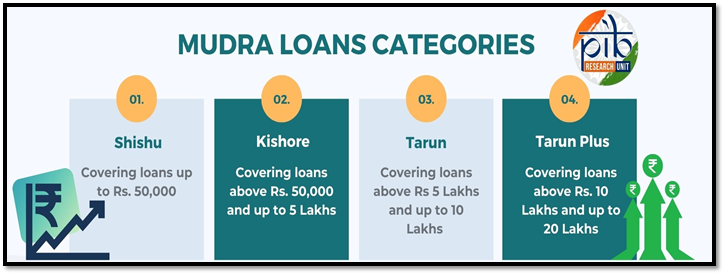
Categories of MUDRA Loans
PMMY provides collateral-free loans through financial institutions like Scheduled Commercial Banks, Regional Rural Banks (RRBs), Small Finance Banks (SFBs), Non-Banking Financial Companies (NBFCs), and Micro Finance Institutions (MFIs). These loans are provided for income-generating activities in sectors like manufacturing, trading, services, and allied agriculture activities.
Objectives of PMMY
- Financial Inclusion: PMMY targets marginalized and socio-economically neglected sections of society, promoting financial inclusivity.
- Support to Small Businesses: By providing affordable loans, the scheme encourages small-scale entrepreneurs, particularly women and minority groups, to establish and expand their businesses.
- Fostering Entrepreneurship: PMMY aims to unlock the potential of India’s entrepreneurial spirit, especially in rural and underserved areas.
MUDRA: The Institutional Backbone
Role of Micro Units Development & Refinance Agency Ltd. (MUDRA)
MUDRA is the primary institution set up by the Government of India to manage and implement the Mudra Yojana. It acts as a refinancing agency that provides financial support to small and micro-enterprises by working through financial intermediaries, such as banks and micro-finance institutions.
Funding Sources
- Scheduled Commercial Banks
- Regional Rural Banks (RRBs)
- Small Finance Banks (SFBs)
- Non-Banking Financial Companies (NBFCs)
- Micro Finance Institutions (MFIs)
Application Process
Applicants can avail loans through any of the aforementioned financial institutions or apply online via the Udyami Mitra Portal.
Benefits of Pradhan Mantri Mudra Yojana
- Collateral-free Loans: No security is required to obtain loans, which reduces the financial burden on borrowers.
- Easily Accessible: PMMY loans are available across India, making them accessible to entrepreneurs in both rural and urban areas.
- Quick and Flexible Loans: Loans can be disbursed quickly with flexible repayment terms (up to 7 years).
- Empowering Women Entrepreneurs: The scheme offers special incentives for women entrepreneurs, helping them to establish and grow their businesses.
- Support to Rural Areas: Special emphasis on empowering rural enterprises and reducing regional disparities.
- MUDRA Card: The MUDRA Card is a RuPay debit card that allows borrowers to access funds through an overdraft facility, enhancing liquidity for businesses.
- No Default Penalty: In case of loan defaults due to unforeseen circumstances, the government will step in to reduce the burden on entrepreneurs.
Categories of Loans Under PMMY
1. Shishu Category: Loans up to ?50,000
- Targeted at micro-enterprises at the initial stage of their business journey.
2. Kishore Category: Loans between ?50,000 and ?5 lakh
- Targeted at enterprises looking to expand their operations and upgrade their infrastructure.
3. Tarun Category: Loans between ?5 lakh and ?10 lakh
- For established businesses that are in need of funds to scale up.
4. Tarun Plus: Loans between ?10 lakh and ?20 lakh
- A new category designed for entrepreneurs who have repaid loans under the Tarun category and wish to further expand their business.
Achievements of PMMY (2023-24)
- Total Loans Sanctioned: ?5.4 trillion across 66.8 million loans in FY 2023-24.
- Loans Disbursed: Significant amounts were disbursed under each category:
- Shishu: ?1,08,472.51 crore
- Kishore: ?1,00,370.49 crore
- Tarun: ?13,454.27 crore
- Women Borrowers: A large share of loans have gone to women entrepreneurs, ensuring gender inclusivity.
- Minority Borrowers: The scheme also emphasizes financial empowerment of minority communities.
- NPA Reduction: The Non-Performing Assets (NPA) in Mudra loans have reduced to 3.4% in FY 2024, compared to higher levels in earlier years.
Digital Tools and Support Systems
MUDRA MITRA App
The MUDRA MITRA mobile app helps users access information about the PMMY scheme, loan application procedures, and other resources. The app is available for download on Google Play Store and Apple App Store.
Online Loan Application
Entrepreneurs can apply for loans online via portals such as PSBloansin59minutes and Udyamimitra, providing greater convenience and accessibility.
Steps to Improve Implementation
- Handholding Support: Assistance in submitting loan applications is available for applicants.
- Intensive Awareness Campaigns: The government conducts publicity campaigns to raise awareness about PMMY.
- Simplified Loan Process: The loan application forms have been simplified to encourage wider participation.
- Performance Monitoring: Regular monitoring of PMMY implementation to ensure its success.
- Interest Subvention: A 2% interest subvention is offered for prompt repayment of Shishu loans.
Conclusion
The Pradhan Mantri Mudra Yojana has been a transformative scheme in fostering entrepreneurship and ensuring financial inclusion for small and micro-businesses across India. With the recent increase in loan limits and the addition of the Tarun Plus category, the scheme continues to empower emerging entrepreneurs and provides a crucial lifeline for business growth and sustainability. By supporting women, minorities, and new entrepreneurs, PMMY has contributed significantly to economic upliftment and inclusive growth in the country.
The right to die with dignity
- 26 Oct 2024
In News:
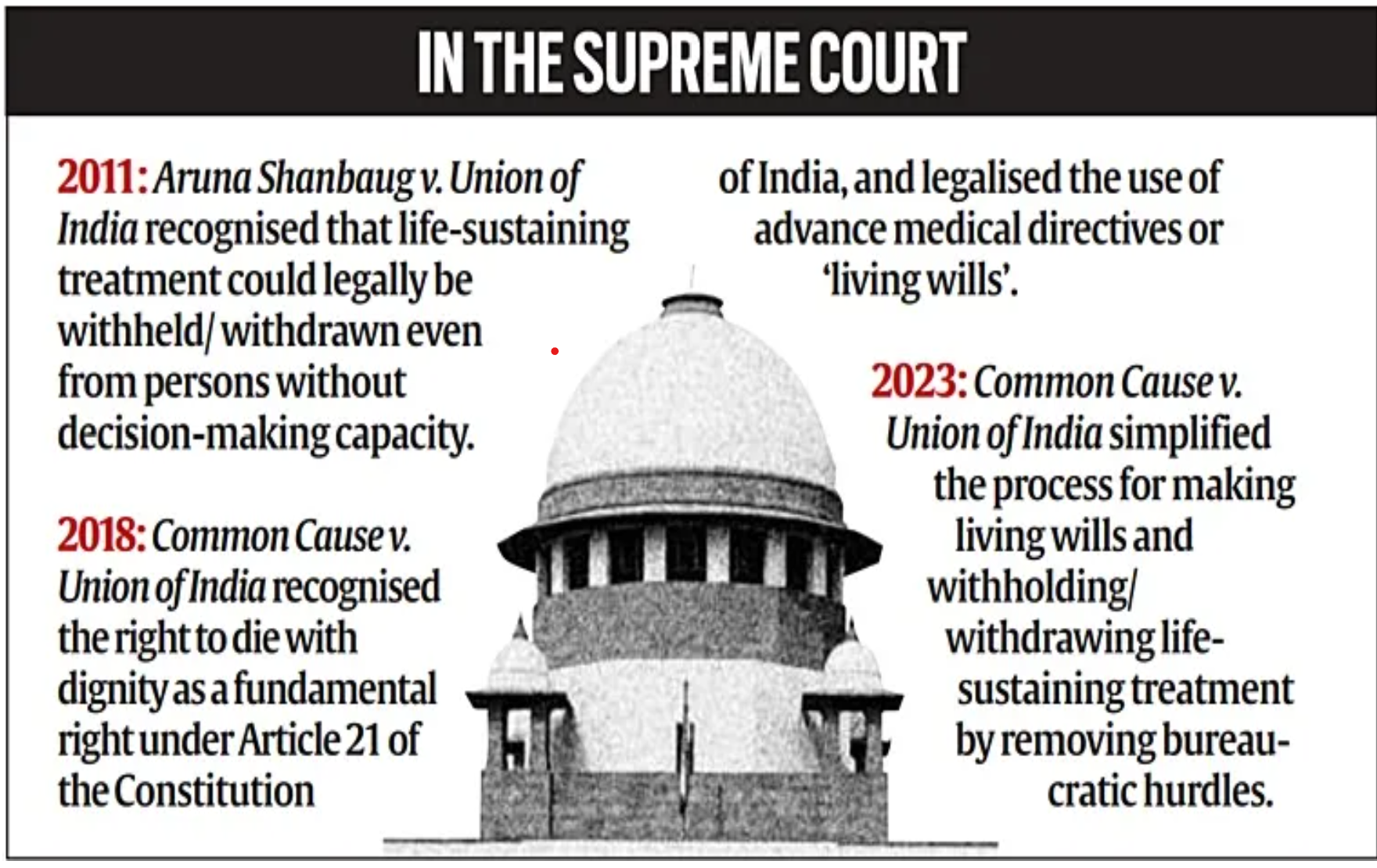
- The Ministry of Health and Family Welfare's draft guidelines (October 2024) aim to implement the Supreme Court's 2018 and 2023 orders on the right to die with dignity.
Legal Context: Supreme Court Rulings and Constitutional Rights
- Right to Refuse Treatment:
- Common Law & Article 21: The right to refuse medical treatment is grounded in common law and is now recognized as a fundamental right under Article 21 of the Indian Constitution, following the 2018 Supreme Court judgment in Common Cause v. Union of India.
- Supreme Court Rulings: The court's rulings in 2018 and 2023 affirmed that individuals have the constitutional right to refuse life-sustaining treatment and to die with dignity.
Withholding and Withdrawing Life-Sustaining Treatment
- Definition and Meaning:
- What Is Life-Sustaining Treatment? Life-sustaining treatments, such as ventilators and feeding tubes, artificially replace vital bodily functions to sustain life.
- Withholding/Withdrawal: This refers to discontinuing these treatments when they no longer improve the patient's condition or merely prolong suffering.
- When Is It Done?
- End-of-Life Care: Withholding or withdrawing treatment is considered when further medical intervention is futile and would only artificially prolong the dying process.
- Focus on Comfort: After withdrawing life-sustaining measures, the focus shifts to palliative care to alleviate pain and suffering.
Understanding Euthanasia and Misconceptions
- What Is Euthanasia?
- Definition: Euthanasia refers to the intentional ending of a terminally ill patient’s life by medical professionals to relieve suffering.
- Passive Euthanasia Misconception: In India, the term "passive euthanasia" is often mistakenly used to describe withholding or withdrawing life-sustaining treatment, but this does not involve the active killing of the patient.
- Legal Framework: The Indian Council of Medical Research (ICMR) clarified in 2018 that "passive euthanasia" is not a legally accepted practice in the country.
The Role of Doctors: Ethical Dilemmas and Shared Decision-Making
- Is Withdrawing Treatment "Giving Up" on the Patient?
- Not Abandonment: Withdrawing life-sustaining treatment is not about abandoning the patient but recognizing when further interventions would cause unnecessary suffering.
- Palliative Care: The patient’s comfort and dignity are prioritized through palliative care, which focuses on pain management and emotional support for both the patient and family.
- Doctors' Ethical Responsibility:
- Shared Decision-Making: The process encourages a collaborative approach between doctors and the patient’s family or surrogate decision-makers. This joint decision-making ensures that the wishes of the patient are respected and relieves the doctor from bearing sole responsibility for life-and-death decisions.
Living Wills and Advance Medical Directives
- What Is a Living Will?
- Definition: A living will is a legal document where a person outlines their medical preferences in the event they lose decision-making capacity.
- Eligibility and Process: Individuals aged 18 or older, who are capable of making decisions, can draft a living will, naming at least two trusted surrogate decision-makers.
- Legal Requirements: The document must be signed in the presence of an executor, two witnesses, and notarized to be legally binding.
- 2023 Supreme Court Guidelines: The Court simplified the procedure for making living wills to ensure that the right to die with dignity is upheld.
Medical Procedure for Withholding or Withdrawing Treatment
- Supreme Court Guidelines
- The Supreme Court laid out a clear procedure for withholding or withdrawing life-sustaining treatment, emphasizing patient autonomy, expert assessments, and family consent.
- Primary and Secondary Medical Boards:
- Primary Medical Board: The treating hospital sets up a Primary Medical Board, consisting of the treating doctor and two subject-matter experts, to assess the patient's condition and determine if life-sustaining treatment is appropriate.
- Secondary Medical Board: A Secondary Medical Board, comprising independent experts, reviews the Primary Board's decision for added oversight.
- Consent from Family/Surrogate Decision-Makers:
- The patient’s wishes, as outlined in an advance directive or by a surrogate, must be respected, and their consent is essential for proceeding with treatment withdrawal.
- Judicial Oversight:
- Once the decision to withdraw treatment is made, the hospital is required to notify the local judicial magistrate, ensuring transparency and accountability.
Conclusion: Legal and Ethical Clarity in End-of-Life Care
- Shared Decision-Making: The process ensures that medical teams, families, and surrogate decision-makers collaborate, preventing any medical professional from facing moral or legal dilemmas alone.
- Protection of Autonomy: These frameworks and guidelines uphold patient autonomy, offering a legal and ethical pathway for terminally ill patients to exercise their right to die with dignity.
16th BRICS Summit
- 25 Oct 2024
In News:
Recently, the 16th BRICS Summit was held in Kazan, Russia.
Key Highlights:
Overview of the Bilateral Meeting between PM Modi and President Xi
- Location & Context: The meeting took place on the sidelines of the 16th BRICS Summit in Kazan, Russia (October 23, 2024), marking the first bilateral interaction between PM Modi and President Xi Jinping in nearly five years.
- Significance: The meeting focused on India-China relations, specifically the border dispute that arose following the 2020 standoff in Ladakh.
- Agreement on Border Disengagement: Both leaders welcomed an agreement for "complete disengagement" along the Line of Actual Control (LAC), which could pave the way for the resolution of issues that emerged after the Galwan Valley clashes in June 2020.
Key Points of the India-China Border Pact
- Resolution of Border Issues: The agreement addresses longstanding disputes, including in Depsang Plains and Demchok, where Chinese forces had encroached on Indian territory.
- Restoration of Patrolling: Both nations agreed to restore patrols to old patrolling points (PPs) along the LAC in these disputed areas.
- Next Steps: The Special Representatives (SRs) on the India-China boundary will meet soon to oversee the management of peace and tranquility in the border areas and explore mutually acceptable solutions.
- Diplomatic Mechanisms: Dialogue mechanisms at the foreign ministers and other official levels will be utilized to stabilize and rebuild bilateral relations, contributing to regional and global stability.
Strategic Importance of the Bilateral Meeting
- Maintaining Peace and Stability: PM Modi emphasized that differences between India and China should be managed carefully to ensure that broader peace and tranquility are maintained.
- Global Impact: Both leaders affirmed that stable India-China relations would have a positive impact on regional and global peace and contribute to a multipolar world.
- Long-Term Strategic Perspective: The leaders discussed progressing bilateral relations from a strategic perspective, enhancing communication, and exploring cooperation to address developmental challenges.
Key Takeaways from the 16th BRICS Summit
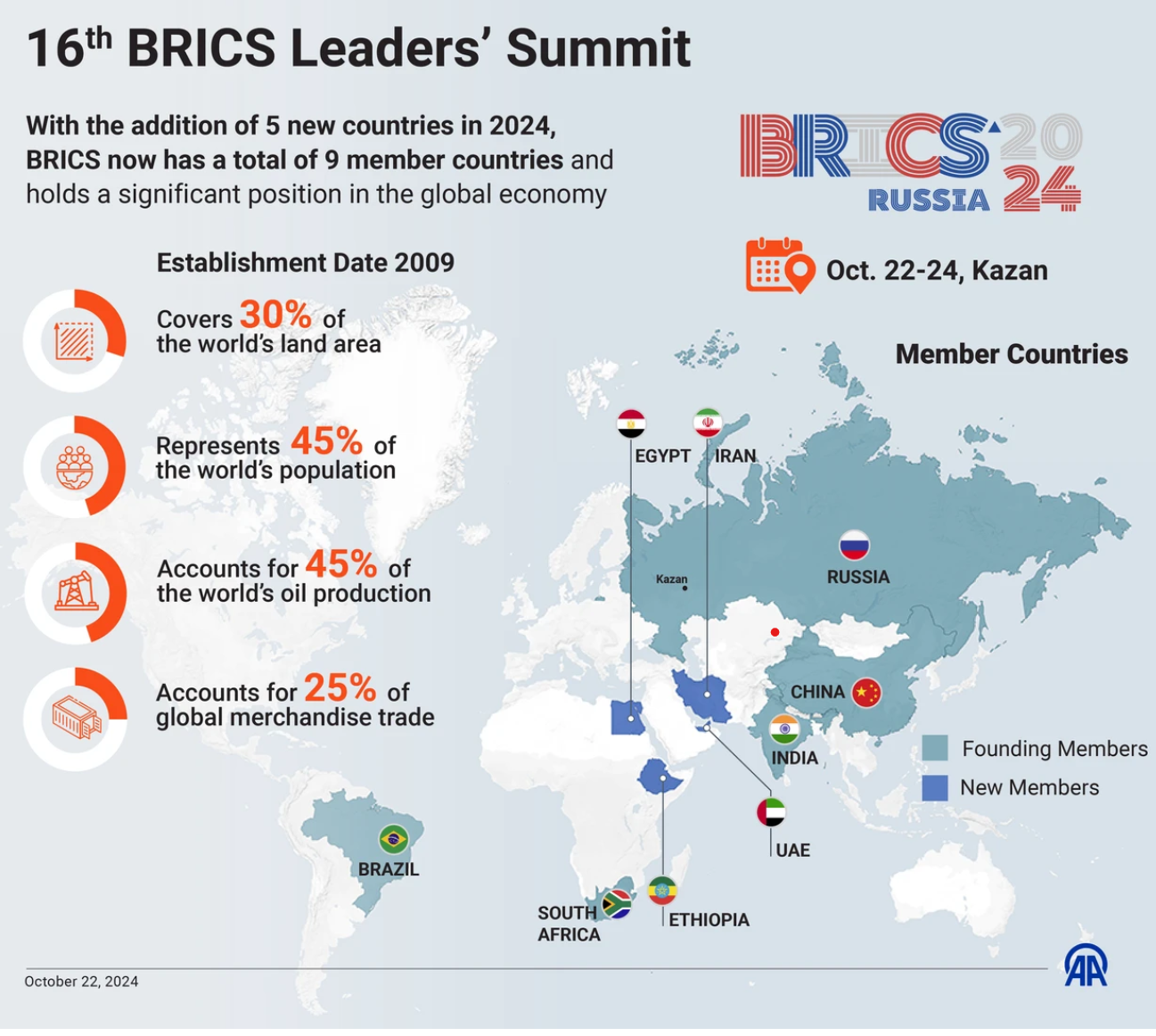
- Expansion and New Membership: The summit saw the inclusion of five new members—Egypt, Ethiopia, Iran, the UAE, and Saudi Arabia (pending formalization). This expansion reflects BRICS’s growing influence as a forum representing the Global South.
- Focus on Multilateralism: Leaders emphasized multilateral cooperation to address challenges such as global security, economic growth, and sustainable development.
- Kazan Declaration: The declaration touched upon key issues:
- Geopolitical Conflicts: It called for dialogue and diplomacy to resolve disputes like the Ukraine crisis and the West Asia conflict.
- Sanctions and Trade: Criticized unilateral sanctions and their disruptive effects on global trade and development goals.
- Grain Exchange: A proposal was made to establish a BRICS Grain Exchange, aimed at improving agricultural trade among member states.
- Financial Integration: There was a push for greater financial integration through the use of local currencies for trade, exemplified by India’s UPI system as a successful model.
Importance of BRICS in the Global Context
- Global Influence: BRICS continues to be a key player in global geopolitics, representing 40% of the world’s population and 26% of global GDP (as of 2023).
- Strategic Goals: BRICS has consistently called for reform of international institutions like the UNSC, IMF, and World Bank, advocating for a more equitable global governance structure.
- Economic Collaboration: The New Development Bank (NDB), established in 2015, continues to play a vital role in funding development projects across BRICS countries, though the group’s influence in global finance remains limited compared to the World Bank.
Challenges Facing BRICS Expansion
- Geopolitical Contradictions: The inclusion of diverse new members (e.g., UAE, Egypt, Iran) could complicate decision-making due to geopolitical rivalries.
- Decision-Making Hurdles: Achieving consensus among an expanding membership will become more challenging. The expansion may dilute the cohesiveness of the group, as seen in other multilateral forums like the Non-Aligned Movement (NAM) and G77.
- De-Dollarisation Efforts: While BRICS aims to de-dollarize trade and reduce reliance on the SWIFT system, efforts to develop alternatives like a BRICS payment system and BRICS currency are still in nascent stages.
- Economic Disparities: Economic gaps among members—China’s GDP is significantly larger than the combined GDP of other members—could also create imbalances in decision-making.
India’s Role and Strategic Positioning in BRICS
- Geopolitical Balancing: India's participation in BRICS is a strategic maneuver to balance its global position and strengthen ties with emerging economies, particularly in the Global South.
- Diplomatic Relations with Russia: India continues to prioritize its relationship with Russia, which remains crucial for regional security and energy cooperation.
- India-China Ties: The agreement on the India-China border represents a significant shift in relations, with potential for a reset in Sino-Indian ties.
Key Themes in the Kazan Declaration
- Global Governance: Calls for reforming global institutions to give developing nations more representation.
- Energy and Sustainability: Proposals for strengthening energy cooperation, including the creation of energy corridors and the promotion of sustainable energy practices.
- Security: Emphasized the need for universal security by addressing the security concerns of all nations and promoting dialogue over confrontation.
Conclusion: Future of India-China and BRICS Relations
- India-China Relations: The border disengagement pact is a critical step towards stabilizing the India-China relationship, with potential positive impacts on regional security and global geopolitics.
- BRICS’s Growing Influence: As BRICS expands, it faces internal challenges but remains a potent voice for the Global South, aiming to reshape global governance and financial systems.
- India’s Strategic Positioning: India is likely to play a pivotal role in BRICS, especially as the group’s focus shifts towards regional stability, economic cooperation, and de-dollarization in the coming years.
Stubble Burning and the Supreme Court's Ruling: Protecting the Right to a Pollution-Free Environment

- 24 Oct 2024
Introduction
Recently, the Supreme Court of India expressed serious concerns about the ongoing issue of stubble burning in the states of Punjab and Haryana. The Court criticized the selective enforcement of penalties for stubble burning and emphasized that such practices violate citizens' fundamental right under Article 21 of the Indian Constitution, which guarantees the right to live in a pollution-free environment.
Court’s Observations on Stubble Burning
- The Supreme Court highlighted the failure of state governments in effectively implementing laws against stubble burning.
- Selective Enforcement: The Punjab and Haryana governments were accused of prosecuting only a few violators while allowing many others to escape punishment by paying a nominal fine.
- The Court observed that this approach is a blatant violation of the right to live in a pollution-free environment, which is guaranteed under Article 21 of the Constitution.
Right to a Pollution-Free Environment
- The Court emphasized that every citizen has the fundamental right to live in an environment free from pollution, as mandated by Article 21 of the Constitution.
- The Court questioned the effectiveness of current environmental regulations, specifically pointing out the lack of proper machinery to collect fines under Section 15 of the Environment (Protection) Act, 1986.
Impact of Stubble Burning
Stubble burning, primarily in the northern states of India, exacerbates air pollution, especially in Delhi and surrounding regions. The seasonal spike in air pollution during the months of October and November is largely attributed to farm fires. This not only worsens the air quality but also has severe implications for public health.
Environmental and Health Consequences
- Air Pollution: The burning of crop residues significantly contributes to the rise in PM2.5 and PM10 levels, leading to hazardous air quality.
- Soil Health: Burning crop residues depletes essential nutrients from the soil, reducing organic carbon content and harming soil fertility.
Health Risks
- Exposure to pollutants like particulate matter (PM) can lead to respiratory problems, heart diseases, and other health complications for the population, especially in densely populated areas like Delhi.
Legal and Institutional Shortcomings
- Inadequate Implementation: Despite laws and penalties being in place, the lack of an effective enforcement mechanism has resulted in the persistence of stubble burning.
- Toothless Penalties: The Supreme Court criticized the amended Section 15 of the Environment Protection Act, 1986, which replaced criminal penalties with financial fines for environmental violations. However, the lack of rules and appointed adjudicating officers has rendered this provision ineffective.
- No Serious Enforcement: The failure of the Central government and state authorities to implement effective penalties has led to widespread non-compliance with environmental laws.
Government Actions and Responses
Centre’s Efforts:
- The Central Government has introduced a Central Sector Scheme to promote agricultural mechanization for in-situ management of crop residue in Punjab, Haryana, Uttar Pradesh, and Delhi.
- The government provides financial assistance of up to 50% for the purchase of machinery, such as the Happy Seeder, to manage paddy stubble without burning.
- A total of ?3,062 crore has been released from 2018 to 2023 to tackle stubble burning.
State-Level Actions:
- The Punjab government has introduced cash incentives for farmers who refrain from burning stubble. Additionally, the state is offering non-fiscal incentives, such as access to panchayat land for storing paddy straw.
- The Pusa Decomposer, developed by the Indian Agricultural Research Institute (IARI), is a bio-enzyme used to decompose crop residue. It helps in turning the stubble into manure within 20-25 days, enhancing soil health.
Challenges for Farmers:
- Many farmers still prefer burning stubble due to high costs associated with alternative methods of residue management.
- The Happy Seeder and other machinery remain expensive and are not affordable for most small-scale farmers, leading them to resort to burning as the most cost-effective option.
Court’s Directive and the Way Forward
- The Supreme Court directed the Centre and state governments to ensure better enforcement of laws related to air pollution, vehicular emissions, and industrial pollution.
- The Court also urged the Union Government to consider Punjab’s request for additional funds to tackle the stubble burning issue and to strengthen the enforcement mechanism.
- Urgency for Action: The Court’s observations suggest that the existing framework needs urgent reforms to protect citizens’ right to a pollution-free environment.
Constitutional Provisions Related to Environmental Protection
India’s Constitution provides several provisions to ensure the protection of the environment:
Article 21: Right to Life and Environment
- In the landmark case Subhash Kumar v. State of Bihar (1991), the Supreme Court held that the right to life under Article 21 includes the right to a wholesome environment.
- This view was reiterated in Virender Gaur v. State of Haryana (1994), further strengthening the legal framework for environmental protection.
Directive Principles of State Policy
- Article 48A: The State is mandated to protect and improve the environment and safeguard forests and wildlife.
- Article 39(e) and 47: These Articles place a duty on the State to promote public health and ensure environmental protection.
Fundamental Duties
- Article 51A(g) places a duty on citizens to preserve and protect the environment.
Conclusion
The Supreme Court’s ruling highlights the urgent need for better implementation of environmental laws and the protection of citizens’ fundamental rights under Article 21. While government schemes are in place, a more robust and consistent approach is required to address the issue of stubble burning and air pollution. Immediate reforms in the enforcement mechanisms and incentives for farmers are crucial to achieve a sustainable, pollution-free environment in India.
Biodiversity COP16

- 23 Oct 2024
In News:
The Convention on Biological Diversity (CBD), while historically overshadowed by climate change discussions, is now gaining increasing attention due to the growing recognition of the global biodiversity crisis. This evolving prominence highlights the need for urgent action to preserve ecosystems and halt biodiversity loss, which is intimately linked with the climate crisis.
Overview of the Convention on Biological Diversity (CBD)
- Origins and Objectives:
- The CBD emerged from the 1992 Rio Earth Summit, alongside the UN Framework Convention on Climate Change (UNFCCC).
- Main Goals:
- Protect global biodiversity.
- Restore ecosystems.
- Ensure equitable distribution of the benefits derived from biological resources.
- COP16 and the Kunming-Montreal Framework:
- The 16th Conference of Parties (COP16) marks the first meeting following the Kunming-Montreal Global Biodiversity Framework adopted at COP15 in 2022.
- The framework sets out four key goals and 23 targets to be achieved by 2030, including:
- Protect 30% of global lands and oceans by 2030.
- Restore 30% of degraded ecosystems by 2030.
The Growing Convergence Between Climate Change and Biodiversity
- Interlinkages Between Climate Change and Biodiversity:
- Mutual Impact:
- Climate change accelerates biodiversity loss by altering habitats and threatening species.
- In turn, ecosystem degradation contributes to climate change by releasing greenhouse gases (GHGs) from deforestation and soil degradation.
- Shared Drivers:
- Both crises are driven by unsustainable human activities, including over-exploitation of natural resources, deforestation, over-consumption, and pollution.
- Increasing Synergy:
- There is a growing realization of the need for integrated solutions that address both climate change and biodiversity loss simultaneously.
- Momentum for 30 x 30 Targets
- The 30 x 30 Commitment:
- The 30 x 30 targets are central to the Kunming-Montreal Framework, which includes:
- Conservation of 30% of the world's lands and oceans.
- Restoration of 30% of degraded ecosystems.
- These targets aim to ensure the preservation of biodiversity-rich areas and the restoration of degraded ecosystems globally by 2030.
- National Biodiversity Strategies and Action Plans (NBSAPs):
- Countries are required to develop and submit their NBSAPs (akin to Nationally Determined Contributions (NDCs) for climate change).
- As of now, only 32 countries have submitted their NBSAPs, with more expected during COP16.
- High Seas Treaty:
- A crucial agreement for achieving 30 x 30 targets is the High Seas Treaty (also called Biodiversity Beyond National Jurisdictions (BBNJ)), which focuses on:
- Establishing protected marine areas in biodiversity-rich regions beyond national jurisdictions.
- Ensuring regulation of human activities in these areas.
Access and Benefit Sharing: The Case of Genetic Resources
- Genetic Resources and Their Exploitation:
- The oceans, along with terrestrial ecosystems, harbor a wide variety of genetic resources that can be exploited for medical, commercial, and scientific purposes.
- Advances in biotechnology and digital sequencing of genetic material have raised issues about the equitable sharing of benefits from these resources.
- Nagoya Protocol and Benefit Sharing:
- The Nagoya Protocol (2010) set out guidelines for the access and fair sharing of benefits derived from genetic resources.
- At COP16, discussions will center on how genetic sequences (used in products such as medicines, crops, etc.) can be used fairly, ensuring that indigenous communities, who may be the original custodians of these resources, benefit equitably.
Finance Mechanisms for Biodiversity Conservation
- Financial Targets:
- One of the key goals of the Kunming-Montreal Framework is to mobilize $200 billion per year by 2030 for biodiversity conservation globally.
- Developed countries are expected to contribute $20 billion annually to developing nations, increasing to $30 billion by 2030.
- Phasing Out Harmful Subsidies:
- Countries are urged to eliminate perverse incentives that harm biodiversity, such as subsidies for:
- Over-fishing.
- Deforestation.
- Fossil fuel consumption.
- The goal is to repurpose such incentives to support sustainable practices and conservation efforts.
- New Financial Mechanisms:
- COP16 discussions will also focus on creating innovative financial mechanisms, such as:
- A biodiversity fund.
- Biodiversity credits, similar to carbon credits, which would allow countries or organizations to offset their biodiversity loss by investing in conservation projects elsewhere.
Challenges and the Way Forward
- Implementation of 30 x 30 Targets:
- The main challenge lies in translating ambitious goals into actionable plans at the national and local levels. Countries must not only submit action plans but also implement and monitor them effectively.
- Increased Global Cooperation:
- Addressing biodiversity loss requires collaboration between countries, industries, and local communities to ensure that efforts are comprehensive and inclusive.
- Public Awareness and Engagement:
- It is crucial to raise awareness about the importance of biodiversity conservation and the urgent need for collective action to mitigate the combined threats of biodiversity loss and climate change.
Conclusion: The Need for Urgent Action
The discussions at COP16 signal an important shift in how the world addresses biodiversity and its links to climate change. As countries continue to recognize the interconnectedness of these two crises, the outcome of the CBD negotiations could play a pivotal role in shaping global environmental policy. However, meeting the ambitious goals set forth by the Kunming-Montreal Framework requires strong political will, adequate financing, and effective global cooperation.
What are the stress factors for Indian Railways?

- 22 Oct 2024
In News:
On October 17, eight coaches of the Agartala-Lokmanya Tilak Express derailed in Assam with no casualties. On October 11, a passenger train rear-ended a stationary goods train near Chennai, also with no casualties. Indian trains have been involved in multiple accidents of late. The Balasore accident on June 2, 2023, had the greatest death toll, more than 275, yet pressure on the Railways to improve safety competes with pressures straining its subsistence.
Railway Accident Trends
- Decline in Accidents Over Time:
- From 1,390 accidents per year in the 1960s, railway accidents have reduced to about 80 accidents per year in the last decade.
- Recent Consequential Accidents:
- 34 accidents in 2021-2022
- 48 accidents in 2022-2023
- 40 accidents in 2023-2024
- Primary Causes of Accidents:
- 55.8% due to staff errors (railway personnel).
- 28.4% due to non-staff errors.
- 6.2% due to equipment failure.
- Role of Signalling Failures:
- Major accidents, such as Balasore and Kavaraipettai, were attributed to signalling system failures.
Key Safety Technologies and Measures
- Kavach System:
- Kavach is an automatic train protection system designed to prevent collisions by monitoring train positions and activating alarms or braking.
- As of February 2024, Kavach was implemented on only 2% (1,465 route km) of the railway network, limiting its effectiveness.
- Signalling System Overhaul:
- Outdated and faulty signalling systems contribute significantly to accidents. Both Balasore and Kavaraipettai incidents were linked to failures in signalling infrastructure.
Financial Strain on Indian Railways
- Operating Ratio (OR):
- The Operating Ratio (OR) in 2024-2025 is estimated to be ?98.2, indicating that the Railways spends ?98.2 for every ?100 earned.
- A higher OR reduces available funds for safety improvements and infrastructure upgrades.
- Budgetary Constraints:
- The 2023-24 budget showed a 7.2% reduction in capital outlay for track renewal and a 96% decrease in the Depreciation Reserve Fund, which is used to replace aging assets.
- Revenue Imbalance:
- Freight services account for 65% of Railways’ revenue but face capacity constraints, with 30% of the network operating at over 100% capacity.
- Passenger services, however, continue to incur significant losses, with ?68,269 crore loss in 2021-22.
Challenges in Rail Infrastructure
- Slow Infrastructure Development:
- The government's Dedicated Freight Corridors (DFCs), intended to alleviate congestion, are severely delayed:
- The Eastern DFC is the only fully operational corridor.
- Other corridors, including the Western DFC and additional planned routes, remain incomplete.
- Track and Equipment Maintenance:
- Ongoing delays in upgrading and maintaining essential infrastructure (tracks, wagons, signalling) contribute to the rising number of accidents.
Loco Pilot Working Conditions
- Extended Working Hours:
- Loco pilots often work 12-hour shifts due to manpower shortages, leading to fatigue and increased risk of human error.
- Stress and exhaustion are significant contributors to accidents caused by human error, including Signal Passed at Danger (SPAD).
Recommendations for Improving Railway Safety
- Loco Pilot Vacancies:Immediate recruitment to fill the 18,799 vacant loco pilot positions to prevent overworking and reduce fatigue-related errors.
- Expand Kavach Deployment:Accelerate the nationwide installation of the Kavach system, particularly on high-risk and high-traffic routes, to enhance safety.
- Complete Dedicated Freight Corridors (DFCs):Expedite the completion of DFCs to ease congestion and increase freight movement efficiency.
- Independent Railway Safety Authority:Establish an independent Railway Safety Authority with statutory powers, as recommended by the Kakodkar Committee (2012), to enforce safety standards and monitor implementation.
- Improve Signal Infrastructure:Invest in advanced and reliable signalling systems to prevent errors stemming from outdated or malfunctioning infrastructure.
- Regulate Working Hours:Enforce strict work hour limits to reduce fatigue among railway staff and ensure proper rest between shifts.
- Strengthen Trackside Infrastructure:Install fencing along tracks in high-risk areas to prevent cattle run-overs, a common cause of derailments in rural and semi-urban areas.
Conclusion
- Indian Railways faces a complex set of challenges, balancing safety requirements with financial constraints. Despite technological advancements like Kavach, its limited deployment and outdated infrastructure continue to present significant risks.
- A holistic approach to reform is needed, including addressing manpower shortages, upgrading safety technologies, and investing in infrastructure development. This will be essential for reducing accidents, improving safety, and ensuring the long-term sustainability of India’s vast railway network.
Section 6A of the Citizenship Act, 1955
- 19 Oct 2024
In News:
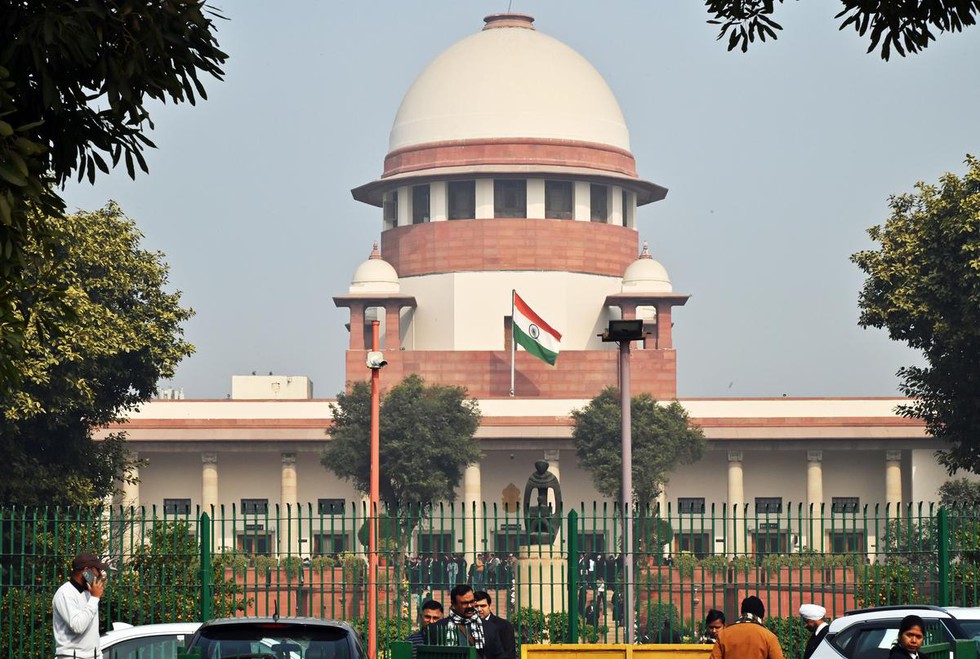
A Constitution Bench of the Supreme Court, in a majority judgment of 4:1 ratio, upheld the constitutionality of Section 6A of the Citizenship Act, 1955, which permits immigrants from Bangladesh residing in Assam to secure Indian citizenship, as a valid piece of legislation aligned to the Preambular value of fraternity.
Background:
- Section 6A of the Citizenship Act, 1955, deals with the citizenship status of immigrants from Bangladesh who entered Assam before March 25, 1971.
- Introduced as part of the 1985 Assam Accord, it provides a special provision for Assam due to the unique demographic challenges posed by large-scale migration from Bangladesh.
Key Aspects of the Supreme Court Ruling
Majority Opinion
- Constitutional Validity: The Court reaffirmed that Section 6A does not violate Articles 6 and 7 of the Constitution. These Articles set the cut-off for granting citizenship to migrants from East and West Pakistan. Section 6A, operating from a later date, is distinct and does not interfere with these earlier constitutional provisions.
- Justification of Cut-off Date: The March 25, 1971 cut-off date is upheld as reasonable. This date coincides with Operation Searchlight, launched by the Pakistani Army to suppress the Bengali nationalist movement. Migrants arriving before this date are considered part of India's post-partition demographic landscape.
- Fraternity and Equal Treatment: The Court emphasized that the principle of fraternity, as enshrined in the Preamble, cannot be selectively applied. Immigrants who arrived before March 25, 1971, are entitled to citizenship, while those arriving after are considered illegal immigrants. The ruling aims to balance the humanitarian aspect of migration with the state's right to protect its cultural and economic integrity.
- Historical Context: The judgment also invoked the Assam Accord, which was designed to address the issue of large-scale migration from Bangladesh, providing a political solution to Assam’s concerns. The Court held that the special provisions for Assam under Section 6A do not violate Article 14 (equality before the law) due to the distinct situation in Assam compared to the rest of India.
Section 6A of the Citizenship Act: Provisions and Purpose
- Section 6A was introduced under the 1985 Citizenship (Amendment) Act following the Assam Accord. It allows migrants who entered Assam before January 1, 1966, to automatically gain citizenship. For those entering between January 1, 1966, and March 25, 1971, citizenship can be granted after fulfilling specific conditions.
- Exclusion of Post-1971 Migrants: Migrants arriving in Assam after March 25, 1971, are not eligible for Indian citizenship under Section 6A and are considered illegal immigrants.
- Assam Accord Context: The Assam Accord sought to resolve the issue of illegal immigration from Bangladesh and address the political, cultural, and economic concerns of the indigenous Assamese population. It set the cut-off date of March 25, 1971, as a landmark for distinguishing between legal and illegal migrants.
Implications of the Supreme Court Judgment
Impact on Immigrant Recognition
- Continued Citizenship: By upholding Section 6A, the Court grants continued citizenship rights to immigrants from Bangladesh who entered Assam before the cut-off date of March 25, 1971. This decision affirms India's commitment to protect those displaced by the Bangladesh Liberation War.
Assamese Identity Preservation
- Cultural Protection: The majority opinion dismissed concerns that the presence of immigrants would infringe upon the cultural and linguistic rights of the Assamese people. The Court emphasized that existing constitutional safeguards (e.g., Article 29(1)) are sufficient to preserve the unique identity of the Assamese community, even in the face of demographic changes.
Demographic and Economic Impact
- Tensions on Demographic Shift: Critics argue that the continued influx of migrants, though legally recognized, may strain Assam’s demographic balance, potentially threatening its cultural identity and economic resources. This could fuel local demands for stricter immigration controls and increase political mobilization around cultural preservation.
- Resource Allocation Challenges: The judgment implies that immigrants who are granted citizenship will have access to public resources, adding pressure on Assam's limited economic resources. This may necessitate the implementation of more robust policies for equitable resource distribution.
Pressure on Immigration Laws and Enforcement
- Immigration Law Enforcement: The judgment stresses the need for more effective enforcement of immigration laws, particularly regarding the detection and deportation of illegal immigrants who entered Assam post-1971. The inefficiencies in the current mechanisms for detecting such immigrants were criticized, and the Court called for judicial oversight to improve the enforcement process.
Regional and International Implications
- Bangladesh Relations: The decision, by excluding post-1971 immigrants from citizenship, may strain India-Bangladesh relations, as it could be perceived as India pushing responsibility for these migrants onto Bangladesh. This has the potential to complicate regional cooperation on issues like border management, migration control, and security.
Conclusion: Balancing Humanitarian and Political Interests
The Supreme Court’s decision to uphold Section 6A of the Citizenship Act, 1955, reflects a delicate balance between humanitarian concerns—acknowledging the plight of displaced persons—and the political necessity of protecting Assam’s cultural and demographic integrity. While the judgment provides clarity on the legal status of immigrants in Assam, it also highlights the need for efficient immigration enforcement, greater judicial oversight, and equitable resource management to address the ongoing challenges posed by migration in the region.
India - Canada Relations

- 18 Oct 2024
In News:
India-Canada relations have recently faced serious setbacks following allegations of India's involvement in the killing of Khalistani leader Hardeep Singh Nijjar in Canada. These claims have led to escalating diplomatic tensions and mutual expulsions of diplomats between the two countries.
Recent Developments in India-Canada Relations
- Assassination of Hardeep Singh Nijjar:
- Nijjar, a prominent Khalistani leader, was assassinated in British Columbia, Canada.
- The Canadian Prime Minister accused Indian officials of involvement, which India has denied as "absurd."
- Diplomatic Fallout:
- Both nations expelled each other's diplomats, reducing diplomatic staff and freezing consular services, exacerbating the tensions.
- Support from the Five Eyes Alliance:
- Canada enlisted the Five Eyes intelligence alliance to gain international backing amid the escalating diplomatic crisis with India.
What is the Five Eyes Alliance?
- About:
- The Five Eyes is a multilateral intelligence alliance composed of Australia, Canada, New Zealand, the United Kingdom, and the United States.
- These countries cooperate on signals intelligence under the UK-USA Agreement.
- Expansion:
- The alliance later grew into the Nine Eyes and Fourteen Eyes alliances, incorporating additional countries like the Netherlands, Denmark, France, Norway, and others.
Key Areas of India-Canada Relations
- Political Relations:
- Diplomatic ties began in 1947, with both countries sharing democratic values, human rights, and pluralism.
- Collaborative efforts in global forums like the UN, G20, and Commonwealth focus on climate change, security, and sustainable development.
- Economic Cooperation:
- Bilateral trade in 2023 was worth USD 9.36 billion.
- Canada is the 18th largest investor in India with investments totaling USD 3.3 billion (2000-2023).
- Ongoing Comprehensive Economic Partnership Agreement (CEPA) negotiations aim to boost trade in goods, services, and investments.
- Diaspora Connections:
- Over 1.8 million people of Indian origin in Canada, contributing significantly to cultural and economic exchanges.
- Canada is home to one of the largest Indian diaspora populations globally.
- Education and Space Innovation:
- IC-IMPACTS promotes joint research in healthcare, agricultural biotechnology, and waste management.
- Space collaboration includes partnerships between ISRO and the Canadian Space Agency.
- Indian students represent nearly 40% of Canada's international student population.
- Nuclear Cooperation:
- A 2010 nuclear agreement allows the supply of uranium to India and establishes a Joint Committee for oversight.
- Strategic Importance:
- India’s role is key in Canada’s Indo-Pacific strategy, including collaboration on maritime security, counter-terrorism, and regional stability.
Challenges in India-Canada Relations
- Diplomatic Immunity Issues:
- Canada invoked the Vienna Conventions to protect its diplomatic staff amid tensions, with both sides highlighting the importance of maintaining diplomatic norms.
- Khalistan Issue:
- India views Canada’s tolerance of Khalistani separatist groups as a threat to its territorial integrity.
- Canada’s investigation into India’s alleged role in Nijjar’s assassination has exacerbated diplomatic mistrust.
- Economic and Trade Barriers:
- The political rift has stalled negotiations for the CEPA and slowed bilateral trade.
- Canadian investments in India face increased uncertainty due to deteriorating relations.
- Visa and Immigration Delays:
- Reduced Canadian diplomatic staff in India has caused significant delays in visa processing, especially for students.
- Geopolitical Implications:
- Tensions between India and Canada risk damaging India’s reputation on the global stage, particularly if allegations of intelligence overreach are substantiated.
- Canada’s membership in the G7 and ties with the Five Eyes make the situation complex, affecting relations with other strategic partners of India, including the US, UK, Australia, and Japan.
The Vienna Convention on Diplomatic Immunity
- Vienna Convention on Diplomatic Relations (1961): Establishes the framework for the treatment and protection of diplomatic missions and their personnel.
- Diplomatic Immunity: Diplomats are protected from arrest and detention by the host country.
- Inviolability of Diplomatic Premises: Diplomatic missions cannot be entered without permission.
- Protection of Consular Officers: Ensures consular officers can assist their nationals without interference.
Way Forward for India-Canada Relations
- Address the Khalistan Issue: Engage in active dialogue to resolve concerns about the Indian diaspora and the Khalistan movement, respecting each other’s sovereignty.
- Strengthen Economic Ties:
- Revitalize CEPA negotiations, with a focus on sectors like technology, renewable energy, and infrastructure.
- Enhance trade and investment frameworks for mutually beneficial opportunities.
- Balance Geopolitical Interests:
- Both nations should navigate relationships with major powers like the US, China, and Russia with care.
- A cautious approach is necessary to maintain strategic partnerships without further conflict.
- Leverage Multilateral Platforms: Utilize forums like the G7 and Five Eyes to address global challenges and promote shared values, while working to stabilize bilateral ties.
Conclusion
India-Canada relations are at a critical juncture due to recent tensions. While historical ties and shared interests provide a strong foundation, the diplomatic fallout requires careful management. Both nations must seek ways to restore dialogue, address sensitive issues like the Khalistan movement, and focus on economic cooperation to stabilize and strengthen the relationship moving forward.
Global Hunger Index 2024
- 17 Oct 2024
Why in the news?
India is ranked 105th among 127 countries in the Global Hunger Index (GHI) 2024, indicating a ‘serious’ level of hunger, along with Afghanistan and Pakistan, which also face hunger challenges.
According to the Global Hunger Index released on 10th October 2024, the hunger levels in 42 countries are at alarming levels, making the goal of Zero Hunger by 2030 unattainable. At this pace of progress, the world will not even attain a low hunger level until 2160. The world’s GHI score is 18.3, which is considered moderate in the severity of hunger scale.
Key Takeaways:
1. The GHI is published by Concern Worldwide and Welthungerhilfe annually to measure and track hunger at global, regional, and national levels. The purpose of the report is to create awareness and understanding of the struggle against hunger and call attention to those areas of the world where hunger levels are highest and there is a need for additional efforts.
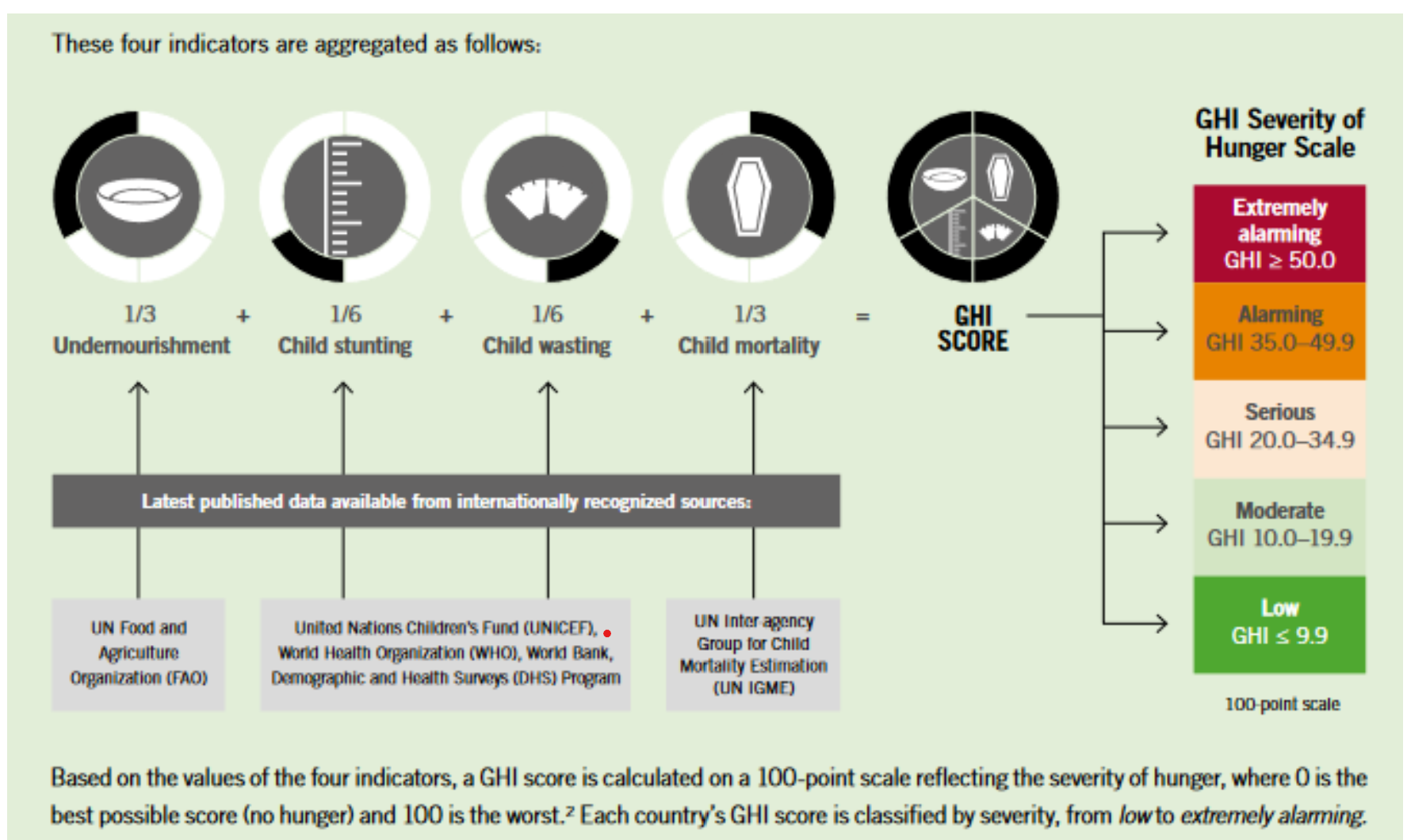
2. GHI is calculated based on a formula that combines four indicators that together capture the multidimensional nature of hunger:
- Undernourishment: the share of the population whose caloric intake is insufficient;
- Child stunting: the share of children under the age of five who have low height for their age, reflecting chronic undernutrition;
- Child wasting: the share of children under the age of five who have low weight for their height, reflecting acute undernutrition; and
- Child mortality: the share of children who die before their fifth birthday, reflecting in part the fatal mix of inadequate nutrition and unhealthy environments.
3. The 2024 GHI reflects that multiple factors are posing challenges in attaining Zero Hunger. The challenges include large-scale armed conflicts, climate change indicators that are worsening faster than expected, high food prices, market disruptions, economic downturns, and debt crises in many low- and middle-income countries.
4. The report highlights the link between Gender inequality, climate change, and hunger. Gender is intertwined with climate and food security challenges in ways that respective policies and interventions often ignore. Women and girls are typically hardest hit by food insecurity and malnutrition. They also suffer disproportionately from the effects of weather extremes and climate emergencies.
5. Six countries – Somalia, Yemen, Chad, Madagascar, Burundi, and South Sudan- have levels of hunger considered alarming. This is the result of widespread human misery, undernourishment, and malnutrition.
What is Hunger?
The Food and Agriculture Organization of the United Nations (FAO) defines hunger as food deprivation, or undernourishment, as the habitual consumption of too few calories to provide the minimum dietary energy an individual requires to live a healthy and productive life, given that person’s sex, age, stature, and physical activity level.
6. India ranked 105th out of 125 countries in the Global Hunger Index 2024, with a score of 27.3, indicating a serious level of hunger. Child wasting is particularly high in India. Child undernutrition in India goes hand in hand with the poor nutritional status of mothers, suggesting an intergenerational pattern of undernutrition and underscoring the need for attention to maternal health nutrition and infant feeding.
7. India’s GHI score of 27.3 is a cause for concern, especially when compared to its South Asian neighbours like Bangladesh, Nepal, and Sri Lanka, which fall into the “moderate” category
8. The performance of India on various parameters of GHI:
- 13.7 per cent of India’s population suffers from undernourishment,
- 35.5 per cent of children under the age of five are stunted
- 18.7 per cent experience child wasting and
- 2.9 per cent of children do not reach their fifth birthday.
9. The policy recommendations made in the document include strengthening accountability to international law and the enforceability of the right to adequate food, promoting gender-transformative approaches to food systems and climate policies and programs, and making investments that integrate and promote gender, climate, and food justice.
National Family Health Survey
1. The National Family Health Survey (NFHS) in India provides estimates of underweight, (low weight for age), stunting (low height for age), and wasting (low weight for height). These conditions affect preschool children (those less than 6 years of age) disproportionately and compromise a child’s physical and mental development while also increasing the vulnerability to infections.
2. According to the NFHS 5, the percentage of stunted, wasted, and underweight children is 36 per cent, 19 per cent and 32 per cent respectively.
(Thought Process: These data can be incorporated in your Mains Answer Writing to enrich your content.)
3. NFHS 5 highlighted that among mothers with a child between ages 6-23 months, 18 per cent reported that their child did not eat any food whatsoever — referred to as “zero-food” — in the 24 hours preceding the survey. The zero-food prevalence was 30 per cent for infants aged 6-11 months, remains worryingly high at 13 per cent among the 12-17 months old, and persists even among 18-23 months-old children at 8 per cent.
Hidden Hunger
In India, we suffer largely from “hidden hunger” which does not always manifest itself in an emaciated appearance. It is a hunger caused by the constant or recurrent lack of food of sufficient quality and quantity. It is the deprivation of vitamins and minerals, essential micronutrients that are necessary for proper growth, physical fitness, and mental development.
4. Going without food for an entire day at this critical period of a child’s development raises serious concerns related to severe food insecurity. According to the World Health Organisation, at six months of age, 33 per cent of the daily calorie intake is expected to come from food. This proportion increases to 61 per cent at 12 months of age. The recommended calorie percentages mentioned here are the minimum amount that should come from food.
5. India has a challenging task in attaining the Sustainable Development Goal (SDG) 2 of “zero hunger”. Mission Poshan 2.0, the overarching flagship programme dedicated to maternal and child nutrition, has evolved in the right direction by targeting SDG 2 “zero hunger” and focusing on food-based initiatives, including its flagship supplementary nutrition programme service as mandated by the 2013 National Food Security Act.
Climate Change and Methane Emissions in the Amazon Rainforest

- 16 Oct 2024
Overview
Recent research from the University of São Paulo reveals that climate change is poised to significantly disrupt the methane cycle in the Amazon rainforest, with potential global repercussions. Rising temperatures and increased flooding are impacting microbial activity in both floodplain and upland forest soils, leading to contrasting changes in methane dynamics.
Key Findings
- Methane Uptake Reduction: The study indicates that methane absorption in upland forest soils could decrease by as much as 70% in warmer, drier conditions. This reduction diminishes the forest's role as a methane sink.
- Floodplain Contributions: Floodplains, which cover over 800,000 square kilometers during the rainy season, contribute up to 29% of global wetland methane emissions. Here, methane-producing microbes thrive due to the breakdown of organic matter.
Understanding the Methane Cycle
- Definition: The methane cycle encompasses the processes that control the production, consumption, and release of methane (CH4) in the environment.
- Microbial Roles:
- Methanogens produce methane, primarily in waterlogged conditions.
- Methanotrophs consume methane, living in drier, oxygen-rich soils. These interactions are critical in regulating methane levels in the atmosphere.
- Sources and Sinks: While wetlands and other environments release methane, hydroxyl radicals (OH) in the troposphere act as a natural sink, helping to oxidize methane into carbon dioxide.
Climate Change Impacts on the Methane Cycle
- Imbalance of Sources and Sinks: As global temperatures rise, the release of methane from soils may increase, exacerbating climate change effects.
- Melting Clathrates: Methane clathrates, trapped in cold sediments, are at risk as warming causes them to release methane, further contributing to greenhouse gas concentrations.
Global Consequences of Methane Disruption
- Climate Change Amplifier: Methane is the second most significant greenhouse gas, with a global warming potential 28 times greater than carbon dioxide over a century.
- Air Quality and Health: Increased methane emissions can lead to higher levels of tropospheric ozone, resulting in respiratory health issues and reduced air quality.
- Biodiversity Threats: The changes in methane dynamics can destabilize ecosystems, leading to shifts in species distributions and loss of biodiversity.
Balancing the Methane Cycle
To mitigate the impacts of methane emissions, various strategies can be employed:
- Enhanced Landfill Design: Utilizing gas collection systems to capture methane for energy rather than allowing it to escape.
- Livestock Management: Introducing feed additives to reduce methane emissions from ruminants.
- Sustainable Agricultural Practices: Implementing techniques like alternative wetting and drying in rice cultivation to lower methane output.
- Soil Health Improvements: Promoting organic fertilization and crop rotation to foster aerobic conditions in soils.
Research Insights
The study involved subjecting soil samples from floodplains and upland forests to elevated temperatures and varying humidity levels. Results indicated:
- Stable methane emissions in floodplains alongside an increase in methane-producing microbes.
- A significant decline in methane uptake in upland soils due to temperature sensitivity, with higher temperatures reducing microbial diversity.
Conclusion
The Amazon rainforest plays a crucial role in regulating global methane levels, and its response to climate change is vital for understanding future greenhouse gas emissions. As these ecosystems face increased pressure from rising temperatures and changing hydrological conditions, it becomes imperative to enhance our understanding and management of methane dynamics to mitigate broader climate impacts.
Asset Monetisation
- 15 Oct 2024
In News
The NITI Aayog has recently increased the asset monetisation target for the fiscal year 2024-25 (FY25) by ?23,000 crore, bringing the total to ?1.9 trillion. This adjustment aligns with the broader target of ?6 trillion set under the National Monetisation Pipeline (NMP) for the period from FY 2022 to FY 2025.
Understanding Asset Monetisation
Definition
Asset monetisation refers to the process of converting public assets into revenue-generating assets without selling them outright. This includes using assets to generate profit or cash, thereby unlocking their economic value.
Importance
- Revenue Generation: Monetisation creates new revenue streams for governments by leveraging underutilised public assets.
- Focus on Public Assets: The emphasis is on monetising existing infrastructure such as roads, airports, railways, and pipelines, primarily targeting brownfield assets—those that can be improved or repurposed.
Monetisation vs. Privatisation
While privatisation involves complete ownership transfer to the private sector, asset monetisation allows public authorities to retain ownership while benefiting from private sector efficiencies through structured partnerships.
The National Monetisation Pipeline (NMP)
Overview
The NMP is an initiative aimed at promoting sustainable infrastructure financing through the monetisation of operational public assets. It envisions a monetisation potential of ?6 lakh crore, focusing on leasing core assets from the Central government and public sector entities.
Preparation and Coverage
- Collaborative Approach: Developed by NITI Aayog in consultation with infrastructure ministries such as Roads, Railways, and Power.
- Sector Coverage: Encompasses various sectors including roads (27% of the total value), railways (25%), power (15%), and telecom (6%).
Framework for Monetisation
- Retention of Rights: The government retains ownership, with assets reverting to public authorities post-transaction.
- Stable Revenue Streams: Focus on de-risked brownfield assets that provide consistent revenue.
- Defined Partnerships: Establishment of contractual frameworks with strict performance indicators.
Alignment with National Infrastructure Pipeline (NIP)
The NMP is integrated with the NIP, which seeks to attract investments in both greenfield and brownfield projects across all sectors.
Current Status of the NMP
Revenue Generation
As of FY24, the NMP has generated ?3.9 trillion, slightly below the original target of ?4.3 trillion for the initial three years.
Successful Monetisation Examples
- The Ministry of Coal exceeded its target, raising ?1.54 trillion against a goal of ?80,000 crore.
- Mining assets have also been monetised significantly, surpassing their revised targets.
Sectors Lagging
- Railways: Only ?20,417 crore monetised, achieving just 30% of the target.
- Civil Aviation: A mere 14% of its targeted monetisation has been achieved.
Challenges Facing the NMP
- Low Monetisation Potential: The NMP's ?6 lakh crore target represents only a small fraction (5-6%) of the total capital expenditure under the NIP.
- Disinvestment Issues: Many sectors chosen for monetisation have consistently fallen short of their disinvestment targets, raising doubts about achieving future goals.
- Long-Term Rights Concerns: Granting private entities long-term operational rights may be perceived as a form of privatisation, potentially leading to public distrust.
- Budget Clarity: There is a lack of transparency regarding how monetisation proceeds will be allocated within the government budget.
- Potential for Monopolies: Consolidation of asset ownership could lead to monopolistic practices, especially in critical infrastructure sectors.
- Taxpayer Concerns: Taxpayers are wary of the potential for double charges on public assets they initially funded.
Way Forward
- Accelerating Monetisation: The government should expedite contract-based monetisation through Public-Private Partnerships (PPP), particularly in sectors like railways and airports.
- Land Monetisation Initiatives: Engaging real estate companies to develop multi-storey buildings can generate additional revenue while enhancing housing options.
- Establishing Budget Guidelines: Clear budgeting guidelines should be developed to clarify the allocation of funds generated from monetisation, ensuring they are used for infrastructure development rather than operational expenses.
Navigating the Middle-Income Trap: Challenges and Solutions for India

- 14 Oct 2024
Introduction
The World Development Report 2024 addresses the phenomenon of the middle-income trap, where countries struggle to maintain growth as they transition from low to middle-income status. This report advocates for a "3i" approach—Investment, global Technology infusion, and domestic Innovation—to overcome this challenge. India faces specific hurdles, including stagnant exports, rising protectionism, and premature deindustrialization.
Understanding the Middle-Income Trap
Definition and Characteristics
- A middle-income trap occurs when a country, after achieving middle-income status, fails to progress to high-income status.
- This phenomenon typically arises when a country's per capita income reaches about 11% of US levels, leading to:
- High wage levels that diminish competitiveness against low-wage economies.
- Insufficient technological advancement to compete with high-income nations.
Economic Implications
- Traditional growth drivers become ineffective.
- Rising wages in labor-intensive sectors decrease competitiveness, while innovation and productivity remain stagnant.
Historical Context: India’s Income Evolution
1. Post-Independence Era (1950s-1970s)
- Per Capita Income: ?265 in 1950-51.
- Growth Rate: 3.5%, dominated by agriculture.
- Economic Structure: Heavy state intervention and public sector focus.
2. Liberalization Phase (1980s-1990s)
- Per Capita Income Growth: Accelerated to 5.6%.
- Major Shift: 1991 liberalization led to a rise in the services sector and an expanding middle class.
3. High Growth Phase (2000-2010)
- GDP Growth: 8-9% annually.
- Per Capita Income: Increased from ?16,173 in 2000-01 to ?24,295 in 2007-08.
- Sectoral Dominance: Surge in software and services exports.
4. Mixed Growth Phase (2010-2020)
- Growth Volatility: Average of 6-7%.
- Wealth Inequality: Top 1% owned 40.5% of national wealth by 2021.
5. Post-Covid Recovery (2020-Present)
- GDP: Reached $3.75 trillion.
- Current Issues: Unemployment at 8.1%, while digital payment systems expanded.
Challenges in Overcoming the Middle-Income Trap
1. Premature Deindustrialization
- The manufacturing sector's GDP share has stagnated at 15-17%, far below the target of 25%.
- Limits potential productivity gains and innovation.
2. Limitations of Services-Led Growth
- Over-reliance on the services sector hampers mass employment and inclusive growth.
3. Declining Total Factor Productivity (TFP)
- TFP growth has been declining, indicating a shift toward input-driven growth rather than efficiency-driven growth.
4. Informal Sector Dominance
- The informal economy comprises about 90% of the workforce, leading to low productivity and limited access to technology.
5. Risk of a Demographic Burden
- Youth unemployment is rising, with only 2.3% of the workforce receiving formal skill training.
6. Global Economic Headwinds
- Slowing global growth affects India’s export-led strategies, with a recent contraction in merchandise exports.
7. Infrastructure and Logistics Bottlenecks
- India ranks 38th in the World Bank’s Logistics Performance Index, highlighting significant infrastructure gaps.
Strategic Measures for India
1. Enhance Manufacturing Competitiveness
- Targeted Industrial Policies: Refine the Production-Linked Incentive scheme and extend it to emerging sectors like green hydrogen.
2. Accelerate Digital Infrastructure and Skills Development
- Leverage India's digital platforms to create a skills ecosystem and modernize vocational training.
3. Boost R&D Expenditure
- Increase public R&D spending to 2% of GDP by 2030, focusing on key sectors like renewable energy.
4. Foster an Innovation-Driven Manufacturing Policy
- Shift focus to high-value specialized manufacturing rather than competing in mass production.
5. Integrate Skills and Education
- Align educational curricula with industry needs and establish centers of excellence in tier-2 and tier-3 cities.
6. Lead in Green Technology
- Scale initiatives like the International Solar Alliance and create a national carbon market.
7. Reform Market Regulations
- Liberalize product and factor markets to enhance competition and efficiency.
Conclusion
India's path out of the middle-income trap necessitates a concerted effort to boost manufacturing, foster innovation, and address productivity challenges. By leveraging digital infrastructure and enhancing skills, alongside adopting green technologies, India can create a sustainable framework for growth. Effective execution of targeted policies will be crucial for transitioning to a high-income economy.
ASEAN SUMMIT
- 11 Oct 2024
In News:
The 21st ASEAN-India Summit took place in Vientiane, Lao PDR, on 10 October 2024. This summit coincided with the 10th anniversary of India’s Act East Policy. Prime Minister Narendra Modi joined ASEAN leaders to assess the progress of the ASEAN-India Comprehensive Strategic Partnership and set the course for future collaboration.
In his address, Prime Minister Modi reaffirmed India's strong support for ASEAN Unity, ASEAN Centrality, and the ASEAN Outlook on the Indo-Pacific. Referring to the 21st century as the “Asian century,” he emphasized the pivotal role of India-ASEAN relations in shaping Asia’s future. He highlighted the success of India’s Act East Policy, noting that in the last decade, trade between India and ASEAN had doubled to over USD 130 billion, with ASEAN becoming one of India’s top trade and investment partners. He also pointed out direct flight connections with seven ASEAN countries, advancements in Fin-tech collaborations, and efforts to restore shared cultural heritage in five ASEAN nations. PM Modi also stressed the importance of completing the review of the ASEAN-India Free Trade Agreement (AITIGA) promptly to unlock greater economic potential. He spoke about the progress made in the India-ASEAN knowledge partnership, particularly through scholarships for ASEAN students at Nalanda University.
In line with the summit’s theme of ‘Enhancing Connectivity and Resilience", PM Modi announced a 10-point plan, which includes:
- Celebrating 2025 as the ASEAN-India Year of Tourism, with USD 5 million allocated for joint initiatives.
- Marking a decade of the Act East Policy through people-centric activities like a Youth Summit, Start-up Festival, Hackathon, Music Festival, ASEAN-India Network of Think Tanks, and Delhi Dialogue.
- Organizing an ASEAN-India Women Scientists Conclave under the ASEAN-India Science and Technology Development Fund.
- Doubling scholarships at Nalanda University and offering new scholarships for ASEAN students at Indian agricultural universities.
- Reviewing the ASEAN-India Trade in Goods Agreement by 2025.
- Enhancing disaster resilience, with India contributing USD 5 million.
- Initiating a new Health Ministers’ track for building health resilience.
- Establishing a regular ASEAN-India Cyber Policy Dialogue to strengthen digital and cyber resilience.
- Hosting a workshop on Green Hydrogen.
- Inviting ASEAN leaders to join the ‘Plant a Tree for Mother’ campaign to promote climate resilience.
During the summit, leaders agreed to develop a new ASEAN-India Plan of Action (2026-2030) to guide future cooperation and adopted two joint statements:
- Joint Statement on Strengthening ASEAN-India Comprehensive Strategic Partnership for Peace, Stability, and Prosperity in the Indo-Pacific, highlighting the role of India’s Act East Policy in advancing the ASEAN-India relationship.
- ASEAN-India Joint Statement on Advancing Digital Transformation, recognizing India’s leadership in digital transformation and embracing a partnership in digital public infrastructure.
Prime Minister Modi expressed his gratitude to the Prime Minister of Laos for successfully hosting the summit and to Singapore for its role as Country Coordinator over the past three years. He looked forward to working with the Philippines, the new Country Coordinator for India.
ABOUT Association of Southeast Asian Nations (ASEAN)
- ASEAN is a political and economic organization focused on fostering economic growth and regional stability among its member countries.
- The member states include Brunei, Cambodia, Indonesia, Laos, Malaysia, Myanmar, the Philippines, Singapore, Thailand, and Vietnam.
- ASEAN was founded in 1967 in Bangkok, Thailand, with the signing of the ASEAN Declaration (Bangkok Declaration) by its original members: Indonesia, Malaysia, the Philippines, Singapore, and Thailand. Brunei Darussalam joined in 1984, followed by Vietnam in 1995, Lao PDR and Myanmar in 1997, and Cambodia in 1999.
ASEAN Summit:
- This is ASEAN’s highest decision-making body, consisting of the heads of state or government of member nations. The summit is held twice a year.
- The first ASEAN Summit took place in 1976 in Bali, Indonesia.
The Mental Health Crisis in India

- 10 Oct 2024
In News:
India faces a significant mental health crisis, driven by various factors including economic disparities, social isolation, and changing family dynamics. The pandemic further worsened these issues, leading to detrimental effects on mental well-being.
Causes of Mental Illness
- Socioeconomic Factors: Poverty, violence, inequality, and environmental deprivation contribute to rising mental health issues.
- Pandemic Impact: Lockdowns and uncertainties have heightened stress levels and anxiety.
- Adverse Life Experiences: Trauma, abuse, and dysfunctional family relationships can severely impact mental health.
- Cultural Pressures: The urban focus on consumerism and status can lead to feelings of inadequacy and dissatisfaction.
The Shortage of Mental Health Professionals
India's mental health services are severely lacking, with only 0.75 psychiatrists per 100,000 population—far below the World Health Organization's recommendation of three. This shortage underscores the need for policy interventions and incentives to increase the supply of mental health professionals.
Government Initiatives for Mental Health
The Indian government has implemented several initiatives to improve mental health care:
- National Mental Health Programme (NMHP): Launched in 1982 to enhance community-based mental health services.
- Mental Healthcare Act, 2017: Decriminalized suicide attempts and introduced advanced directives for treatment choices.
- Rights of Persons with Disabilities Act, 2017: Recognizes mental illness as a disability, enhancing rights for affected individuals.
- Manodarpan Initiative: Provides psycho-social support to students.
- Kiran Helpline: A suicide prevention helpline for crisis management.
- National Tele-Mental Health Programme: Launched in 2022 to expand access to mental health services, particularly in underserved areas.
Economic Survey 2023-24
For the first time, the Economic Survey emphasized the importance of mental health in policy recommendations, calling for effective implementation of mental health initiatives to address existing gaps.
Understanding Healthy Workplaces
Defining a Healthy Workplace
A healthy workplace fosters collaboration between employers and employees to promote physical and psychological safety. It encompasses open communication, respect, and a supportive environment, crucial for addressing workplace stress, anxiety, and burnout.
Current Crisis: Overwork and Mental Health
The phenomenon of ‘Karoshi’ (death from overwork) highlights the severe consequences of workplace stress. In India, 40% of employees report high stress levels due to excessive work demands.
Ethical Perspectives on Healthy Workplaces
Creating a healthy workplace involves:
- Fairness and Equity: Ensuring all employees have equal access to resources and opportunities.
- Respect for Individual Dignity: Acknowledging contributions and fostering psychological safety.
- Moral Responsibility of Employers: Providing a safe working environment and promoting mental health initiatives.
- Transparency and Accountability: Building trust through open communication about policies and practices.
- Promoting Work-Life Balance: Encouraging a balance between professional and personal life to prevent burnout.
Global Precedents for Work-Life Balance
Countries like Australia and France have introduced regulations, such as the ‘right to disconnect,’ allowing employees to disengage from work communications after hours.
Conclusion and Way Forward
Establishing healthy workplaces is not merely a regulatory compliance issue but an ethical commitment to employee well-being. Both employers and employees must collaborate to create an environment of psychological safety, open communication, and mutual respect. By prioritizing these principles, organizations can foster workplaces that enhance productivity and support mental health, ultimately driving innovation and improving overall well-being.
MeitY relaxes AI compute procurement norms for Start-ups

- 09 Oct 2024
Overview
The Ministry of Electronics and IT (MeitY) has relaxed certain provisions related to the procurement of computing capacity for artificial intelligence (AI) solutions. This decision is part of the Rs 10,370 crore IndiaAI Mission, aimed at enhancing the country’s AI capabilities.
Key Relaxations
Annual Turnover Requirements
- Primary Bidders: Turnover requirement reduced from ?100 crore to ?50 crore.
- Non-Primary Consortium Members: Requirement halved from ?50 crore to ?25 crore.
Computing Capacity Adjustments
- The performance threshold for successful bidders has been revised:
- FP16 Performance: Reduced from 300 TFLOPS to 150 TFLOPS.
- AI Compute Memory: Reduced from 40 GB to 24 GB.
Importance of the Changes
These adjustments respond to concerns raised by smaller companies about exclusionary requirements that favored larger firms. The aim is to create an inclusive environment that allows start-ups to participate in the AI landscape.
AI Mission Goals
- Establish a computing capacity of over 10,000 GPUs.
- Develop foundational models with capacities exceeding 100 billion parameters.
- Focus on priority sectors such as healthcare, agriculture, and governance.
New Technical Criteria
- Companies must demonstrate experience in offering AI services over the past three financial years.
- Minimum billing of ?10 lakh required for eligibility.
Local Sourcing Requirements
- Components for cloud services must be procured from Class I or Class II local suppliers as per the ‘Make in India’ initiative:
- Class I Supplier: Domestic value addition of at least 50%.
- Class II Supplier: Local content between 20-50%.
Data Sovereignty and Service Delivery
- All AI services must be delivered from data centres located in India.
- Data uploaded to cloud platforms must remain within India's sovereign territory.
Implementation Strategy
- The Rs 10,370 crore plan will be implemented through a public-private partnership model.
- 50% viability gap funding has been allocated for computing infrastructure development.
Conclusion
The relaxations in AI compute procurement norms aim to support the growth of start-ups in India, fostering an environment conducive to innovation in artificial intelligence. With these changes, smaller companies are better positioned to contribute to the country's ambitious AI goals.
How India can harness the power of AI to become a Trailblazer

- 08 Oct 2024
Introduction
India stands at the forefront of an AI revolution, poised to leverage its unique position for unprecedented growth and innovation. With a robust economic outlook, the nation is ready to transform its AI capabilities.
Economic Landscape
Projected Growth
- Nomura estimates India's economy will grow at an average rate of 7% over the next five years, surpassing the IMF's global growth forecast of 3.2% for 2024.
- Hosting the G20 and Global Partnership on AI meetings in 2023 has created a favorable geopolitical environment.
Market Potential
- India’s AI market is expected to reach $17 billion by 2027, with a growth rate of 25-35% annually from 2024 to 2027 (Nasscom).
- The country leads Asia Pacific in the use and adoption of Generative AI, with significant engagement from students and employees.
The Role of Industry
Driving Transformation
- Similar to historical industrial leaders, India Inc has the potential to drive significant change across various sectors.
- The goal is to transition from participation to leadership in the global AI ecosystem.
Sector-Specific Strategies
- Industries must align AI capabilities with specific sectoral goals by mapping challenges, opportunities, and ambitions.
Case Study: Logistics Sector
Historical Inefficiencies
- A decade ago, the logistics sector in India faced significant inefficiencies.
AI Integration
- Traditional AI introduced automation and basic forecasting. Companies like PandoAI have leveraged AI to consolidate supply chain data and provide valuable analytics.
- The integration of Generative AI can further enhance predictive capabilities and innovative solutions.
Infrastructure and Investment
Current Challenges
- India generates 20% of the world’s data but has only 2% of global data centers, limiting technological advancement.
Government Initiatives
- Plans to procure 10,000 GPUs in the next 18-24 months and a National Semiconductor Mission to establish a domestic chip industry.
Need for Industry Investment
- Collaboration between government and industry is crucial to meet the growing demands for computing power.
Talent Development
Workforce Dynamics
- Hiring of AI talent increased by 16.8% in 2023, indicating a rising focus on AI capabilities.
- Many Indian-origin AI professionals work for international companies, highlighting the need for local opportunities.
Educational Initiatives
- Programs like FutureSkills PRIME should be expanded to enhance talent development in AI.
Ethical Standards and Governance
Importance of Trust
- Establishing trustworthy AI standards is essential for consumer confidence and sustainable operation.
- Challenges such as bias and data security require robust governance frameworks.
Operationalizing Ethics
- Develop AI governance frameworks addressing ethical concerns and data security.
- Ensure transparency in AI algorithms and decision-making processes.
- Promote inclusive AI development by engaging diverse perspectives.
- Invest in ethical AI research through collaborations with academic institutions.
Conclusion
India’s commitment to a strategic vision, substantial investment, and adherence to trustworthy AI practices can position it as a global leader in the AI landscape. This is a pivotal moment for India to harness AI's transformative power, paving the way for a new era of economic prosperity.
National Agriculture Code (NAC)
- 07 Oct 2024
Introduction
The Bureau of Indian Standards (BIS) is in the process of developing the National Agriculture Code (NAC), which aims to establish standardized practices across the agricultural sector. This initiative mirrors existing frameworks such as the National Building Code and the National Electrical Code.
Purpose of the National Agriculture Code
The NAC seeks to standardize agricultural practices throughout the entire agricultural cycle, ensuring consistency and quality in farming operations. It will serve as a comprehensive guide for farmers, agricultural institutions, and policymakers.
Structure of the NAC
The NAC will be divided into two main parts:
- General Principles: Applicable to all crops, providing a foundational framework.
- Crop-Specific Standards: Tailored standards for key crops such as paddy, wheat, oilseeds, and pulses.
Coverage of the NAC
The code will encompass a wide range of agricultural processes, including:
- Agricultural Cycle: From crop selection to post-harvest operations.
- Post-Harvest Operations: Including standards for storage, processing, and traceability.
- Emerging Practices: Guidelines for natural and organic farming, as well as the integration of Internet-of-Things (IoT) technologies.
- Input Management: Recommendations for the use of fertilizers, pesticides, and weedicides.
Objectives of the National Agriculture Code
The BIS outlines several key objectives for the NAC:
- Standardization: Create a national code that reflects the diverse agro-climatic zones and socio-economic conditions across India.
- Quality Culture: Act as a reference for policymakers and regulators to enhance agricultural quality.
- Guidance for Farmers: Provide a practical guide to assist farmers in making informed decisions.
- Integration of Standards: Combine existing Indian standards with agricultural practices.
- Modernization: Emphasize aspects such as SMART farming, sustainability, and documentation.
- Capacity Building: Support training programs conducted by agricultural extension services.
Implementation Timeline
The BIS has established working panels comprising university professors and research organizations to draft the NAC, with a target completion date set for October 2025. Following this, training programs for farmers will be organized, facilitated by universities with financial assistance from the BIS.
Standardized Agriculture Demonstration Farms (SADF)
In conjunction with the NAC, the BIS is launching Standardized Agriculture Demonstration Farms (SADFs) at select agricultural institutions. These farms will serve as experimental sites to test and implement agricultural practices aligned with Indian standards. Partnerships with prominent agricultural institutes are being formalized through Memorandums of Understanding (MoUs), with two agreements already signed, including one with Govind Ballabh Pant University of Agriculture and Technology.
Significance of the NAC
- Uniform Standards: Promotes best practices in diverse agricultural environments.
- Stakeholder Guidance: Provides a structured framework for informed decision-making.
- Support for Modern Techniques: Encourages the adoption of innovative practices and technologies.
- Farmer Empowerment: Facilitates training and capacity building for enhanced productivity.
Challenges and Limitations
- Implementation Barriers: Standardizing practices across varied climates and soil conditions may prove challenging.
- Adoption Resistance: Smaller farmers might struggle with resource availability or awareness of new practices.
- Dynamic Agricultural Needs: The need for frequent updates to the NAC to keep pace with evolving agricultural trends.
- Infrastructure Constraints: Rural areas may lack the necessary infrastructure to effectively implement NAC guidelines.
Conclusion
The National Agriculture Code represents a pivotal move towards modernizing and standardizing agricultural practices in India. While it aims to enhance productivity and sustainability, its success hinges on effective implementation, farmer engagement, and ongoing updates to meet the changing landscape of agriculture.
Fairwork India Report
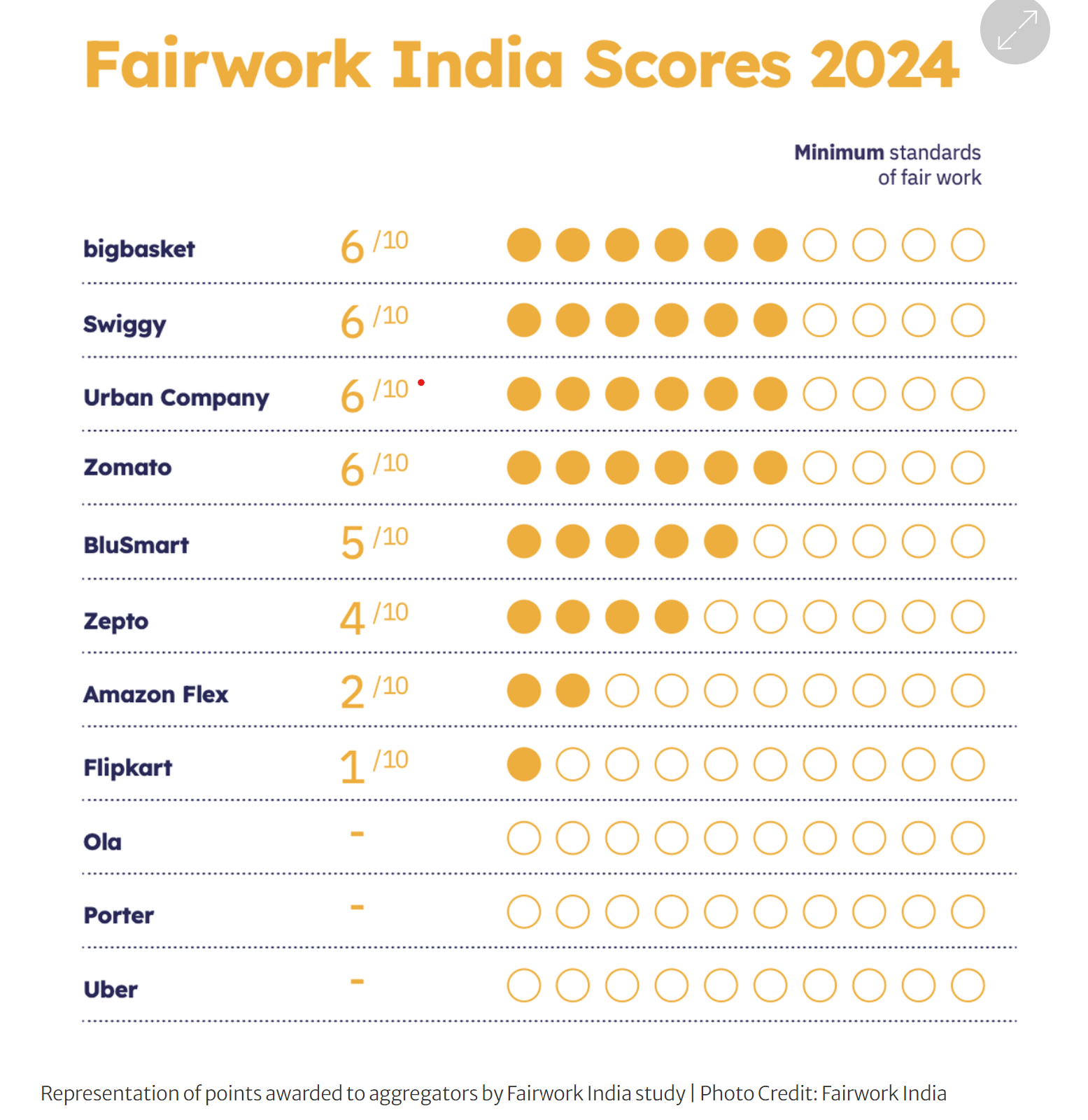
- 06 Oct 2024
In News:
The Fairwork India Ratings 2024 report, which analyses the work conditions of platform workers on digital labour platforms in India, draws a picture of aggregators who are non-committal to ensuring that workers earn the local living wage and unwilling to recognise collectivisation of workers.
Key Findings:
- Overall Performance: No platform scored above six out of ten, and none achieved top points across the five assessed principles: Fair Pay, Fair Conditions, Fair Contracts, Fair Management, and Fair Representation.
- Study Background: This report is the sixth annual analysis conducted by the Fairwork India Team, in collaboration with the Centre for IT and Public Policy (CITAPP), IIIT-Bangalore, and Oxford University.
Analysis of Welfare Legislation
- The report discusses the evolving nature of platform work and its implications for proposed legislation affecting gig workers in Karnataka and Jharkhand.
- Political interest in gig workers' welfare has increased, but the effectiveness of these initiatives remains uncertain.
- Professors Balaji Parthasarathy and Janaki Srinivasan highlight the importance of ongoing research and advocacy for improving gig worker conditions.
Methodology
- Principles of Assessment: Platforms were evaluated based on five principles, each consisting of two points—one that could only be awarded if the first point was fulfilled.
- Data Collection: Worker interviews were conducted across multiple cities, including Bengaluru, Chennai, Delhi, Kochi, and Thiruvananthapuram.
- Platforms Analyzed: The study included 11 platforms from various sectors, such as logistics, food delivery, and personal care.
Detailed Findings by Principle
Fair Pay
- First Point: Bigbasket and Urban Company were recognized for implementing a minimum wage policy ensuring workers earn at least the local minimum wage.
- Second Point: No platform met the criteria for committing to a local living wage after work-related costs.
Fair Conditions
- First Point: Platforms such as Amazon Flex, BigBasket, and Swiggy provided adequate safety equipment and training.
- Second Point: BigBasket, Swiggy, Urban Company, Zepto, and Zomato offered additional protections, including accident insurance and compensation for medical-related work absences.
Fair Contracts
- First Point: BigBasket, BluSmart, and others ensured contract accessibility and data protection protocols.
Fair Management
- First Point: Amazon Flex, BigBasket, and several others provided due process in disciplinary decisions.
- Second Point: BluSmart, Swiggy, Urban Company, and Zomato were noted for regular external audits and anti-discrimination policies.
Fair Representation
- Despite increased collectivization efforts among platform workers, no platform showed a willingness to recognize collective bodies, underscoring a critical gap in worker representation.
Conclusion
The Fairwork India Ratings 2024 report highlights significant challenges in ensuring fair work conditions for platform workers in India, stressing the need for continuous advocacy and reform in the gig economy.
National Urban Livelihood Mission (NULM)
- 05 Oct 2024
In News:
The Government is set to launch NULM 2.0, the latest iteration of the National Urban Livelihood Mission (NULM), aimed at enhancing the livelihoods of urban poor and vulnerable populations. This version will specifically target six key groups: construction workers, gig workers, waste management workers, care workers, domestic workers, and transportation workers.
Overview of DAY-NULM
The Deendayal Antyodaya Yojana-National Urban Livelihoods Mission (DAY-NULM) was initiated in 2014 by the Ministry of Housing and Urban Affairs to replace the Swarna Jayanti Shahari Rozgar Yojana. It aims to uplift urban poor through organized self-help groups (SHGs), skill development, and access to credit.
Key Features:
- Funding Structure: DAY-NULM operates as a Centrally Sponsored Scheme, with a funding ratio of 75:25 between the central and state governments, adjusted to 90:10 for North Eastern and Special Category states.
- Mobilization of Women: The mission has successfully formed over 831,000 SHGs, mobilizing more than 8.4 million urban poor women by 2023.
- Objectives: It focuses on sustainable livelihoods through skill development, financial access, and entrepreneurship, particularly for women.
Components and Achievements
DAY-NULM includes various initiatives such as:
- Skill training programs.
- Support for self-employment.
- Rehabilitation for street vendors.
Performance Highlights:
- Over 89.33 lakh women have joined SHGs, with 6.12 lakh receiving initial funds.
- Approximately 15 lakh individuals have undergone skill training, leading to employment for 8.20 lakh.
- Surveys have identified 53.76 lakh street vendors, resulting in significant documentation and support.
Introduction of NULM 2.0
NULM 2.0 is a revamped initiative designed to further support urban livelihoods through financial aid and infrastructure enhancements.
Key Features:
- Microcredit Access: Eligible individuals can obtain microcredit of up to ?4 lakh, while groups can access up to ?20 lakh, with a subsidized interest rate of 5%.
- Support for Enterprises: The funding aims to assist beneficiaries in starting small businesses, creating social infrastructure, and providing grants for innovative projects, such as sanitation machinery.
Pilot Initiative
To effectively implement NULM 2.0, the government will conduct a pilot program in 25 cities. This will focus on:
- Identifying urban poor populations.
- Ensuring targeted assistance to improve beneficiaries’ earnings and living conditions.
Conclusion
The rollout of NULM 2.0 represents a significant step in addressing the needs of the urban poor, with a comprehensive framework designed to provide financial support and improve livelihoods. By focusing on critical worker groups and leveraging microcredit, the initiative aims to foster sustainable development and enhance the quality of life for urban vulnerable communities.
Women Entrepreneurship Platform
- 01 Oct 2024
In News:
Telangana has become the first state in India to establish a chapter of NITI Aayog’s Women Entrepreneurship Platform (WEP), aimed at promoting and supporting women entrepreneurs across various sectors.
Overview of WEP
- Objective: To provide women entrepreneurs access to resources, tools, and networks for business growth.
- Previous Operation: WEP was primarily a Central Government initiative before this chapter's establishment.
Launch Details
- Event: The WEP Telangana Chapter was launched in Hyderabad.
- Key Figures:
- NITI Aayog CEO BVR Subrahmanyam
- State IT and Industries Secretary Jayesh Ranjan
- Co-chair of WEP Sangeetha Reddy
Customised Support for Women Entrepreneurs
- Services Offered:
- Digital skilling
- Access to financial services
- Mentorship
- Market linkages
- Implementation Body: WE Hub will serve as the nodal body for the scheme in the state, leveraging its expertise to empower women entrepreneurs.
Importance of Women Entrepreneurship
- Economic Impact: Emphasis the crucial role of women entrepreneurship in India's economic future.
- Challenges Addressed: The initiative aims to overcome barriers faced by women entrepreneurs in finances, mentoring, and marketing.
Future Expansion Plans
- Vision for Growth:
- Principal Economic Advisor Anna Roy outlined plans to expand WEP to tier 2 and 3 cities.
- The initiative aims to build an inclusive entrepreneurial ecosystem through a hub-and-spoke model.
WE Bridge Initiative
- Leadership: WE Hub CEO Sita Pallacholla appointed as mission director for the WEP Telangana Chapter.
- State’s Advantages: Telangana was chosen for its supportive environment for entrepreneurship in Self-Help Groups (SHGs) and its robust innovation ecosystem.
- WE Bridge: Introduced as a single-window platform for women entrepreneurs in the state.
Benefits of the Partnership
- Access to Resources: The collaboration with NITI Aayog will enhance opportunities for women, providing access to funding, technology, and networks.
- Mentoring Emphasis: Sangeetha Reddy highlighted the critical role of mentoring in business success.
Objectives of WEP Telangana
- Skill Empowerment: Enhance digital technology and financial literacy among women entrepreneurs.
- Mentorship Connections: Link women entrepreneurs with industry leaders for guidance in business development, marketing, and scaling.
- Market Access: Facilitate connections with potential investors and industry partners through WE Hub’s extensive network.