
UDISE 2025–26: India’s Changing School Education System
- 27 Aug 2026
In News:
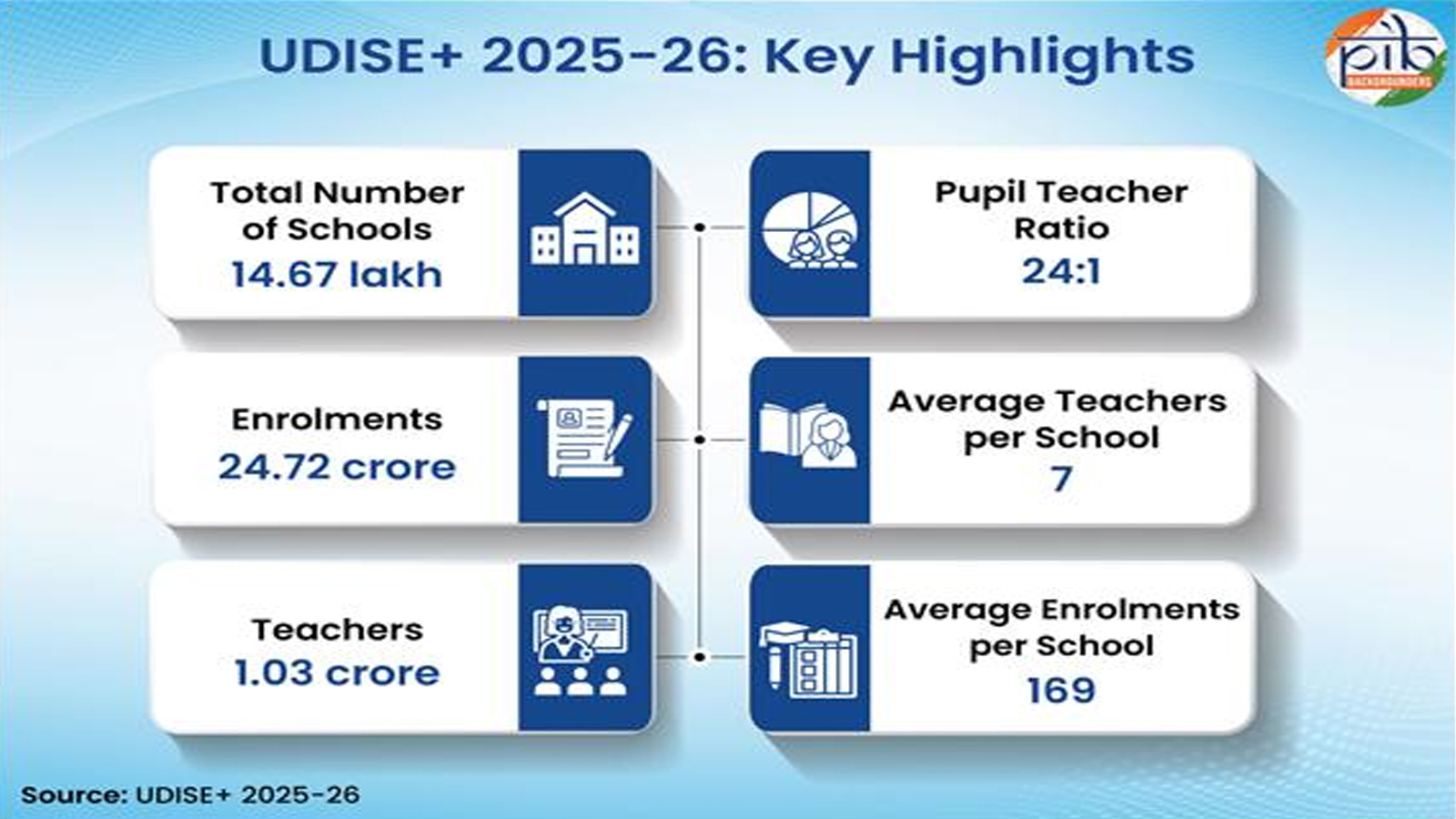
The Department of School Education and Literacy (DoSE&L) released the UDISE 2025–26 Report, providing comprehensive data on India’s school education system. It covers 14.67 lakh schools, 1.03 crore teachers and 24.72 crore students.
UDISE (Unified District Information System for Education Plus) is a major data platform for monitoring school education and supports evidence-based planning, resource allocation and implementation of the National Education Policy (NEP) 2020.
Key Findings
1. Teacher availability has improved:The overall Pupil–Teacher Ratio (PTR) is 24:1, within the NEP 2020 benchmark of 30:1. PTR is 10:1 at the Foundational stage and 21:1 at the Secondary stage.
2. Enrolment and retention:The Gross Enrolment Ratio (GER) is 89.6% at the Middle stage and 71.7% at the Secondary stage, showing wider access but continued scope for improving participation at higher levels.
- Retention rates are 98.5% at Foundational, 91.1% at Preparatory, 83.7% at Middle and 51.9% at Secondary level. The transition rate to Secondary education is 88.3%.
- Dropout rates have declined to 1.8% at Preparatory and 7% at Secondary level, although the Middle-stage dropout rate marginally increased to 3.6%.
3. Better utilisation of school resources:The number of single-teacher schools declined by about 3% to 1,00,843, while zero-enrolment schools fell by 29% to 5,663.
4. Gender and social inclusion:Girls account for 48.4% of total enrolment, while women constitute 54.9% of teachers. SC and ST students together represent 27.7% of enrolment, indicating significant participation of historically disadvantaged groups.
5. Infrastructure and digital connectivity:
- Electricity: 95% schools
- Safe drinking water: 99.5%
- Girls' toilets: 98.5%
- Libraries: 90.5%
- Computer access: 69.9%
- Internet connectivity: 67.4%
Significance
UDISE provides granular, school-level data that can help identify regional and stage-wise gaps, improve resource allocation and monitor educational outcomes. The improvements in teacher availability, retention, gender participation, basic infrastructure and digital connectivity indicate progress towards more accessible, inclusive and technology-enabled school education.
Land Pooling Scheme
- 27 May 2026
In News:
Rajasthan has announced its first-ever Land Pooling Scheme, signalling a shift towards more participatory methods of land assembly for infrastructure, urban development, roads and public utilities. The move is significant because land acquisition has long been one of the biggest obstacles to infrastructure development in India, often resulting in delays, litigation and social resistance.
What is Land Pooling?
Land pooling is a voluntary mechanism under which a group of landowners surrender their land to a development authority for planned urban development. The authority develops infrastructure such as roads, drainage systems, water supply networks, public spaces and social amenities. After development, a portion of the land is retained for public purposes, while the remaining land is returned to the original owners as serviced plots.
Unlike conventional land acquisition, where ownership is permanently transferred to the government in exchange for compensation, land pooling allows owners to remain stakeholders in the development process. Although they receive a smaller parcel of land, its value increases substantially because of the infrastructure created around it.
Typically, 25–45% of pooled land is used for public infrastructure, while 55–75% is returned to landowners as developed plots.
Why Has Land Acquisition Become Problematic?
Land acquisition in India is governed by the Right to Fair Compensation and Transparency in Land Acquisition, Rehabilitation and Resettlement (RFCTLARR) Act, 2013. The Act introduced important safeguards such as Social Impact Assessment (SIA), enhanced compensation, rehabilitation measures and consent requirements of 70% for PPP projects and 80% for private projects.
While these provisions strengthened landowner rights, they also increased project costs and timelines. Large infrastructure projects frequently face delays because of compensation disputes, legal challenges, rehabilitation concerns and resistance from affected communities. In many cases, governments are required to spend enormous sums on compensation before development can even begin.
How Does Land Pooling Address These Challenges?
Land pooling changes the relationship between the state and landowners from one of acquisition to partnership. Since participation is voluntary, the likelihood of prolonged litigation and social conflict is significantly reduced.
The model also lowers the financial burden on governments because authorities do not have to make large upfront compensation payments. Instead, infrastructure costs are gradually recovered through increased land values and development charges.
Another important advantage is that landowners are not displaced from their local communities. They continue to remain in the same area and benefit directly from urbanization. In many cases, the market value of the developed plot received after pooling far exceeds the value of the original undeveloped land.
Lessons from Existing Models
India already has successful examples of land pooling. The Gujarat Town Planning Scheme (TPS), implemented under the Gujarat Town Planning and Urban Development Act, 1976, has facilitated planned urban expansion across more than 1,000 sq km in cities such as Ahmedabad, Surat, Vadodara and Gandhinagar. Similarly, Guwahati adopted a modified version of land pooling by reducing land contribution requirements to 12–15%, making the scheme more acceptable to local stakeholders.
Challenges and the Way Forward
Despite its advantages, land pooling requires accurate land records, GIS-based mapping, transparent valuation mechanisms and strong planning institutions. Protection of tenants, agricultural labourers and other vulnerable groups remains an important concern. Delays in infrastructure creation can also undermine public confidence in the scheme.
Going forward, states need to accelerate land record digitization, establish transparent benefit-sharing frameworks and ensure timely project implementation. If effectively designed, land pooling can become a sustainable solution to India's growing infrastructure and urbanization needs.
Conclusion
Land pooling represents an important evolution in India's land governance framework. By replacing compulsory acquisition with voluntary participation, it reduces conflict, lowers fiscal costs and allows landowners to share the benefits of development. As India urbanizes rapidly, the model offers a balanced approach that combines infrastructure creation with social acceptance and economic inclusion.
India–Russia Relations
- 08 Dec 2025
In News:
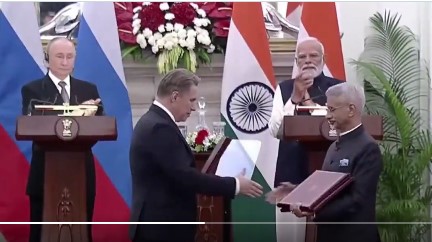
The 23rd India–Russia Annual Summit, held during President Vladimir Putin’s visit to India, reaffirmed the enduring strength of the “Special and Privileged Strategic Partnership” between the two countries. Marking 25 years of the 2000 Strategic Partnership Declaration, both sides signed 16 agreements across defence, trade, healthcare, education, culture, and energy, underscoring the resilience of bilateral ties amid global geopolitical turbulence.
Key Outcomes of the Summit
A major focus was on economic and trade cooperation. India and Russia adopted Programme 2030 to expand long-term strategic economic engagement and set an ambitious target of USD 100 billion in bilateral trade by 2030. Both sides agreed to fast-track negotiations on the proposed India–Eurasian Economic Union (EAEU) Free Trade Agreement. Given sanctions-related financial challenges, the two countries also discussed alternative payment mechanisms, while reaffirming energy as the central pillar of economic ties.
On connectivity, the leaders emphasized cooperation on strategic corridors such as the International North–South Transport Corridor (INSTC), the Chennai–Vladivostok maritime route, and the Northern Sea Route (NSR). These initiatives align with India’s efforts to improve access to Eurasia and Russia’s pivot towards Asia.
In the Russian Far East and Arctic, India reiterated its interest in expanding trade and investment in energy, mining, and maritime sectors. As an Observer in the Arctic Council, India signalled readiness to play a more active role in Arctic research and navigation cooperation.
In civil nuclear and space cooperation, Russia reaffirmed support for India’s nuclear energy expansion, including collaboration at the Kudankulam Nuclear Power Plant and across the nuclear fuel cycle. Space cooperation between ISRO and Roscosmos is set to deepen, particularly in human spaceflight, satellite navigation, and planetary exploration.
Defence cooperation remains a cornerstone. The partnership is gradually shifting from a traditional buyer–seller relationship to joint research, co-development, and co-production of defence equipment. Both sides reviewed progress under the Inter-Governmental Commission on Military and Military Technical Cooperation (IRIGC-M&MTC) and emphasized Make-in-India manufacturing of spare parts for Russian-origin platforms.
At the multilateral level, Russia reiterated support for India’s bid for a permanent seat in the UN Security Council and backed India’s BRICS Chairship in 2026. Cooperation in climate action, low-carbon technologies, and implementation of Article 6 of the Paris Agreement was also highlighted. Both countries reaffirmed a strong commitment to counter-terrorism.
Broader Pillars of Cooperation
Bilateral trade reached USD 68.7 billion in FY 2024–25, largely driven by India’s energy imports. Defence remains a major pillar, with cooperation on systems such as the S-400, BrahMos missile, and Su-30MKI aircraft. Science and technology ties include Gaganyaan astronaut training and the 2021 innovation roadmap. Cultural and educational exchanges are growing, with nearly 20,000 Indian students studying in Russia.
Challenges and Way Forward
Despite strong ties, challenges persist. Defence supply delays due to the Ukraine conflict have affected timelines, requiring India to strengthen indigenous production and joint spares manufacturing. The trade relationship is heavily skewed in Russia’s favour, making diversification of Indian exports through the EAEU FTA crucial. Western sanctions have complicated payment systems, necessitating the use of rupee-based trade settlements and alternative banking channels. Russia’s growing proximity to China also reduces its strategic neutrality, compelling India to balance ties through deeper engagement with Europe, Central Asia, and the Indo-Pacific. Concerns over Indian nationals recruited into the Russian military highlight the need for stronger migrant protection mechanisms.
Conclusion
India–Russia ties remain strategically significant, especially in defence, energy, and connectivity. However, the relationship is evolving toward broader economic, technological, and regional cooperation. Managing geopolitical pressures, diversifying trade, and strengthening financial arrangements will be key to sustaining this long-standing partnership in a rapidly changing global order.
India’s Humanitarian Assistance and Disaster Relief (HADR) & Soft Diplomacy
- 09 Sep 2025
Introduction
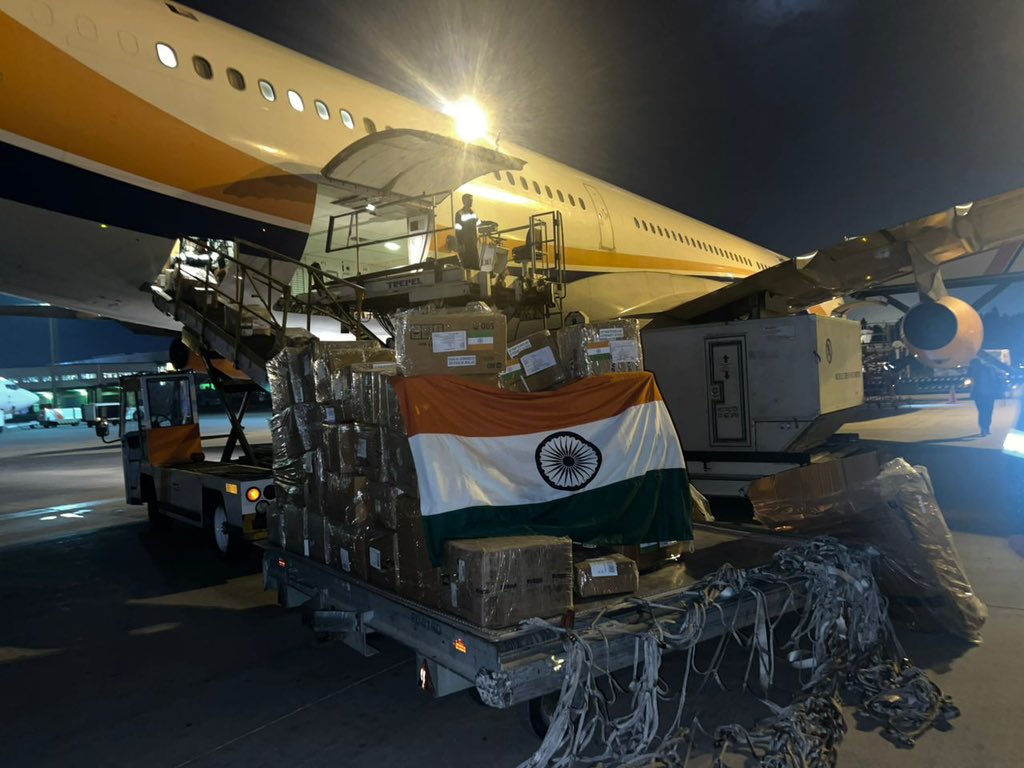
Humanitarian Assistance and Disaster Relief (HADR) has emerged as a cornerstone of India’s foreign policy and regional engagement. Rooted in the ethos of “VasudhaivaKutumbakam” (the world is one family), India has actively extended aid during natural disasters, reflecting both compassion and strategic foresight. The recent dispatch of 21 tonnes of relief material to Afghanistan after the devastating 6.0-magnitude earthquake, which killed over 1,400 people, underlines India’s commitment to humanitarian outreach and its role as a responsible global actor.
Understanding HADR and Soft Diplomacy
- HADR refers to India’s coordinated relief and rescue operations in disaster-hit regions, at home and abroad. It includes the supply of food, medicines, shelter, sanitation, and technical support.
- Soft Diplomacy implies the use of non-coercive instruments—humanitarian aid, cultural goodwill, and capacity-building initiatives—to enhance India’s global influence and strengthen bilateral trust.
Together, HADR and soft diplomacy enable India to project power through empathy rather than force.
Key Features of India’s HADR Approach
- Rapid Response: The Indian Air Force and Navy ensure swift deployment of relief materials and evacuation missions. For instance, the IAF’s strategic airlift capabilities enable timely supply drops in inaccessible regions.
- Inclusive Relief: Aid packages typically include medicines, food, water, tents, blankets, and water purifiers, focusing on essential survival needs.
- Neutral Assistance: India provides aid without attaching political preconditions, strengthening credibility and neutrality.
- Global Footprint: Beyond neighbours, India has extended assistance to Africa, Pacific Island states, and West Asia, thereby widening its humanitarian outreach.
- Institutional Mechanisms: Agencies like NDMA, NDRF, IAF, Indian Navy, and the Ministry of External Affairs ensure coordination for effective large-scale responses.
Strategic Importance of HADR
- Regional Goodwill: India has earned the reputation of being the “first responder” in South Asia and the Indian Ocean Region. Operations during the Nepal earthquake (2015), Sri Lanka floods, and Maldives water crisis (2014) highlight this proactive role.
- Trust-Building: Humanitarian gestures strengthen bilateral ties, particularly with vulnerable neighbours such as Afghanistan, Nepal, Sri Lanka, and the Maldives.
- Soft Power Projection: Such assistance reinforces India’s image as a responsible rising power committed to collective security and humanitarian values.
- Security Dimension: Active engagement through HADR enhances maritime security partnerships and counters external influences in the region, particularly China’s growing footprint in the Indian Ocean.
Contemporary Relevance
In a world marked by climate change, extreme weather events, and fragile states, the frequency of humanitarian crises is increasing. India’s HADR capacity demonstrates both moral leadership and strategic autonomy. For example, during the COVID-19 pandemic, India’s “Vaccine Maitri” initiative delivered vaccines to over 90 countries, merging humanitarianism with diplomacy.
Furthermore, India’s active participation in multilateral frameworks like BIMSTEC, IORA, and QUAD’s disaster response initiatives showcases its evolving role in shaping global disaster governance.
Challenges
- Logistical hurdles in conflict zones like Afghanistan.
- Resource constraints given India’s vast domestic vulnerabilities.
- The need for greater coordination between civilian and defence agencies.
Conclusion
India’s HADR efforts, anchored in soft diplomacy, reflect a balance of humanitarian compassion and strategic pragmatism. By acting as a credible first responder, India not only saves lives but also nurtures trust, stability, and regional cooperation. In the long run, strengthening institutional mechanisms, enhancing maritime capacity, and integrating climate resilience will further consolidate India’s role as a humanitarian power in a volatile world.
Medical Tourism in India
- 10 Aug 2025
In News:
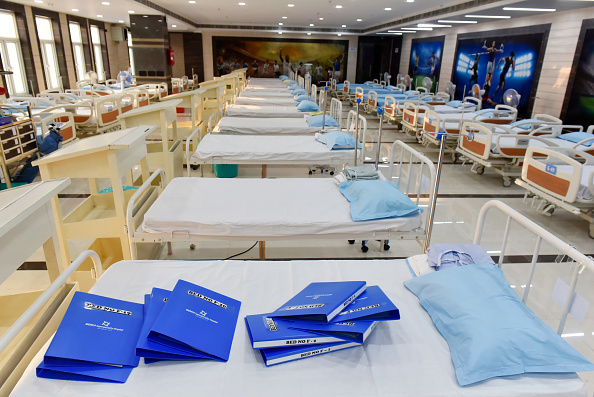
India has emerged as one of the leading destinations for medical tourism, attracting foreign patients due to its cost-effective treatments, advanced healthcare infrastructure, and traditional wellness systems. The surge in foreign tourist arrivals (FTAs) for medical purposes highlights the sector’s growing role in India’s economy, diplomacy, and healthcare landscape.
Current Trends in Medical Tourism
- Between January–April 2025, India recorded 1,31,856 medical FTAs, accounting for 4.1% of total FTAs in this period.
- In 2024, medical FTAs stood at 6.44 lakh, a sharp increase from 1.82 lakh in 2020, indicating robust growth despite global pandemic disruptions.
- Top source countries (2024):
- Bangladesh – 4.82 lakh arrivals (largest contributor).
- Iraq – 32,008 arrivals.
- Somalia – 11,717 arrivals.
- Oman – 10,431 arrivals.
- Uzbekistan – 8,921 arrivals.
This surge reflects both India’s healthcare competitiveness and rising global demand for affordable, high-quality treatment.
Why India attracts Medical Tourists
- Affordability & Quality – Advanced medical procedures at a fraction of Western costs.
- Specialised Expertise – Strong presence in cardiology, orthopaedics, oncology, organ transplants, and IVF.
- Traditional Wellness – Ayurveda, Yoga, and naturopathy complement allopathic care, attracting wellness tourists.
- Regulatory Support – Extension of e-Medical visa and attendant visa facilities to 171 countries, easing travel for patients.
- Integrated Ecosystem – Hospitals, facilitators, hotels, airlines, and regulatory bodies work together under the ‘Heal in India’ initiative.
Government Initiatives
- National Efforts:
- ‘Heal in India’ campaign (Ministry of Health & Family Welfare) promoting India as a global healthcare hub.
- Encouraging public-private partnerships (PPP) to expand hospital capacity, improve service delivery, and enhance medical infrastructure.
- Branding and showcasing India’s medical expertise at international platforms.
- Visa Facilitation:E-medical visa/e-medical attendant visa for 171 countries to smoothen entry of international patients.
- State-level Initiatives (Case Study: Gujarat):
- Registration of wellness retreats on official tourism websites.
- Participation in global health & wellness exhibitions, seminars, and conferences.
- Familiarisation trips (FAM) for industry stakeholders to promote wellness centres.
- Training paramedical staff to improve quality of care for foreign patients.
- Use of social media and global outreach to project Gujarat’s health infrastructure and wellness potential.
Economic & Strategic Significance
- Foreign Exchange Earnings – Growing inflows from high-value medical travellers.
- Employment Generation – Creation of jobs in healthcare, tourism, and allied sectors.
- Soft Power & Health Diplomacy – India’s outreach in medical care strengthens its global image and fosters bilateral goodwill, especially with neighbouring and developing countries.
- Regional Leadership – With Bangladesh, Iraq, and African nations as major contributors, medical tourism strengthens India’s role as a regional healthcare hub.
Challenges
- Uneven distribution of healthcare infrastructure across states.
- Regulatory concerns regarding quality assurance in smaller hospitals and clinics.
- High dependence on a few source countries.
- Competition from emerging medical tourism destinations like Thailand, Singapore, and Turkey.
Way Forward
- Standardisation& Accreditation – Enforcing global quality standards across hospitals to build trust.
- Digital Integration – Expanding telemedicine, AI-based diagnostics, and digital health records for seamless cross-border care.
- Wellness Tourism Synergy – Combining allopathic treatments with Ayush-based wellness offerings.
- Infrastructure Development – Strengthening airports, medical hubs, and hospitality sectors near healthcare clusters.
- Diversification of Source Countries – Targeting Africa, Middle East, and Latin America for expansion.
Conclusion
India’s medical tourism sector is a sunrise industry, merging healthcare excellence with tourism potential. With over 1.3 lakh medical FTAs in early 2025 alone, the sector underscores India’s strength as a global healthcare destination. By addressing challenges and scaling up initiatives like ‘Heal in India’, India can transform medical tourism into a key pillar of economic growth, soft power, and international diplomacy.
Suposhit Gram Panchayat Abhiyan
- 26 Dec 2024
In News:
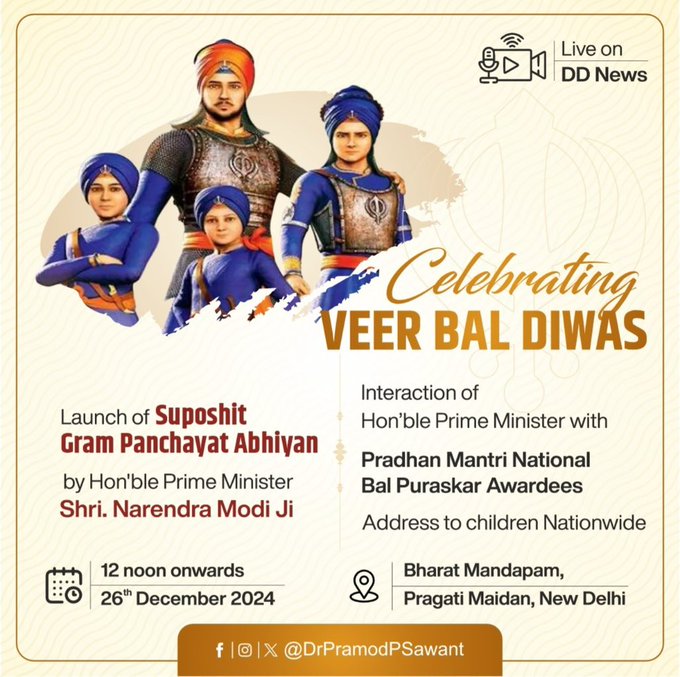
On December 26, 2024, Prime Minister Narendra Modi presided over the Veer Bal Diwas celebrations at the Bharat Mandap in New Delhi. This annual event commemorates the martyrdom of the sons of Sri Guru Gobind Singh Ji and highlights the importance of nurturing the next generation. During the occasion, PM Modi also launched the ‘Suposhit Gram Panchayat Abhiyan,’ an initiative aimed at improving nutrition and well-being in rural India.
Veer Bal Diwas: Commemorating Sacrifice and Courage
Veer Bal Diwas was declared on January 9, 2022, by PM Modi to honor the sacrifices made by the young sons of Guru Gobind Singh Ji — Sahibzada Baba Zorawar Singh and Baba Fateh Singh — who were martyred in 1704. During the Mughal-Sikh battles, these two brave boys were captured and offered safety if they converted to Islam, which they refused. Their refusal to abandon their faith led to their brutal martyrdom by being bricked alive in the walls of a fort in Sirhind (Punjab). This act of resilience and unwavering faith is a cornerstone of Sikh history and culture.
Veer Bal Diwas not only commemorates their sacrifice but also serves as a reminder of the strength, faith, and courage demonstrated by all four of Guru Gobind Singh Ji’s sons. It underscores the Sikh ideals of sacrifice, courage, and dedication to faith.
Suposhit Gram Panchayat Abhiyan: Addressing Malnutrition in Rural Areas
On the same day, PM Modi launched the 'Suposhit Gram Panchayat Abhiyan', a nationwide mission focused on improving nutritional outcomes in rural areas. The initiative aims to enhance nutrition-related infrastructure and promote active community participation in tackling malnutrition. By encouraging village-level involvement, the program seeks to ensure that nutrition becomes a community-driven effort.
Key Objectives
- Malnutrition Eradication: The initiative focuses on combating malnutrition in rural communities by improving access to better nutrition.
- Healthy Competition: Encourages competition among villages to adopt best practices for nutrition and overall health.
- Sustainable Development: Promotes long-term, sustainable health practices that align with India's broader goals, such as the Poshan Abhiyan and the Sustainable Development Goals (SDGs).
The program aims to make rural populations active participants in improving their own well-being, strengthening community-driven initiatives for better nutritional outcomes.
Engaging Children and Fostering Patriotism
In line with Veer Bal Diwas, various events were organized to engage young minds across the nation. These initiatives not only raised awareness about the significance of the day but also fostered a culture of courage, dedication, and patriotism.
- Online Competitions: Interactive quizzes were conducted through platforms like MyGov and MyBharat to encourage participation and understanding of Veer Bal Diwas.
- Creative Activities: Schools, Child Care Institutions, and Anganwadi centers organized storytelling, creative writing, and poster-making contests to engage children and promote nationalistic values.
Honoring Young Achievers: PMRBP Awardees
The event also saw the presence of the recipients of the Pradhan Mantri Rashtriya Bal Puraskar (PMRBP), which recognizes children who have demonstrated exceptional abilities in various fields. The awardees, 17 in total, were presented with medals, certificates, and citation booklets by President Droupadi Murmu. These young achievers served as a source of inspiration, reinforcing the theme of celebrating youth potential on Veer Bal Diwas.
Conclusion: Strengthening the Foundation of India’s Future
The celebrations of Veer Bal Diwas and the launch of the Suposhit Gram Panchayat Abhiyan highlight the government’s commitment to nurturing India’s future by investing in its children and rural communities. By honoring historical sacrifices and fostering community-driven health and nutrition initiatives, these efforts contribute to building a resilient, prosperous India that can meet global challenges head-on. The twin focus on children’s development and rural well-being underscores India’s vision of a healthier, more inclusive society, aligned with national and global development goals.