
Google’s $15 Billion AI Data Centre in Andhra Pradesh
- 18 Oct 2025
In News:
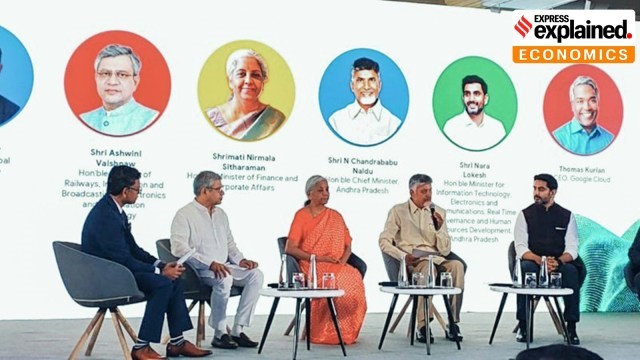
Google’s announcement of a USD 15-billion investment to establish an Artificial Intelligence (AI) data centre in Visakhapatnam marks a transformational moment in India’s digital infrastructure landscape. The initiative, the largest single investment by Google in India, comes amid a geo-economic context of recalibrating India-US relations and the government’s emphasis on technological self-reliance and swadeshi digital systems. The project positions India as an emerging hub in global AI capability and computing power.
Why AI Data Centres Matter
AI-focused data centres differ fundamentally from conventional facilities. While traditional data centres are built around CPU-based servers to support cloud storage, websites, and enterprise applications, AI data centres rely on high-performance GPUs to handle data-heavy and compute-intensive workloads such as generative AI, advanced analytics, image/video processing, and deep-learning models. This makes them significantly more power-intensive and infrastructure-demanding, requiring robust energy supply and advanced cooling systems.
According to estimates cited by Google, the Visakhapatnam AI hub is expected to add at least USD 15 billion to the US GDP between 2026 and 2030 through increased AI adoption and cloud-driven activity, demonstrating the cross-border economic impact of such investments.
Partnerships and Green Infrastructure
The facility is being developed in partnership with AdaniConneX and Airtel, leveraging the same backbone used for Google’s global platforms like Search, YouTube, and Workspace. The project includes building a major subsea cable landing station, linking eastern India to Google’s expansive global cable network, enhancing international data routes and reducing latency.
A key dimension of the partnership lies in sustainable power and energy independence. AdaniConneX, a joint venture between Adani Enterprises and EdgeConneX, will provide 100% clean energy, supported by new transmission lines, renewable generation, and energy storage facilities in Andhra Pradesh. This aligns with India’s climate commitments and enhances grid resilience.
Economic Impact and Capacity Expansion
India’s data centre industry, currently valued at ~USD 10 billion with USD 1.2 billion in FY24 revenue, is projected to add 795 MW of capacity by 2027 — reaching 1.8 GW. Google’s project alone is expected to generate nearly 1.88 lakh direct and indirect jobs, strengthening regional development and high-skilled employment.
However, high capital costs and limited job intensity remain policy concerns. Approximately 40% of capex in data centres goes towards electrical systems, and 65% of operating costs are attributed to electricity, with ~?60–70 crore required per MW of capacity. This necessitates a careful assessment of incentives and long-term strategic benefits.
Energy Security and the Nuclear Option
The International Energy Agency (IEA) predicts that global data-centre electricity demand may double by 2026, raising questions around sustainability. While renewable energy remains the mainstay, its intermittency has prompted policy consideration of nuclear energy as a round-the-clock clean power source — a trend already visible in the United States and now emerging in India’s energy strategy.
Conclusion
Google’s AI hub in Visakhapatnam represents a strategic convergence of digital infrastructure, clean-energy innovation, and global technological cooperation. For India, it underscores the dual challenge of expanding digital capability while ensuring energy security and environmental sustainability. The success of this initiative will influence India’s journey toward becoming a global digital superpower underpinned by resilient, sovereign, and sustainable compute ecosystems.
Mana Mitra: Andhra Pradesh’s WhatsApp Governance Model

- 24 Sep 2025
In News:
- The Central Government, through the Department of Administrative Reforms and Public Grievances (DARPG), has decided to study and replicate Andhra Pradesh’s “WhatsApp Governance Model”, recognized as a national best practice in e-governance.
- The announcement came during the 28th National Conference on e-Governance 2025, held in Visakhapatnam on the theme “Viksit Bharat: Civil Service and Digital Transformation.”
About Mana Mitra
- Mana Mitra, launched by the Andhra Pradesh government in January 2025, is India’s first WhatsApp-based governance platform.
- It integrates 36 departments and provides 738 citizen services through a single WhatsApp number — 9552300009 — ensuring accessibility, efficiency, and transparency in public service delivery.
Objectives
- Ease of Access: Deliver services through WhatsApp, a widely used platform, reducing citizens’ dependence on physical offices.
- Transparency & Trust: Digital certificates are issued with QR-coded verification, minimizing fraud and fake documentation.
- Inclusivity: Brings governance to the mobile phones of rural and remote citizens, fostering last-mile digital inclusion.
How It Works
- Single-Number Access: Citizens initiate a chat by sending “Hi” on WhatsApp.
- Menu-Driven Services: A chatbot guides users through departments and available services—education, revenue, endowments, RTC, tourism, and health.
- Instant Document Delivery: Documents such as income and caste certificates, hall tickets, and tax receipts are generated digitally with verifiable QR codes.
- Real-Time Dashboard: Tracks service delivery, ensuring accountability and performance monitoring.
- Next-Gen Tech Integration: Future phases will use AI chatbots, voice-based assistance, and blockchain authentication for secure transactions.
Key Features
- Wide Coverage: 738 services across 36 departments.
- Security: Built-in encryption and QR verification to prevent misuse.
- Partnership with Meta: Ensures robust backend infrastructure and global-grade security.
- Scalability: Phase-II aims to include AI, voice, and real-time grievance redressal systems.
Significance and Impacts
- Citizen-Centric Governance: Empowers citizens by providing services at their fingertips, in line with the vision of Minimum Government, Maximum Governance.
- Administrative Efficiency: Reduces paperwork, manual processing, and delays through automation.
- Cost and Time Savings: Citizens save travel and administrative costs; departments save on manpower and logistics.
- Digital Inclusion: Leverages WhatsApp’s nearly 500 million Indian users, ensuring access even in areas with limited digital literacy.
- Model for Replication: DARPG recognized it as a national model to be documented and replicated across all states.
Challenges
- Digital Divide: Connectivity issues in remote and tribal regions can hinder equitable access.
- Cybersecurity Threats: Phishing, fake accounts, or data breaches must be prevented through strong encryption and verification systems.
- Capacity Building: Frontline staff need training for effective digital grievance handling.
- Data Privacy: Must comply with the Digital Personal Data Protection Act (DPDPA) 2023.
- Scalability and Reliability: Systems must withstand heavy user loads without technical failures.
Way Forward
- AI & Voice Integration: Enable predictive service delivery and multilingual assistance.
- Strengthen Cybersecurity: Introduce two-factor authentication and blockchain-based certification.
- Enhance Digital Literacy: Awareness campaigns targeting rural, elderly, and marginalized populations.
- Institutionalization: Provide legislative backing to make WhatsApp governance legally accountable.
- Nationwide Replication: Integrate with platforms like DigiLocker, UPI, and CoWIN to create a unified digital service ecosystem.
The 28th National Conference on e-Governance 2025
- Venue: Visakhapatnam, Andhra Pradesh.
- Organizers: DARPG and the Ministry of Electronics & IT in collaboration with the AP Government.
- Theme:Viksit Bharat: Civil Service and Digital Transformation.
- Participants: Delegates from 28 States and 8 Union Territories, including 70 speakers.
- Focus Areas:
- AI for Viksit Bharat: Driving inclusive and scalable solutions.
- Cybersecurity and digital sovereignty in e-governance.
- Gram Panchayat-level innovations and agri-stack development.
- Role of subsea cables and AI data centers in digital infrastructure.
Conclusion
Mana Mitra represents a transformative step in India’s digital governance journey, bridging citizens and the state through a simple yet powerful medium — WhatsApp. By ensuring transparency, efficiency, and inclusivity, it exemplifies how technology can democratize governance. If successfully replicated nationwide, this model could become a cornerstone of Viksit Bharat 2047, bringing governance truly “to the people’s fingertips.”
Andhra Pradesh's Natural Farming Model
- 18 Nov 2024
In News:
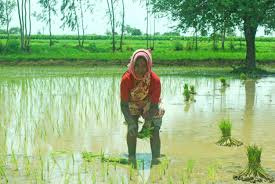
Andhra Pradesh's (AP) natural farming model presents a transformative opportunity to reshape the state’s agricultural landscape by 2050. An analysis by the Food and Agriculture Organization (FAO), in collaboration with the AP government, reveals how scaling natural farming could employ more farmers, increase incomes, and foster sustainable agricultural practices, potentially surpassing the benefits of conventional industrial agriculture.
AgroEco2050: Exploring Two Agricultural Futures
The AgroEco2050 initiative aimed to envision two possible futures for Andhra Pradesh’s agricultural systems by 2050:
- Industrial Agriculture Path: Focusing on intensification of conventional farming, relying heavily on chemicals, machinery, and monocultures.
- Natural Farming Path: Expanding agroecological practices, relying on regenerative, chemical-free farming methods to create more jobs, better livelihoods, and improve the environment.
The study compared these pathways, analyzing their impacts on employment, income, food production, biodiversity, and land use.
Key Findings: Natural Farming’s Impact on Employment and Income
- Employment Growth
- By 2050, natural farming would employ twice as many farmers as industrial agriculture: 10 million compared to 5 million.
- Unemployment in natural farming would decrease to 7%, in stark contrast to a projected 30% unemployment rate in the industrial agriculture scenario.
- Farmer Income
- Natural farming is expected to be more profitable for farmers due to lower input costs (seeds, fertilizers, machinery) and higher market prices for high-quality produce.
- The income gap between farmers and non-farmers, which stood at 62% in 2019, would decrease to 22% under natural farming by 2050, a sharp improvement compared to the 47% gap predicted under industrial agriculture.
What is Natural Farming?
Natural farming is an ecological, chemical-free farming system that emphasizes the use of locally available resources. Key practices include:
- Biodiversity-based pest management
- On-farm biomass recycling (e.g., mulching)
- Indigenous techniques like using cow dung and urine for soil fertility.
Globally recognized as a form of regenerative agriculture, it offers a sustainable alternative to industrial agriculture by sequestering carbon and restoring soil health.
Global Adoption
States like Andhra Pradesh, Karnataka, Himachal Pradesh, and others are already adopting natural farming. While still evolving, its acceptance among farmers is steadily growing.
Zero Budget Natural Farming (ZBNF) in Andhra Pradesh
Origin and Growth
- In 2016, Andhra Pradesh launched the Zero Budget Natural Farming (ZBNF) initiative to offer a sustainable alternative to capital-intensive agriculture.
- This program, implemented by RythuSadhikaraSamstha, targets covering 6 million farmers across 6 million hectares.
National Recognition
The ZBNF approach gained national attention when it was featured in the 2019 Union Budget, aimed at doubling farmers' incomes by 2022. The central government now promotes this model under the Paramparagat Krishi Vikas Yojana (PKVY).
Challenges in Scaling Natural Farming
- Farmer Training and Support
- Farmers need ongoing education and support to transition effectively to natural farming. Current training systems often fail to address the full scope of their needs.
- Certification Barriers
- The certification process for organic farming, including Participatory Guarantee Systems (PGS) and third-party certifications, is complex and costly, presenting a barrier for small-scale farmers.
- Marketing and Procurement Challenges
- There is a lack of effective marketing systems for organic products, which hampers the ability of farmers to sell their produce at fair prices.
- Without strong procurement or buy-back systems, farmers may struggle to find markets for their products.
- Policy and Funding Gaps
- Organic and natural farming programs still receive minimal funding compared to subsidies for chemical fertilizers, impeding large-scale adoption.
- Slow state-level implementation and a continued reliance on chemical inputs also delay the widespread shift to natural farming.
Moving Forward
- Scientific Research on Yields
- To address concerns about lower yields for staple crops, more scientific research is needed to assess the long-term viability of natural farming, especially for crops like wheat and rice, which are crucial for India’s food security.
- Localized Adoption
- Natural farming may be best suited for non-staple crops or localized farming, balancing sustainability with the need for food security.
- Risk Mitigation for Food Security
- Careful evaluation of natural farming’s impact on staple crop yields is necessary to avoid the food security risks witnessed in countries like Sri Lanka, where a sudden shift to organic farming led to reduced yields and increased prices.
Conclusion
The Andhra Pradesh natural farming model offers a promising alternative to industrial agriculture, with the potential to create jobs, improve farmers' incomes, and promote environmental sustainability. However, for this vision to become a reality, significant efforts must be made to address challenges related to training, certification, marketing, and funding. With continued research, policy support, and community involvement, natural farming can play a crucial role in feeding the future and promoting a more sustainable agricultural system.