
National Family Health Survey–6 (NFHS-6)
- 01 Jun 2026
In News:
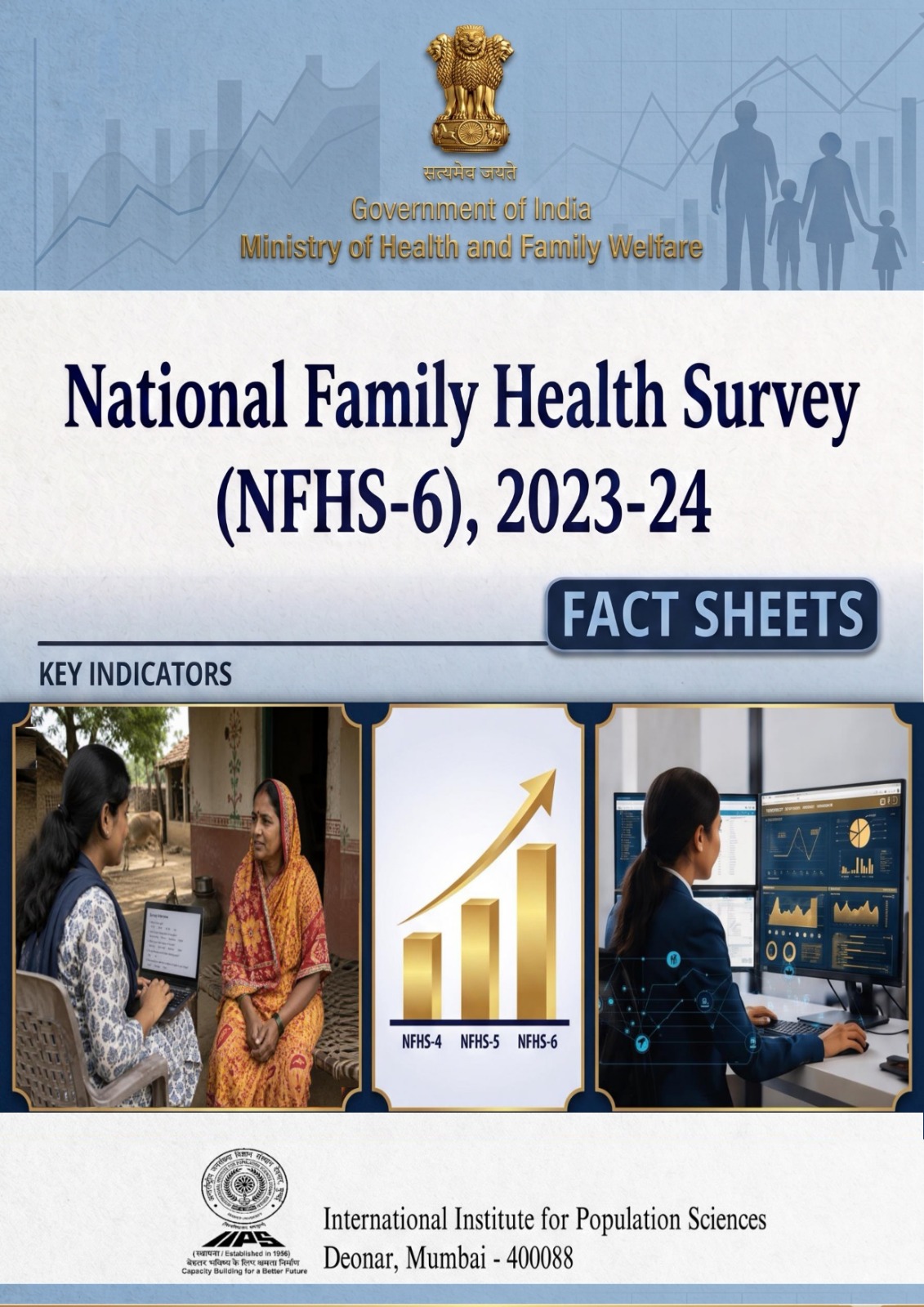
The Ministry of Health and Family Welfare (MoHFW) has released the National Family Health Survey–6 (NFHS-6) (2023–24), conducted by the International Institute for Population Sciences (IIPS), Mumbai across 715 districts covering nearly 6.79 lakh households. As India’s most comprehensive health and demographic survey, NFHS-6 provides district-level evidence for policy formulation, monitoring of welfare schemes, and tracking progress towards the Sustainable Development Goals (SDGs).
Major Gains Recorded
Maternal and Child Health
India has made significant progress towards safe motherhood and improved healthcare access:
- Institutional deliveries increased from 88.6% to 90.6%.
- Antenatal Care (ANC) coverage rose from 92.6% to 95.9%.
- Women receiving ANC in the first trimester increased from 70% to 76.2%.
- Mothers receiving at least four ANC visits increased from 58.5% to 65.2%.
- Skilled birth attendance improved from 89.4% to 91.3%.
- Postnatal care within two days of delivery rose from 79.1% to 85.3%.
Child Nutrition and Immunisation
The survey reflects encouraging improvements in child health outcomes:
- Stunting declined from 35.5% to 29.3% (17% reduction).
- Severe wasting reduced from 7.7% to 5.2% (32% reduction).
- Children aged 6–8 months receiving complementary feeding increased from 45.9% to 59.5%.
- Full immunisation among children aged 12–23 months increased from 83.8% to 87.1%.
- Rotavirus vaccine coverage more than doubled from 36.4% to 85.4%.
- Coverage of the second dose of measles vaccine rose from 58.6% to 71.8%.
- 95.6% of vaccinations were administered through public health facilities, demonstrating strong public trust.
Family Planning and Financial Protection
- India’s Total Fertility Rate (TFR) remains stable at 2.0, below the replacement level of 2.1.
- Contraceptive Prevalence Rate (CPR) increased from 66.7% to 69.1%.
- Household health insurance coverage rose sharply from 41.0% to 60.2%, driven largely by Ayushman Bharat–PMJAY and related initiatives.
Women’s Empowerment
- Women who have ever used the internet increased from 33.3% to 64.3%.
- Women operating their own bank accounts increased from 78.6% to 89.0%.
- Women owning and using a mobile phone rose from 53.9% to 63.6%.
Key Challenges
Despite the progress, NFHS-6 highlights several emerging concerns:
- 12.9% of children aged 12–23 months are still not fully immunised.
- Only 37.8% of pregnant women consumed Iron-Folic Acid supplements for the recommended 180 days.
- Rising burden of Non-Communicable Diseases (NCDs) and lifestyle-related disorders.
- Growing dual burden of malnutrition, with persistent undernutrition coexisting alongside rising overweight and obesity among adults.
- Caesarean section deliveries increased sharply from 21.5% to 27.2%, requiring closer monitoring.
Government Initiatives Driving Progress
Key schemes contributing to these gains include Janani Suraksha Yojana (JSY), Janani Shishu Suraksha Karyakram (JSSK), Pradhan Mantri SurakshitMatritva Abhiyan (PMSMA), SUMAN, POSHAN Abhiyaan, Saksham Anganwadi and POSHAN 2.0, Universal ImmunisationProgramme, U-WIN, Mission Parivar Vikas, and Ayushman Bharat–PMJAY.
NFHS-6 presents a picture of accelerated improvements in maternal health, child nutrition, immunisation, women’s empowerment and financial protection, reaffirming India's progress towards SDGs and Universal Health Coverage. However, rising NCDs, obesity, incomplete immunisation, and nutritional challenges indicate that future health policy must move beyond access and focus on preventive healthcare, behavioural change, nutrition security, and quality health outcomes.