
Higher Education Commission of India (HECI) Bill 2025
- 26 Nov 2025
In News:
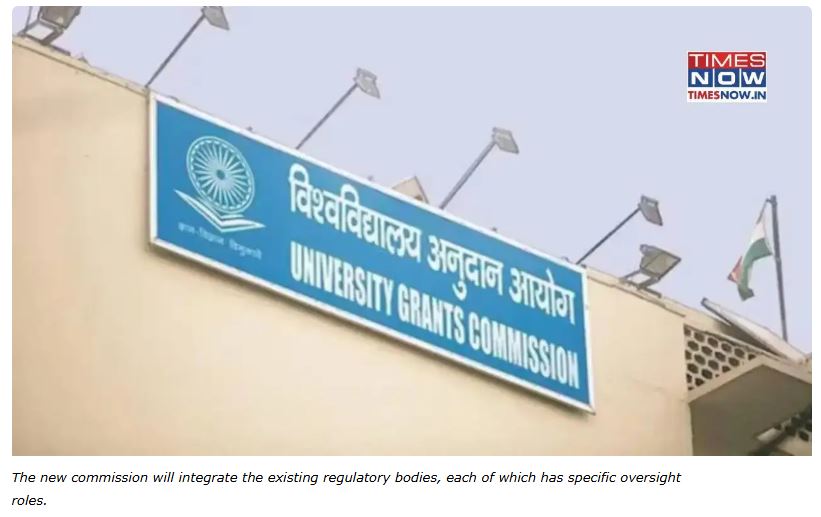
The Union Government is set to table the Higher Education Commission of India (HECI) Bill, 2025 in Parliament, nearly five years after the National Education Policy (NEP 2020) recommended a single, integrated regulator for higher education.
What is the HECI Bill, 2025?
- Nature: A draft legislation to establish a single regulatory authority for higher education in India.
- Coverage: All higher education except medical and legal education.
- Core Change: Replaces the existing multi-regulator system led by University Grants Commission (UGC), All India Council for Technical Education (AICTE) and National Council for Teacher Education (NCTE).
Objectives of the Bill
- Streamline and simplify higher education regulation.
- Remove fragmentation, overlap, and conflicts of interest.
- Implement NEP 2020’s vision of a transparent, outcome-based, and less intrusive regulatory architecture.
- Promote institutional autonomy and academic freedom.
Key Features of the HECI Framework
1. Single Regulator Model
- HECI will subsume the regulatory roles of UGC, AICTE, and NCTE.
- Medical and legal education will continue to be regulated separately.
2. Four-Vertical Structure (as envisaged in NEP 2020)
- National Higher Education Regulatory Council (NHERC): Regulation and compliance for institutions (excluding medical & legal).
- National Accreditation Council (NAC): Accreditation and quality benchmarking.
- General Education Council (GEC): Academic standards, learning outcomes, and curricular frameworks.
- Higher Education Grants Council (HEGC): Funding-related functions (with major financial control likely retained by the Ministry).
3. Functional Separation
- Clear separation of:
- Regulation
- Accreditation
- Funding
- Academic standard-setting
- Intended to avoid concentration of power and conflicts of interest.
4. Independent, Expert-Driven Governance
- Each vertical to function as an autonomous professional body.
- HECI to act as a light, coordinating commission rather than a heavy regulator.
5. Reduced Regulatory Burden
- Addresses criticism of the current regime being bureaucratic and compliance-heavy.
- Aims to cut duplication, delays, and inconsistent rules across regulators.
6. Institutional Autonomy
- Encourages higher education institutions to become self-governing and academically independent.
- Accreditation outcomes linked with graded autonomy.
Significance of the HECI Bill, 2025
- Major Governance Reform: Ends decades of fragmented higher education regulation.
- Quality Enhancement: Focus on outcomes, accreditation, and professional standards.
- Ease of Doing Academia: Reduces regulatory overlap and administrative friction.
- NEP 2020 Implementation: Converts policy vision into a statutory framework.
Higher Education Commission of India (HECI)
- 21 Aug 2025
In News:
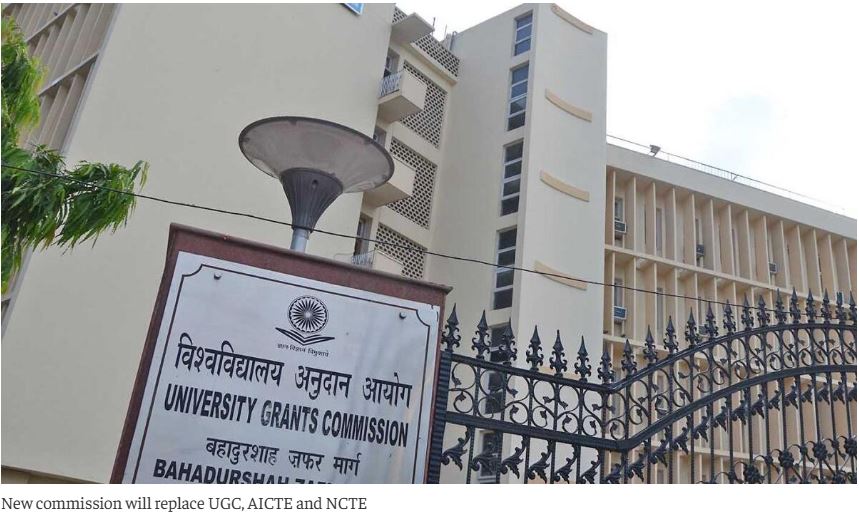
India’s higher education system is poised for its most significant transformation since independence with the establishment of the Higher Education Commission of India (HECI), a unified regulatory body that will replace the fragmented oversight of University Grants Commission (UGC), All India Council for Technical Education (AICTE), and National Council for Teacher Education (NCTE).
Background & Genesis
- The HECI is a proposed unified regulator intended to replace the existing oversight bodies: UGC, AICTE, and NCTE—tasked with regulating non-technical, technical, and teacher-education domains respectively.
- The concept originates from NEP 2020, which advocates for a "light but tight" regulatory framework governed by one umbrella institution with four independent verticals.
- Originally floated in a 2018 draft bill, the idea regained momentum in 2021 and is currently under drafting, with status updates as recent as July–August 2025.
Objectives & Rationale
- Streamline governance: HECI aims to eliminate overlapping jurisdictions, reduce bureaucratic delays, and improve accountability across higher education institutions.
- Enhance autonomy and innovation: Under NEP 2020’s vision, it seeks to foster institutional independence coupled with data-driven oversight.
- Align with global best practices: The vertical structure (regulation, accreditation, funding, standards) mirrors international examples like the UK's Office for Students and Australia’s TEQSA.
Structural Framework: Four Vertical Councils
As per NEP 2020, HECI will function through four independent verticals:
- National Higher Education Regulatory Council (NHERC): Responsible for regulatory oversight, excluding medical and legal education.
- National Accreditation Council (NAC): Acts as a meta-accrediting body, setting phased benchmarks and ensuring quality across institutions.
- Higher Education Grants Council (HEGC): Will manage funding based on transparent, performance-linked criteria, replacing UGC’s funding role.
- General Education Council (GEC): Tasked with developing the National Higher Education Qualification Framework (NHEQF), defining graduate learning outcomes. It will subsume the NCTE and liaise with other professional standard-setting bodies.
Some sources also mention integration of accreditation entities such as NAAC and NBA into HECI’s accreditation wing, adopting peer-review models.
Legislative Journey & Current Status
- The HECI bill is being prepared following NEP 2020, specifically underwritten by Minister Sukanta Majumdar in July 2025. A Cabinet note is anticipated before formal introduction.
- Finalisation is pending, with no clear date as of mid-2025.
Expected Benefits
- Simplified administration—one regulator instead of multiple authorities.
- Improved transparency and efficiency, eliminating redundancy.
- Promoting global standards, quality enhancements, and integration of interdisciplinary and digital learning.