
Lokpal of India
- 31 Oct 2025
In News:
The Lokpal of India, established under the Lokpal and Lokayuktas Act, 2013, was envisaged as an independent anti-corruption ombudsman capable of investigating complaints against high public officials, including the Prime Minister, Union Ministers, MPs and government officials.
Conceived in the backdrop of the 2011 anti-corruption movement, the institution began functioning meaningfully only in 2019, when the first Lokpal was constituted—marking a long-awaited step in strengthening mechanisms for integrity and transparency in governance.
Mandate and Powers
- The Lokpal is empowered to conduct inquiries and investigations under the Prevention of Corruption Act, 1988.
- Its jurisdiction extends to all public servants—Groups A to D—besides heads of government-funded institutions.
- It possesses quasi-judicial powers, including summoning witnesses, demanding documents, ordering asset freezes, and recommending prosecution.
- Crucially, it maintains supervisory authority over the CBI in cases referred by it, reinforcing independent and credible investigations.
- The Lokpal’s composition includes a Chairperson and up to eight members—half of them judicial. As of 2025, Justice A.M. Khanwilkar (retd.) serves as Chairperson, supported by a seven-member team. Members are appointed by the President upon the recommendation of a selection committee comprising the Prime Minister, Speaker of Lok Sabha, Leader of Opposition, Chief Justice of India, and an eminent jurist.
Performance Crisis and Data Trends
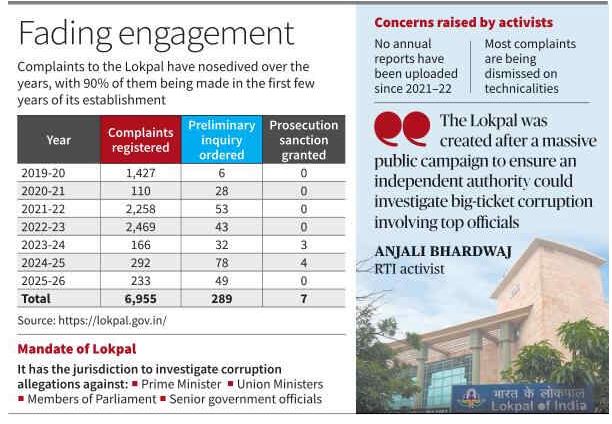
Despite its powerful mandate, the Lokpal’s performance has raised serious concerns. Since inception, it has received 6,955 complaints, yet only 289 preliminary inquiries have been ordered. Out of these, a mere seven cases have progressed to the prosecution stage—an alarming indicator of institutional underutilisation.
The declining public engagement is sharper still. Annual complaints peaked at 2,469 in 2022–23 but plummeted to 233 in 2025, suggesting fading public confidence. Nearly 90% of all complaints were received in its first four years (2019–2023), while the past three years recorded only 691 complaints combined.
Civil society groups have criticised the procedural rigidity of the Lokpal. Activists point out that many complaints are dismissed on technical grounds such as format errors, while substantive allegations remain unaddressed. Further, the Lokpal’s failure to upload annual reports since 2021–22 has generated questions about its transparency and accountability.
Institutional Weaknesses and Controversies
A major lacuna has been the delayed operationalisation of the prosecution wing, notified only in June 2025—twelve years after the enactment of the Lokpal Act—severely constraining its ability to pursue legal action. The credibility of the institution also came under public scrutiny when it issued a tender to procure seven BMW 330Li luxury cars for its Chairperson and members. Critics argue that an anti-corruption body must demonstrate fiscal restraint and ethical prudence in its own functioning.
Way Forward
Strengthening the Lokpal requires structural, procedural, and ethical reforms. A real-time digital dashboard should be created to enable public tracking of cases and reduce opacity. Complaint formats must be simplified to ensure accessibility for ordinary citizens. Institutional autonomy must be reinforced with adequate staffing for inquiry and prosecution wings. Annual reports should be mandatorily published and tabled in Parliament. Above all, Lokpal must cultivate public trust by adopting austerity and demonstrating moral credibility.
Conclusion
The Lokpal was created to be the custodian of public integrity—an independent safeguard against high-level corruption. However, its diminishing complaint inflow, administrative inertia, and controversies signal a crisis of legitimacy. Revitalising the institution through stronger transparency, greater accountability, and ethical restraint is essential if it is to fulfil its constitutional promise of clean and accountable governance.
Lokpal
- 26 Feb 2025
Context:
In February 2025, the Supreme Court of India stayed a controversial order issued by the Lokpal, which had attempted to bring High Court judges within its jurisdiction by categorizing them as "public servants" under the Lokpal and Lokayuktas Act, 2013. The apex court termed the Lokpal’s interpretation as “very disturbing” and in contradiction with settled constitutional principles.
Understanding the Lokpal and Its Jurisdiction
Origin and Legal Framework:
- Concept Origin: The term "Lokpal" was coined by Dr. L.M. Singhvi in 1963. The concept was originally inspired by the Swedish institution of the Ombudsman (1809).
- Legislative Foundation: The Lokpal and Lokayuktas Act, 2013 was passed following public pressure during the Anna Hazare-led India Against Corruption movement.
- Purpose: To act as an independent anti-corruption body with jurisdiction over high-ranking public officials.
Structure and Jurisdiction:
- Composition:Lokpal comprises a Chairperson and up to 8 members (50% must be judicial).
- Selection Committee: Includes the Prime Minister, Speaker of Lok Sabha, Leader of Opposition, Chief Justice of India, and an eminent jurist.
- Jurisdiction (Section 14):
- Prime Minister (with exceptions related to national security, international relations, etc.)
- Union Ministers and Members of Parliament
- Government servants (Group A-D)
- Chairpersons, officers of public entities, and NGOs receiving foreign contributions over ?10 lakh annually
The Controversy: Inclusion of High Court Judges
The Lokpal recently issued an order stating that High Court judges qualify as public servants under the Lokpal Act. The reasoning was based on historical foundations:
- Lokpal’s Argument:
- High Courts were established under British-era laws like the Indian High Courts Act, 1861.
- Article 214 of the Constitution merely recognizes these courts rather than creating them.
- Therefore, High Court judges should fall under Lokpal’s purview, unlike Supreme Court judges who are appointed under Article 124.
Supreme Court’s Response and Constitutional Position
The Supreme Court overruled Lokpal’s interpretation, citing constitutional provisions and established legal precedent:
- Appointment under the Constitution:
- High Court judges are appointed under Article 217 of the Constitution.
- Supreme Court judges are appointed under Article 124.
- Both are constitutional functionaries and hence outside the jurisdiction of Lokpal, which is a statutory body.
- 1991 K. Veeraswami Judgment (Five-Judge Bench):
- Unanimously held that judges are public servants, but no criminal case can be registered against them without prior consultation with the Chief Justice of India (CJI).
- Even if the CJI is the accused, the consultation must occur with other senior SC judges.
- Emphasized judicial independence and the need for protection against frivolous or motivated inquiries.
- Judicial Integrity vs Public Scrutiny:
- While corruption among judges is not immune to scrutiny, the procedure must ensure judicial independence, prevent erosion of public trust, and protect honest judges from harassment.
Critical Analysis: Lokpal's Overreach and Constitutional Boundaries
- Violation of Doctrine of Separation of Powers:The Lokpal's attempt to extend its reach to constitutional judges infringes on the independence of the judiciary, a basic feature of the Constitution.
- Constitutional Supremacy vs Statutory Authority:The Lokpal, being a creation of Parliament, cannot override the constitutional safeguards provided to judges under Articles 124 and 217.
- Judicial Precedent Binding on Statutory Bodies:Ignoring the K. Veeraswami judgment not only undermines legal precedent but also reflects a lack of institutional discipline.
Conclusion
The recent conflict between the Lokpal and the Supreme Court over jurisdictional boundaries highlights the delicate balance between ensuring accountability and preserving judicial independence. While combating corruption remains vital, procedural safeguards and constitutional norms must guide such actions. The episode reiterates the importance of institutional clarity, inter-agency respect, and adherence to constitutional principles in India's democratic framework.