
Carbon Capture, Utilisation and Storage (CCUS) in India
- 06 Feb 2026
In News:
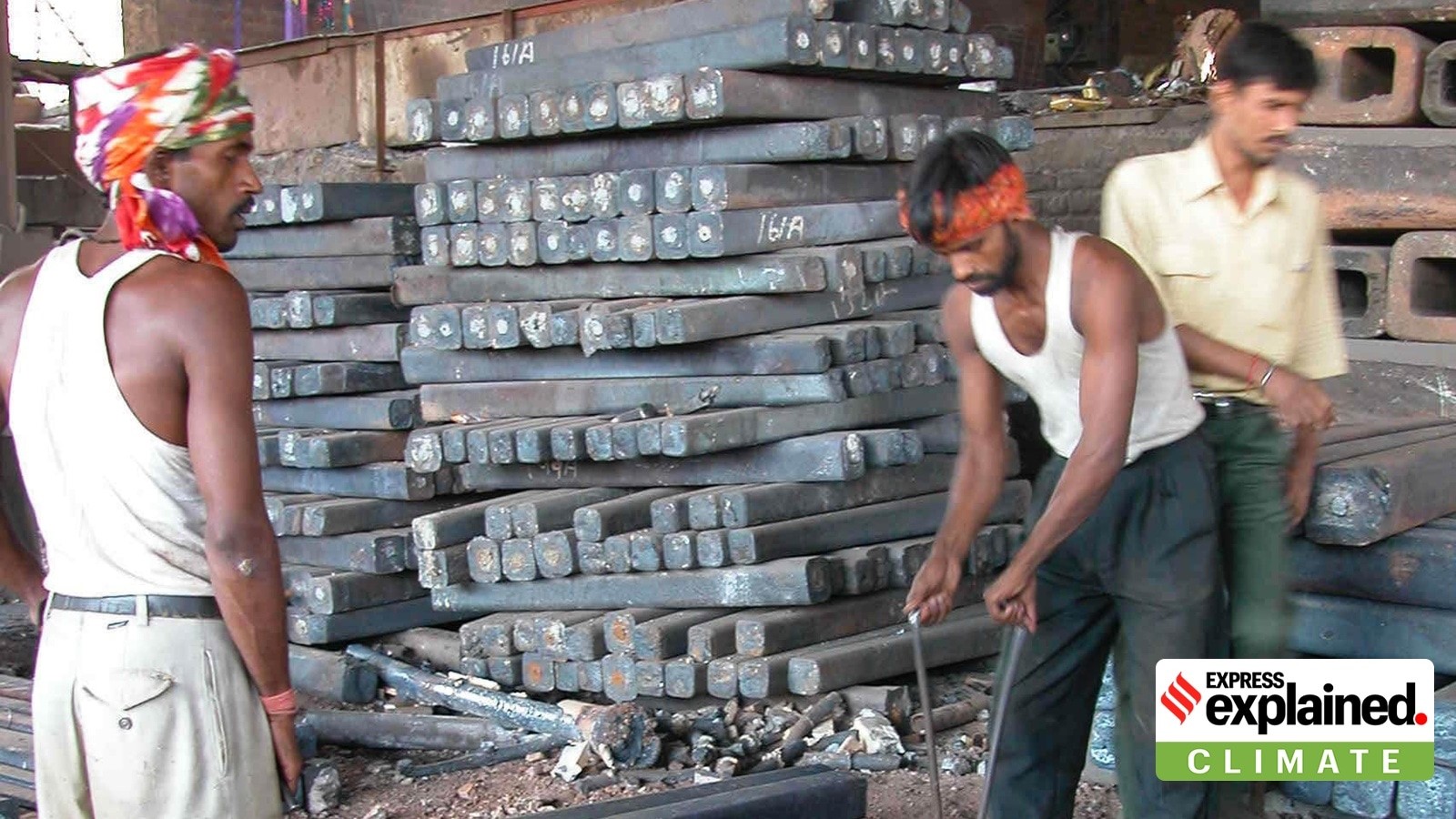
The Union Budget’s allocation of Rs. 20,000 crore over five years for Carbon Capture, Utilisation and Storage (CCUS) marks a significant policy intervention to address emissions from India’s hard-to-abate industrial sectors. The move reflects a strategic recognition that achieving India’s net-zero emissions target by 2070 will not be possible through renewable energy transition alone, especially amid continued industrialisation and infrastructure expansion.
Understanding CCUS
CCUS refers to a suite of technologies that aim to prevent carbon dioxide (CO2)—the principal driver of climate change from entering the atmosphere. The process involves:
- Capturing CO2 from industrial processes such as cement, steel, power generation, refineries and chemicals
- Transporting CO2 through pipelines or other means
- Storing CO2 securely in deep geological formations, or
- Utilising CO2 by converting it into fuels, chemicals or construction materials
Importantly, CCUS is not a single technology but a value chain involving diverse capture methods, materials, transport systems and storage solutions.
Global Status and Climate Relevance
Although CCUS technologies have existed for decades, global deployment has been limited due to high costs, safety concerns, and scale-up challenges. Currently, only about 50 million tonnes of CO2 are captured annually worldwide—less than 0.5% of global emissions of nearly 40 billion tonnes.
However, with global emissions remaining stubbornly high, climate assessments increasingly agree that there is no credible pathway to limiting global warming or achieving net-zero by 2050 without large-scale CCUS adoption. Consequently, CCUS projects are expanding mainly in the United States, Europe and China.
India’s CCUS Journey
India’s CCUS push gained momentum after it announced its net-zero by 2070 commitment at the 2021 Glasgow climate summit. Since then:
- Pilot and demonstration projects have begun in the steel, cement and chemical sectors
- Potential large-scale capture and geological storage sites have been mapped
- Dedicated Centres of Excellence, such as at Indian Institute of Technology Bombay and Jawaharlal Nehru Centre for Advanced Scientific Research, are leading indigenous research
While the underlying science of CCUS is well understood, significant innovation is still required in engineering design, materials, transport logistics and storage safety to make systems affordable, efficient and scalable under Indian conditions.
Policy and R&D Roadmap
In December, the Department of Science and Technology released a CCUS R&D Roadmap for 2030, identifying key technology, financing and policy bottlenecks that have slowed adoption. A major gap highlighted was the lack of funding for field-level testing and scale-up, where commercial risks are highest.
Significance of the Rs. 20,000 Crore Budget Allocation
The five-year budgetary support is designed to:
- Bridge the “valley of death” between laboratory success and commercial deployment
- Raise technology readiness levels of CCUS systems
- Enable scale-up to capture or store 100–500 tonnes of CO2 per day, which is necessary for economic viability
Experts expect that this funding could allow multiple CCUS technologies to reach commercial deployment within five years, transforming India’s industrial decarbonisation landscape.
Economic and Strategic Benefits
CCUS is particularly critical for hard-to-abate sectors such as cement and steel, where:
- A majority of CO2 emissions arise from chemical processes, not fuel combustion
- Renewable electricity alone cannot eliminate emissions
Accordingly, CCUS represents the only viable large-scale decarbonisation route for these industries.
The Budget explicitly targets CCUS applications in power, steel, cement, refineries and chemicals, which together account for the bulk of India’s industrial emissions.
From a trade perspective, CCUS adoption can help Indian exporters navigate emerging carbon-based trade barriers, such as the Carbon Border Adjustment Mechanism (CBAM) of the European Union. Lower embedded emissions would enhance the global competitiveness of Indian products.
Challenges Ahead
Despite strong policy intent, several challenges remain:
- High upfront capital costs and uncertain returns
- Need for long-term monitoring and liability frameworks for CO2 storage
- Limited transport infrastructure for captured CO2
- Regulatory clarity on ownership and responsibility for stored carbon
Addressing these issues will require coordinated action across ministries, industry, academia and financial institutions.
Conclusion
The Rs. 20,000 crore CCUS allocation represents a structural shift in India’s climate strategy, acknowledging the limits of energy transition alone and embracing industrial decarbonisation technologies. If effectively implemented, CCUS can reconcile India’s development imperatives with its climate commitments, safeguard export competitiveness, and enable a credible pathway towards net-zero by 2070. Sustained policy support, technological innovation and regulatory certainty will determine whether this budgetary push translates into long-term climate and economic gains.
Delhi Declaration 2026

- 03 Feb 2026
In News:
The Delhi Declaration emerged from the second India–Arab Foreign Ministers’ Meeting hosted by India, which brought together all 22 members of the League of Arab States a decade after their first ministerial dialogue. Convened amid intensifying regional rivalries and conflict, the declaration clarifies where India and Arab states align and where they prefer strategic silence. It underscores India’s calibrated West Asia policy: norm-based, stability-oriented, and carefully balanced across competing power centres.
Support for Sovereignty and Recognised Governments
A central theme is the reaffirmation of the sovereignty, unity, and territorial integrity of conflict-affected states such as Sudan, Libya, and Somalia. By rejecting external interference and backing internationally recognised governments, India and Arab partners signal a preference for order over fragmentation. This stance places New Delhi closer to the mainstream Arab position that favours reconciliation and state institutions, rather than legitimising parallel authorities or breakaway entities.
Yemen and Maritime Security
On Yemen, the declaration explicitly condemns attacks on Red Sea navigation and reiterates support for Yemen’s unity. The sharper language on maritime security reflects shared concern over trade disruptions and aligns India with a stability-first approach in a theatre marked by proxy competition. For India—heavily dependent on energy imports and sea lanes, secure shipping is a core national interest.
Cautious Engagement on Syria
The text is restrained on Syria, limiting references to counter-terrorism against the Islamic State. This mirrors India’s low-key, diplomatic engagement with evolving political realities in Damascus while avoiding premature endorsement of any faction. The emphasis remains on counter-terror cooperation and humanitarian stability rather than regime politics.
Israel–Palestine: Norms over New Frameworks
Instead of endorsing novel diplomatic architectures, the declaration backs the long-standing Arab Peace Initiative (2002), land for peace, with a Palestinian state based on pre-1967 lines alongside Israel. While supporting efforts to end violence in Gaza, India and Arab states stop short of embracing any new, sweeping blueprint. The reiteration of Palestinian sovereignty reflects continuity in India’s position, even as it maintains strong bilateral ties with Israel.
Strategic Silence on Iran
Notably absent is any direct reference to escalating U.S.–Iran tensions. This omission appears deliberate, allowing capitals to manage sensitive bilateral equations without public positioning. For India, which seeks to preserve energy ties and connectivity options while navigating sanctions exposure, discretion helps sustain diplomatic flexibility.
Economic and Institutional Pillars
Beyond geopolitics, the declaration advances cooperation across five institutional pillars—economy, energy, education, media, and culture, first framed in 2002. With India–Arab trade exceeding $240 billion, economic interdependence anchors the partnership. Energy security, diaspora linkages, and cultural exchanges add durable ballast to political dialogue.
What It Reveals About India’s West Asia Policy
The Delhi Declaration crystallises India’s approach: engage all sides, avoid zero-sum alignments, and privilege internationally recognised norms that reduce conflict spillovers. Partnerships remain transactional and compartmentalised, ensuring that deep bilateral ties do not translate into bloc politics. In a region of fluid rivalries, India positions itself as a steady, pragmatic actor—supporting sovereignty, maritime security, and incremental diplomacy while leaving space to manoeuvre on the most combustible fault lines.
India–EU Free Trade Agreement
- 01 Feb 2026
In News:
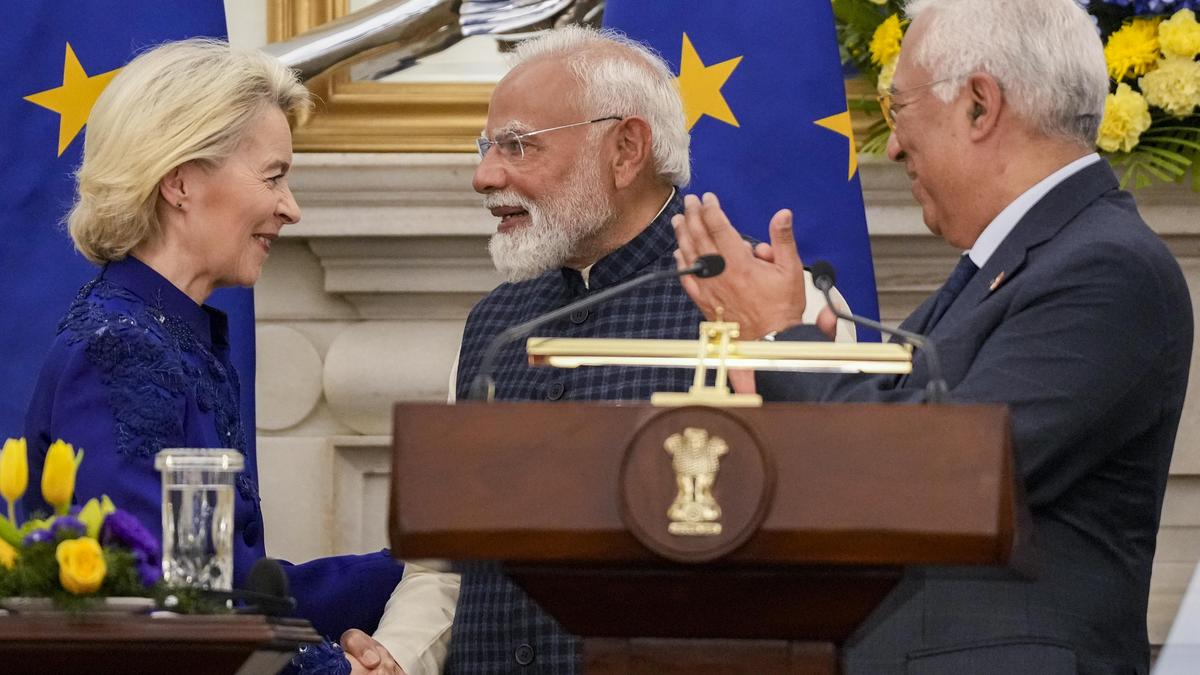
After nearly two decades of intermittent negotiations, India and the European Union have concluded talks on a comprehensive Free Trade Agreement (FTA). Often termed the “mother of all deals,” the agreement reflects both the scale of economic engagement and the careful balancing of ambition with domestic sensitivities.
Why the India–EU FTA Is So Significant
The agreement links two major economic blocs, India, one of the world’s fastest-growing large economies, and the EU, one of the largest integrated markets. The EU accounts for nearly 12% of India’s total trade, making it a more significant partner than many of India’s recent FTA counterparts combined.
Bilateral merchandise trade has crossed $136 billion, while services trade stands above $80 billion, underlining the strategic depth of economic interdependence. Given Europe’s high purchasing power and regulatory influence, deeper access to this market holds structural importance for India’s export-led growth strategy.
What India Gains
1. Near-Complete Tariff Elimination on Exports: The EU will remove duties on a vast majority of tariff lines, covering almost the entire value of India’s exports. Immediate tariff elimination on a large share of goods, along with phased reductions on others, provides Indian exporters with predictable and preferential market access.
2. Boost to Labour-Intensive Sectors: Sectors such as textiles, apparel, leather, footwear, marine products, toys, sports goods, and gems & jewellery, which employ large workforces, stand to gain significantly. These industries often face high EU tariffs, and their removal improves price competitiveness, especially at a time when access to other markets like the US faces uncertainties.
3. Agricultural and Processed Food Access: Products like tea, coffee, spices, grapes, fruits, vegetables, and processed foods gain improved access, benefiting India’s agri-export diversification strategy.
4. Services Market Openings: The EU has expanded commitments across numerous services sectors, including IT/ITeS, professional services, education, and business services. This strengthens India’s position as a global services hub.
What India Concedes
1. Tariff Liberalisation with Safeguards: India has agreed to reduce or eliminate tariffs across most tariff lines, but largely through phased reductions and quota mechanisms to protect sensitive domestic sectors.
2. Automobiles and Wine: High duties on European wine and automobiles will be gradually reduced, but only within strict quota limits. Mass-market vehicles and cheaper wines remain protected, indicating India’s calibrated approach to liberalisation.
Sensitive Sectors Kept Outside
India excluded politically sensitive agricultural sectors such as dairy, poultry, beef, cereals, edible oils, and tobacco. The EU also shielded certain products like sugar, rice, milk powder, and poultry, highlighting mutual protection of vulnerable sectors.
Key Challenges and Unresolved Issues
- Carbon Border Adjustment Mechanism (CBAM): The EU’s CBAM, which imposes carbon-linked costs on imports, remains a concern for Indian exporters in carbon-intensive sectors. Although India secured assurances of equal treatment, CBAM could erode some tariff advantages unless domestic industry transitions toward greener production.
- Domestic Reform Imperative: To fully benefit, India must improve logistics, regulatory certainty, contract enforcement, and infrastructure. Without complementary domestic reforms, preferential market access may not translate into sustained export expansion.
Strategic Significance
Beyond trade, the FTA strengthens India–EU ties in a period of geopolitical and supply chain realignment. It supports:
- Diversification away from overdependence on single markets
- Integration into global value chains
- Greater collaboration in technology, sustainability, and standards
Conclusion
The India–EU FTA represents a structural shift in India’s trade policy—from cautious protectionism toward calibrated integration with major advanced markets. While the agreement opens vast opportunities for exports and services, its ultimate success will depend on India’s ability to enhance domestic competitiveness and navigate emerging regulatory challenges such as CBAM.
Union Budget 2026–27: Growth, Inclusion and Structural Transformation
- 02 Feb 2026
In News:
The Union Budget 2026–27 is anchored in a threefold developmental framework accelerating economic growth, building human capacity, and ensuring inclusive participation. At a time when the global economy faces supply chain realignments, technological disruption, and resource insecurity, the Budget attempts to position India as a resilient, innovation-driven, and socially inclusive economy.
I. Growth Strategy: Investment-Led and Technology-Driven
A defining feature of the Budget is the continued emphasis on public capital expenditure, raised to ?12.2 lakh crore. This reinforces the government’s belief that infrastructure spending crowds in private investment, enhances productivity, and generates employment.
The push spans:
- High-speed rail corridors and freight infrastructure
- Expansion of National Waterways for cost-effective logistics
- Development of City Economic Regions (CERs) to leverage urban agglomeration benefits
These measures reflect a shift from isolated project-based development to integrated regional growth planning.
The Budget also promotes strategic manufacturing and high-technology sectors. The Biopharma SHAKTI initiative (?10,000 crore outlay) aims to develop domestic capabilities in biologics and biosimilars, reducing import dependence while addressing India’s rising non-communicable disease burden. This aligns with the broader push toward knowledge-intensive industrialisation.
Simultaneously, the ?10,000 crore SME Growth Fund recognises MSMEs as drivers of employment and innovation, moving beyond survival support toward scaling globally competitive firms.
II. Human Capital: From Demographic Dividend to Skilled Workforce
The Budget acknowledges that economic growth without skill formation risks jobless expansion. Hence, it invests in education, skilling, and sector-specific workforce creation.
- AVGC labs in schools and colleges support India’s emerging digital content industry.
- Establishment of girls’ hostels in STEM districts addresses gender gaps in higher education.
- A National Institute of Hospitality and guide training scheme link skilling with tourism-led growth.
Healthcare is treated not only as welfare but also as an employment-intensive care economy. The proposal for Regional Medical Hubs integrates healthcare delivery, research, and medical tourism, positioning India as a global health services destination.
III. Inclusive Growth and Social Sector Interventions
The third pillar of the Budget centres on inclusion. Schemes such as Bharat VISTAAR, an AI-based multilingual agricultural advisory, aim to democratise digital infrastructure for farmers, thereby reducing information asymmetry and climate risk.
Similarly, SHE-Marts build on SHG-based mobilisation to promote women’s entrepreneurship, signalling a shift from credit access to market integration and enterprise ownership.
Mental health infrastructure expansion, regional development in the Northeast, and targeted tourism circuits indicate an attempt to address geographical and social imbalances.
IV. Fiscal Prudence with Growth Orientation
Despite higher expenditure, fiscal consolidation remains on track:
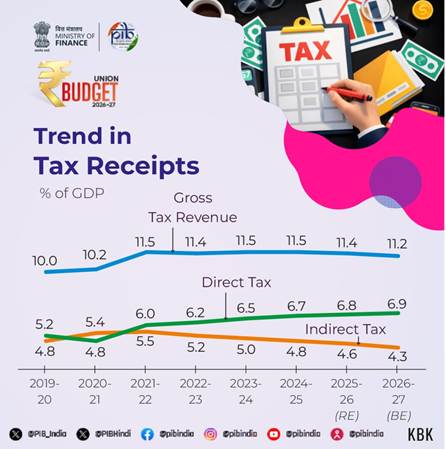
- Fiscal deficit projected at 4.3% of GDP
- Debt-to-GDP ratio on a declining trajectory
This suggests a calibrated approach where growth-enhancing capex is prioritised while maintaining macroeconomic credibility.
V. Tax Reforms: Simplification and Competitiveness
The introduction of the New Income Tax Act (2025) aims to simplify compliance and reduce litigation. Rationalisation of penalties, decriminalisation of minor offences, and automated safe harbour provisions for IT services improve the ease of doing business.
In a bid to attract global capital, tax incentives for data centres, cloud services, and non-resident investors indicate a strategy to integrate India into global value chains in digital and high-tech domains.
VI. Trade Facilitation and Industrial Policy
Customs reforms reduce duties on inputs for critical minerals, clean energy, aviation, and pharmaceuticals, supporting domestic manufacturing. Digitisation of cargo clearance, AI-based risk assessment, and warehouse reforms enhance trade efficiency and logistics competitiveness.
Conclusion
The Union Budget 2026–27 reflects a structural transition in India’s development model—from consumption-led growth to investment, innovation, and inclusion-led expansion. By combining infrastructure investment, industrial policy, human capital formation, and digital governance, the Budget attempts to align short-term growth impulses with the long-term goal of Viksit Bharat. The key challenge lies in effective implementation and coordination with states, which will determine whether these ambitions translate into broad-based socio-economic transformation.