
Children’s Booker Prize

- 29 Oct 2025
In News:
- The Booker Prize Foundation has announced the establishment of the Children’s Booker Prize, a landmark global award dedicated to fiction written for children aged 8 to 12 years.
- Scheduled to debut in 2027, this prize represents the first major expansion of the Booker brand into children’s literature and carries a purse of £50,000, matching the award value of its established sister prizes.
What the Prize Represents
- The Children’s Booker Prize aims to celebrate and elevate fiction for middle-grade readers, acknowledging the importance of early reading habits in shaping future generations of informed, imaginative, and engaged adults. Books originally written in English or translated into English will be eligible, making the award internationally inclusive.
- The Booker Prize Foundation, in partnership with the AKO Foundation, which supports arts, education, and environmental initiatives, seeks to nurture a global culture of reading and inspire literary excellence in children’s storytelling.
Eligibility and Key Features
- Age Category: Fiction aimed at 8–12-year-old readers.
- Geographic Scope: Open to books published in the UK or Ireland, regardless of the author’s nationality.
- Languages: Both original English works and translated works can be submitted.
- Prize Value: £50,000 (same as the adult Booker and International Booker), funded by the AKO Foundation.
- Selection Process: The first award in 2027 will be decided by a jury of children and adults, chaired by acclaimed British children’s author Frank Cottrell-Boyce, the current children’s laureate.
The submission process begins in early 2026, and the prize hopes to build enthusiasm and visibility around high-quality children’s literature.
Purpose and Vision
- According to Booker Prize Foundation Chief Executive Gaby Wood, the award aims to cultivate an enduring love for reading among younger audiences and to serve as a catalyst for literary engagement across generations. The initiative builds on the Booker’s legacy of recognising works that shape global literary culture.
Position Within the Booker Ecosystem
The Children’s Booker Prize joins two established awards under the Booker umbrella:
1. Booker Prize
- Founded: 1969
- Eligibility: Original novels written in English and published in the UK or Ireland.
- Prize Distribution: Award solely to the author.
- Objective: Celebrates outstanding English-language fiction.
- Indian Winners:
- Salman Rushdie – Midnight’s Children (1981)
- Arundhati Roy – The God of Small Things (1997)
- Kiran Desai – The Inheritance of Loss (2006)
- Aravind Adiga – The White Tiger (2008)
2. International Booker Prize
- Established: 2005; restructured in 2016.
- Eligibility: Translated fiction published in the UK or Ireland.
- Prize Distribution: Shared equally between author and translator.
- Objective: Promotes cross-cultural literary exchange and honours translation.
- Indian-Linked Winners:
- Geetanjali Shree – Tomb of Sand (2022) (Hindi, translated by Daisy Rockwell)
- Banu Mushtaq – Heart Lamp (2025) (Kannada, translated by Deepa Bhasthi)
International Booker Prize 2025
- 23 May 2025
In News:
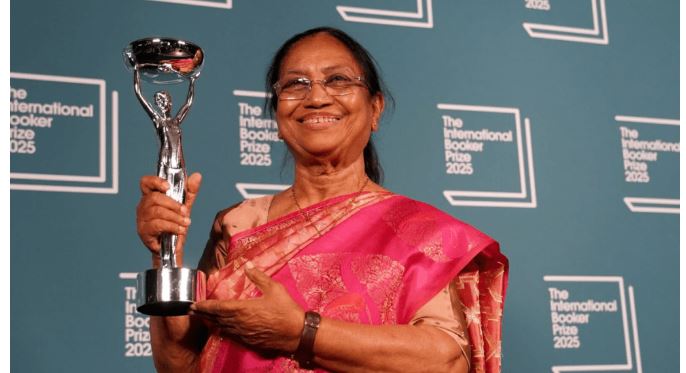
In a historic win, Banu Mushtaq, a prominent Kannada writer, advocate, and activist, became the first Indian author writing in Kannada to win the International Booker Prize 2025 for her short story collection Heart Lamp. The book was translated into English by Deepa Bhasthi, who also became the first Indian translator to win this prestigious award.
About the International Booker Prize
- Established: 2005 by the Booker Prize Foundation, UK.
- Awarded: Annually.
- Purpose: To honour the best work of fiction translated into English, regardless of the original language or nationality of the author.
- Prize Amount: £50,000, shared equally between the author and the translator.
- Shortlisted nominees (authors and translators) receive £2,500 each.
- Focus: Unlike the Booker Prize, which honours original English-language works, the International Booker Prize exclusively celebrates translated fiction, highlighting the importance of translators in global literature.
Key Features
- Celebrates literary excellence, cultural richness, and the art of translation.
- Initially biennial (2005–2015), it became an annual award in 2016.
- Books must be translated into English and published in the UK or Ireland.
India and the International Booker Prize
Year Author Work Language Translator
2022 Geetanjali Shree Tomb of Sand Hindi Daisy Rockwell
2025 Banu Mushtaq Heart Lamp Kannada Deepa Bhasthi
About Banu Mushtaq
- Born: April 3, 1948, in Hassan, Karnataka.
- Professions: Advocate, journalist, feminist writer, women’s rights activist, and former municipal councillor.
- Affiliation: Prominent figure in the Bandaya movement, known for protest literature in Kannada addressing social injustices.
- Journalistic Background: Reported for LankeshPatrike (1981–1990) under the mentorship of P. Lankesh.
Literary Contributions
- Started writing: In 1974; first story published in Prajamatha.
- Themes: Focuses on gender justice, religious identity, caste oppression, and female autonomy.
Heart Lamp: The 2025 Winning Work
- Genre: Short story collection comprising 12 stories written between 1990 and 2023.
- Content: Explores the lives of ordinary South Indian Muslim women, addressing themes like patriarchy, faith, family roles, and self-determination.
- Significance:
- First short story collection to win the International Booker Prize.
- First Kannada-language work to win.
- First win for Indian translator Deepa Bhasthi.
Other Notable Works by Banu Mushtaq
- Benki Male (1999): Awarded the Karnataka Sahitya Academy Award.
- HaseenaMattuItaraKathegalu (2015): Translated into English as Haseena and Other Stories.
- Black Cobra (Short Story): Adapted into the award-winning film Hasina by Girish Kasaravalli.
Booker Prize

- 02 May 2024
Why is it in the News?
The Booker Prize, one of the most prestigious awards in the literary world, has recently come under fire for the historical links to slavery of its original sponsor, Booker Group.
What is the Booker Prize?
- The Booker Prize was founded in 1969, initially just for writers from the Commonwealth, but later opened to writers globally.
- Each year, the prize is awarded to a single work of fiction in the English language.
- In 2004, a separate International Booker Prize was instituted for translated works.
- The prize was co-founded by publishers Tom Maschler and Graham C Greene, and from 1969 to 2001, it was sponsored by, and named after Booker Group Ltd, a British wholesale foods company, established in 1835 as a shipping and trading company, and now owned by Tesco.
- In 2002, British investment management firm Man Group became the prize’s sponsor, and thus it came to be known as The Man Booker Prize.
- After Man Group ended its sponsorship in 2019, American charity Crankstart took over, and reverted the award’s name to its original ‘Booker Prize’.
- Irish author Paul Lynch wins the 2023 Booker Prize for his novel 'Prophet Song'.
About the International Booker Prize:
- The International Booker Prize (formerly known as the Man Booker International Prize) was launched in 2005.
- It was originally awarded every two years to a living author who has published fiction either originally in English or whose work is generally available in translation in the English language.
- It was an award for the body of work of the author, rather than awarded for an individual novel.
- Beginning in 2016, the award changed. It is now given annually to a single book in English translation, with a £50,000 prize for the winning title, shared equally between author and translator.
- Georgi Gospodinov and Angela Rodel have won the International Booker Prize 2023 for the novel ‘Time Shelter’.
- ‘Tomb of Sand’ Geetanjali Shree, translated by Daisy Rockwell Winner 2022 winner.