
India’s Defence Transformation: From Import Dependence to Strategic Self-Reliance
- 23 Aug 2026
In News:
India’s defence sector is undergoing a structural transformation towards Atmanirbharta, technological capability and greater private-sector participation. The objective is not merely to reduce imports but to build an integrated domestic ecosystem capable of designing, producing and exporting advanced defence systems.
Strengthening the Defence Industrial Base
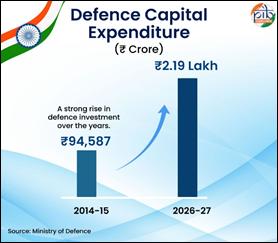
Defence expenditure has increased from ?2.53 lakh crore in 2013–14 to ?7.85 lakh crore in 2026–27, while capital expenditure rose from ?94,588 crore to ?2.19 lakh crore, supporting military modernisation. Indigenous defence production reached a record ?1.78 lakh crore in FY 2025–26, with the private sector contributing 24%.
Defence exports have expanded dramatically, from ?686 crore in 2013–14 to ?38,424 crore in 2025–26, with Indian products reaching 80 countries. The government targets ?3 lakh crore defence production and ?50,000 crore exports by 2029.
Innovation and Indigenisation
India is increasingly opening defence R&D to industry, startups and academia. 25% of the defence R&D budget has been opened to these participants since 2022–23. Schemes such as iDEX, ADITI and the Technology Development Fund (TDF) support indigenous development of critical technologies. As of March 2026, iDEX had facilitated 551 design and development contracts involving 676 innovators, while 80 TDF projects worth ?334 crore were under implementation.
The Positive Indigenisation Lists cover 5,521 items, while Srijan-DEEP provides a digital platform connecting domestic vendors with indigenisation opportunities. Defence Industrial Corridors in Uttar Pradesh and Tamil Nadu are further developing regional manufacturing ecosystems.
Acquisition Reforms and Operational Capability
The Defence Acquisition Council (DAC) has accorded Acceptance of Necessity worth over ?6 lakh crore for DRDO-designed systems to be manufactured by Indian industry. Indigenous procurement of platforms such as Tejas Mk-1A and LCH Prachand reflects the shift towards domestic design and production.
Operational self-reliance is also improving: the Army has achieved about 91% ammunition self-sufficiency, while indigenous missile, air-defence, hypersonic and naval capabilities are expanding. The commissioning of 12 warships and submarines, including platforms with high indigenous content, demonstrates growing naval industrial capacity.
Challenges and Way Forward
India must move beyond production targets towards technology ownership, higher domestic value addition and indigenous critical components. Persistent challenges include dependence on specialised imports, limited R&D-industry linkages, technology gaps and the need for skilled human capital.
The way forward lies in strengthening public-private R&D, MSME integration, defence startups, technology transfer and testing infrastructure, while ensuring predictable procurement and export policies. A deeper domestic defence ecosystem can simultaneously enhance national security, technological sovereignty, high-skilled employment and India’s strategic autonomy, supporting the vision of a technologically advanced defence power by 2047.
SIPRI Yearbook 2026
- 13 Jun 2026
In News:
The Stockholm International Peace Research Institute (SIPRI), in its Yearbook 2026, has highlighted growing global nuclear risks, weakening arms-control frameworks, and the increasing integration of emerging technologies into warfare. A significant observation regarding India is the expansion of its nuclear arsenal to approximately 190 warheads and the reported deployment of a small number of warheads in an operational state, reflecting the evolving nature of India's strategic deterrence posture.
Key Findings on India
India emerged as the fifth-largest military spender globally in 2025, with defence expenditure rising by 8.9% to USD 92.1 billion. SIPRI also identified India as the second-largest importer of major arms during 2021–25, accounting for 8.2% of global arms imports.
According to the report, India's nuclear stockpile is estimated at 190 warheads, comprising 12 deployed warheads and 178 in reserve/storage. This places India behind China (620 warheads) but ahead of Pakistan (170 warheads). The report suggests that India is gradually enhancing the operational readiness and survivability of its nuclear deterrent.
Another notable development was the integration of cyber operations into military confrontation during the 2025 India-Pakistan conflict, indicating the growing importance of cyber capabilities in modern warfare and deterrence.
Global Security Trends
The report notes that all nine nuclear-armed states continue to modernize and expand their arsenals. Globally, there are an estimated 12,187 nuclear warheads, of which around 9,745 are available for military use, while more than 4,000 remain deployed on missiles and aircraft.
The United States and Russia together possess nearly 86% of the world's nuclear weapons, yet the expiry of the New START Treaty in 2026 without a successor agreement has increased concerns regarding strategic stability.
SIPRI also points to the growing use of artificial intelligence, autonomous systems, drones, and cyber capabilities in contemporary conflicts such as Ukraine and Gaza, signalling a transformation in the nature of warfare.
Simultaneously, the global arms-control architecture is witnessing strain, reflected in withdrawals from treaties such as the Convention on Cluster Munitions and the Anti-Personnel Mine Convention.
India's Nuclear Doctrine
India's nuclear doctrine, officially operationalized in 2003, is based on the principles of credible minimum deterrence and No First Use (NFU).
Under the doctrine, India pledges not to initiate a nuclear attack and reserves the use of nuclear weapons solely for retaliation against a nuclear strike on Indian territory or armed forces. Any such retaliation would be massive and designed to inflict unacceptable damage on the aggressor.
The doctrine also emphasizes strict civilian control through the Nuclear Command Authority (NCA). The Political Council, chaired by the Prime Minister, alone possesses the authority to authorize nuclear weapon use, while the Executive Council, headed by the National Security Advisor, provides operational inputs.
India additionally maintains that it may consider nuclear retaliation in response to a major chemical or biological weapons attack.
Evolution of India's Nuclear Programme
India's nuclear journey began as a peaceful programme focused on energy self-reliance under Homi J. Bhabha and Jawaharlal Nehru. However, changing security dynamics, particularly China's nuclear test in 1964, prompted India to conduct its first nuclear test, Pokhran-I (Smiling Buddha), in 1974.
Subsequently, strategic concerns arising from China's capabilities and the China-Pakistan nexus led to Pokhran-II (Operation Shakti) in May 1998, after which India formally declared itself a nuclear weapon state.
Since then, India has developed a doctrine centred on deterrence rather than warfighting while simultaneously integrating into global nuclear commerce through the 2008 India–US Civil Nuclear Agreement and the Nuclear Suppliers Group waiver.
India's Position on Global Nuclear Governance
India remains outside the Nuclear Non-Proliferation Treaty (NPT) and the Comprehensive Nuclear-Test-Ban Treaty (CTBT), arguing that these arrangements are discriminatory because they divide the world into nuclear "haves" and "have-nots."
At the same time, India has demonstrated responsible nuclear behaviour and has secured membership in major export-control regimes, including the Missile Technology Control Regime (MTCR), Wassenaar Arrangement, and Australia Group, while continuing to seek membership in the Nuclear Suppliers Group (NSG).
Conclusion
The SIPRI Yearbook 2026 underscores a world witnessing renewed strategic competition, nuclear modernization, and rapid technological transformation in warfare. For India, the expansion of its nuclear arsenal and limited deployment of warheads reflect efforts to maintain a credible deterrent amid a complex security environment shaped by nuclear rivalry with Pakistan, strategic competition with China, and evolving threats in cyberspace and emerging technologies. Going forward, balancing national security requirements with commitment to responsible nuclear stewardship and global disarmament will remain central to India's strategic outlook.
India’s Defence Export Surge
- 05 Apr 2026
In News:
India’s defence sector has achieved a historic milestone in the financial year 2025-26, with defence exports reaching an all-time high of ?38,424 crore. This represents a staggering 62.66% increase over the previous fiscal year (?23,622 crore). This surge is a testament to India's transition from being one of the world's largest arms importers to an emerging global exporter, driven by the vision of Atmanirbhar Bharat (Self-Reliant India).
Key Highlights of FY 2025-26
The growth in exports is characterized by a robust partnership between the public and private sectors:
- Sectoral Contribution: Defence Public Sector Undertakings (DPSUs) contributed 54.84% (?21,071 crore), while the private sector accounted for 45.16% (?17,353 crore).
- Surging Growth: DPSU exports skyrocketed by 151%, while private firms maintained steady growth with a 14% increase.
- Global Footprint: India now exports defence equipment to more than 80 countries. The number of active exporters has grown to 145, reflecting a more competitive and wider industrial base.
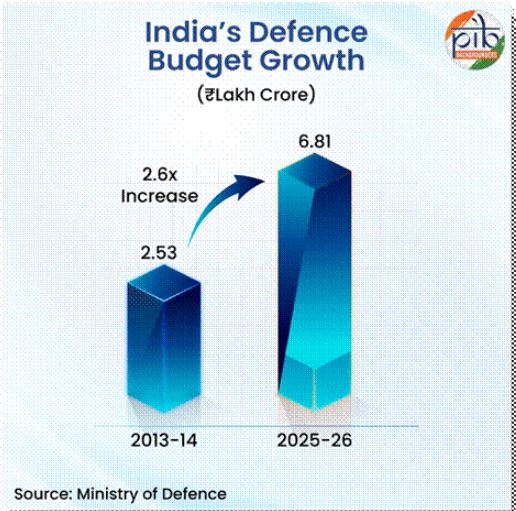
- Budgetary Support: The defence budget has grown significantly to ?6.81 lakh crore in 2025-26, providing the necessary capital for modernization and indigenous production.
Major Exported Products and Destinations
India's export basket has expanded from components to full-scale advanced platforms:
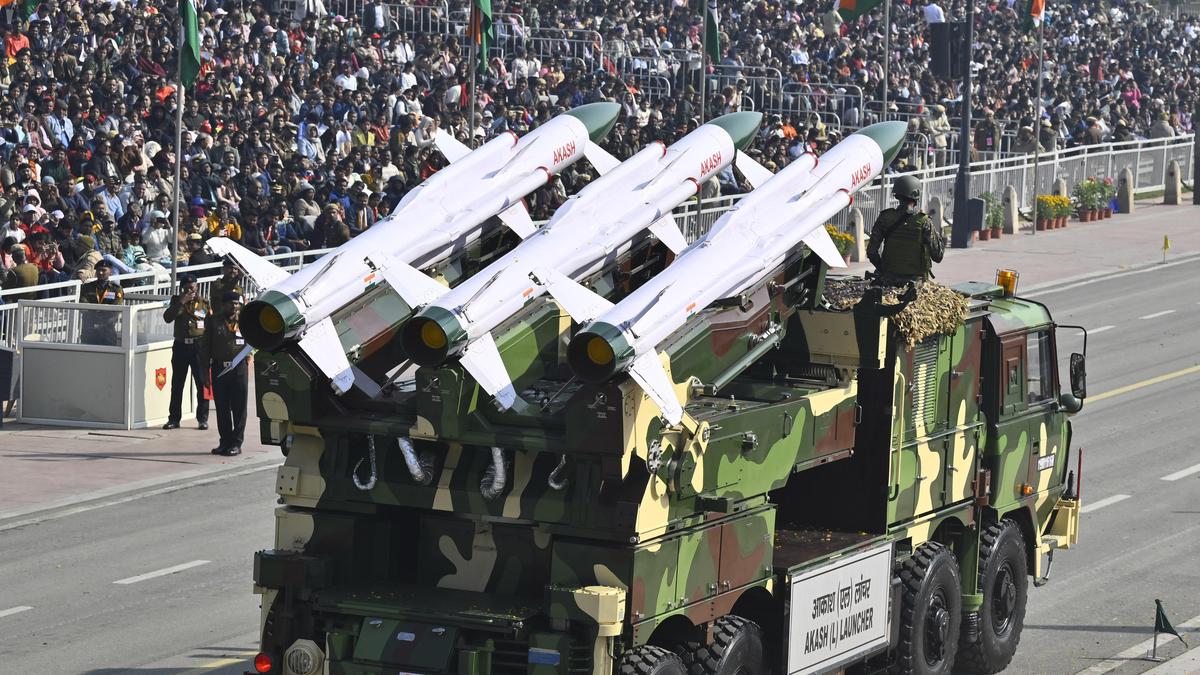
- Key Products: BrahMos Supersonic Cruise Missiles, Akash Surface-to-Air Missile systems, Pinaka Multi-Barrel Rocket Launchers, Advanced Towed Artillery Gun System (ATAGS), Dornier-228 aircraft, and Zen Anti-Drone Systems.
- Top Buyers:
- Components/Sub-systems: United States, France, and Israel (primarily for aero-structures and electronics).
- Indigenous Weapon Systems:Armenia (Akash, Pinaka, ATAGS) and the Philippines (BrahMos).
- Others: UAE, South Korea, Italy, and various nations across Africa and Southeast Asia.
The Strategic Imperative for Indigenisation
The push for domestic manufacturing is rooted in the need for Strategic Autonomy:
- National Security: Reducing dependence on foreign OEMs ensures that supply chains are not disrupted during geopolitical crises or through technology denials (sanctions).
- Economic Efficiency: Indigenous production conserves foreign exchange and creates a "waste-to-wealth" cycle within the domestic economy.
- Tailored Technology: Platforms can be customized for India’s unique terrains—ranging from high-altitude Himalayan regions to tropical maritime zones.
- Technological Sovereignty: Owning the Intellectual Property (IP) allows India to upgrade and modify systems without seeking external permissions.
Key Reforms Driving the Transformation
The Government of India has introduced several structural reforms to facilitate this growth:
- DAP 2020 & IDDM: The Defence Acquisition Procedure (DAP) 2020 prioritizes the Indian-IDDM (Indigenously Designed, Developed, and Manufactured) category as the highest preference for procurement.
- Simplified ‘Make’ Procedures:
- Make-I: Government-funded (up to 70%) development of complex systems.
- Make-II: Industry-funded prototypes with simplified paperwork and fast-track approvals.
- FDI Liberalization: Automatic route for Foreign Direct Investment increased to 74%, and up to 100% via government approval for niche technologies.
- Innovation Ecosystems:
- iDEX (Innovations for Defence Excellence): Grants for startups and MSMEs.
- Technology Development Fund (TDF): Funding up to ?10 crore for R&D in critical technologies.
- Defence Industrial Corridors (DICs): Established in Uttar Pradesh and Tamil Nadu, these hubs have attracted over ?9,145 crore in investment and signed nearly 290 MoUs to build a localized supply chain.
Roadmap to 2029: The Global Hub Vision
The Ministry of Defence has set ambitious targets for the near future:
- Production Target: Reach ?3 lakh crore in annual domestic defence production by 2029.
- Export Target: Aim for ?50,000 crore in annual exports by 2029.
- MSME Integration: Engaging over 16,000 MSMEs to ensure a resilient and tiered manufacturing ecosystem.
DefenceAtmanirbharta
- 24 Nov 2025
In News:
India’s defence sector has undergone a structural transformation over the past decade, marked by record production, expanding exports, and deepening indigenisation. In FY 2024–25, India achieved its highest-ever defence production of ?1.54 lakh crore, while defence exports touched a record ?23,622 crore, reflecting the tangible outcomes of the Atmanirbhar Bharat vision in the strategic domain. This shift signifies India’s transition from one of the world’s largest defence importers to an emerging global manufacturing and export hub.
Rising Production and Export Trajectory
Indigenous defence production rose sharply from ?46,429 crore in FY 2014–15 to ?1,27,434 crore in FY 2023–24, registering a growth of about 174%. This expansion has been supported by sustained budgetary commitment, with the defence budget increasing from ?2.53 lakh crore (2013–14) to ?6.81 lakh crore (2025–26). In FY 2024–25 alone, the Ministry of Defence signed 193 contracts worth ?2.09 lakh crore, of which 177 contracts were awarded to domestic industry, reinforcing the “Buy Indian” approach.
Defence exports, once negligible at less than ?1,000 crore in 2014, have grown steadily, with India now exporting to 80–100 countries. Both Defence Public Sector Undertakings (DPSUs) and the private sector have contributed, with the latter’s share rising to 23%, supported by nearly 16,000 MSMEs supplying subsystems, components, and niche technologies.
Policy Reforms Driving Self-Reliance
This growth has been underpinned by far-reaching reforms. The Defence Acquisition Procedure (DAP) 2020prioritised the Buy (Indian–IDDM) category, streamlined approvals, and embedded advanced technologies such as AI, cyber, and space systems into procurement. Complementing this, the Defence Procurement Manual (DPM) 2025 simplified revenue procurement worth nearly ?1 lakh crore annually, standardised procedures, enhanced digitalisation, and reduced compliance burdens for industry.
Other key enablers include Positive Indigenisation Lists restricting imports of thousands of items, liberalisedFDI norms (74% automatic, 100% via approval), the ?1 lakh crore Research, Development and Innovation (RDI) Scheme, and innovation platforms such as iDEX and the Technology Development Fund. The restructuring of the Ordnance Factory Board into seven DPSUs improved autonomy and efficiency, while Defence Industrial Corridors in Uttar Pradesh and Tamil Nadu attracted over ?9,000 crore in investments, creating manufacturing clusters.
Defence Exports as Strategic Outreach
Export facilitation has been simplified through digital authorisation portals, Open General Export Licences, and rationalised SOPs, resulting in faster clearances and a wider exporter base. Defence exports are increasingly viewed as instruments of diplomacy, fostering interoperability, long-term partnerships, and strategic trust through training, maintenance, and logistics support alongside equipment sales.
Persistent Challenges
Despite progress, challenges remain. India still depends on imports for critical technologies such as propulsion systems, advanced sensors, electronics, and special materials. Production scale is yet to fully match the Armed Forces’ growing requirements, and DPSUs face stiff competition in global markets. Policy–implementation gaps, bureaucratic delays, and dependence on foreign supply chains continue to constrain competitiveness.
Way Forward
Sustaining momentum requires deep-tech capability building, higher defence R&D spending, stronger private-sector participation, and accelerated procurement reforms. Leveraging export diplomacy, long-term procurement commitments, and ecosystem-based innovation can help India achieve its targets of ?3 lakh crore defence production and ?50,000 crore exports by 2029.
Conclusion
India’s defence sector has entered a decisive phase of Atmanirbharta, with record production, rising exports, and a broad-based industrial ecosystem. If structural reforms are consistently implemented and technological depth is strengthened, India is well-positioned to emerge as a globally competitive defence manufacturing hub by the end of this decade, enhancing both national security and economic growth.
Government’s Strategy to Boost Defence Exports and Domestic Manufacturing
- 22 Oct 2025
In News:
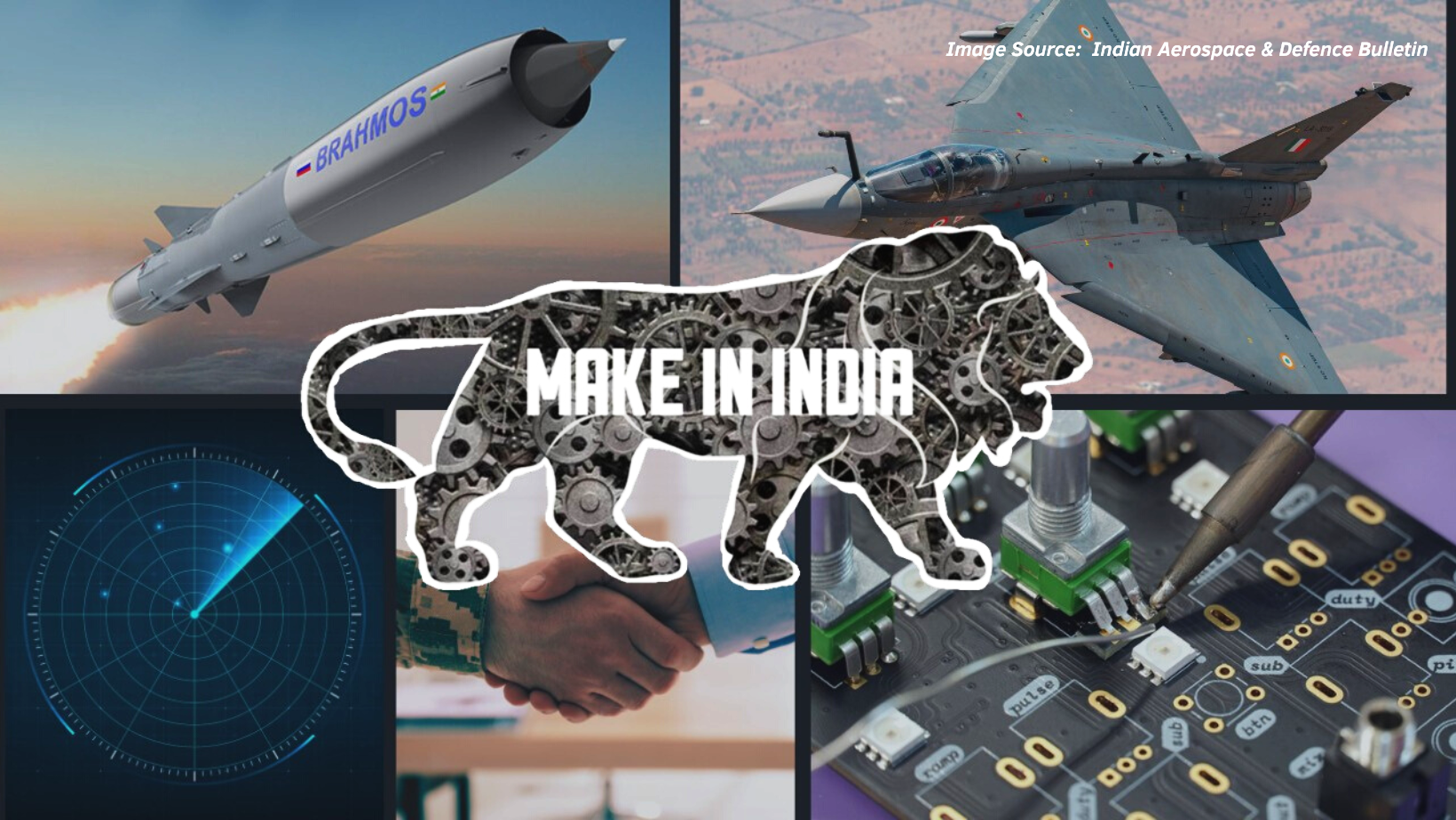
Defence Minister Rajnath Singh recently announced the government’s target to expand India’s defence manufacturing ecosystem to a valuation of ?3 lakh crore and enhance defence exports to ?50,000 crore by 2029.This marks a significant step in India’s vision of transforming from the world’s largest arms importer to a global defence manufacturing and export hub.
About the Initiative
The plan represents a strategic roadmap to strengthen India’s indigenous defence production base while increasing global competitiveness. It aligns with the objectives of Atmanirbhar Bharat and Make in India initiatives in the defence sector.
Key Features and Focus Areas
1. Private Sector Integration
- Encouraging partnerships between private defence manufacturers, Defence Research and Development Organisation (DRDO), and Defence Public Sector Undertakings (DPSUs).
- Collaboration with foreign Original Equipment Manufacturers (OEMs) to facilitate joint ventures, co-development, and technology transfer.
- Promoting participation in the Defence Industrial Corridors in Uttar Pradesh and Tamil Nadu to attract domestic and foreign investment.
2. Indigenisation of Defence Platforms
- Expanding indigenous production of major systems such as:
- LCA Tejas fighter aircraft
- Akash surface-to-air missiles
- Pinaka multi-barrel rocket launchers
- Advanced Light Helicopters (ALH) and Arjun tanks.
- Focus on import substitution through locally developed components, sensors, and sub-systems.
3. Policy and Regulatory Reforms
- Simplification of defence procurement procedures (DPP) and Defence Acquisition Procedure (DAP) to ensure faster clearances.
- Streamlined export licensing and authorisation through a single-window system.
- Incentivisation under Make-I, Make-II, and iDEX (Innovations for Defence Excellence) programmes.
- Enhanced funding for start-ups and MSMEs in defence innovation under the Technology Development Fund (TDF).
4. Skill Development and Research
- Establishment of specialised defence education and skilling institutes, such as Symbiosis Skills and Professional University, to build a trained workforce.
- Promotion of R&D collaboration between academia, industry, and DRDO to accelerate innovation in next-generation technologies like AI, robotics, and autonomous systems.
5. Operational Validation
- Indigenous systems have been successfully deployed in real operations—such as Operation Sindoor, which demonstrated the combat readiness and reliability of domestically produced defence equipment.
- Strengthening of quality assurance and field validation processes to enhance global trust in Indian defence products.
Strategic Significance
- Economic Growth:The initiative will boost industrial output, exports, and employment, contributing to India’s defence industrial self-reliance and GDP growth.
- Global Competitiveness:Positions India as a net defence exporter, catering to friendly nations in Asia, Africa, and Latin America.
- National Security:Reduces dependence on foreign arms imports and enhances strategic autonomy in critical technologies.
- Technological Innovation:Encourages indigenous innovation and the development of dual-use technologies benefiting both defence and civilian sectors.
- Geopolitical Leverage:Expanding defence exports strengthens India’s diplomatic ties through defence diplomacy and builds strategic partnerships with friendly nations.
Challenges Ahead
- Need for faster project implementation and clearer export procedures.
- Addressing R&D funding gaps and improving private sector participation.
- Ensuring competitive pricing and quality to meet global standards.
- Streamlining coordination among MoD, DRDO, DPSUs, and private players.
Way Forward
- Promote joint ventures with global defence majors to enhance technology absorption.
- Strengthen testing and certification infrastructure to meet international benchmarks.
- Expand defence offset policies to attract advanced technologies.
- Encourage defence start-ups and innovation clusters for rapid prototyping and scalable production.
Conclusion
India’s ambitious target to achieve ?3 lakh crore in defence production and ?50,000 crore in exports by 2029 reflects a paradigm shift toward self-reliance, innovation, and global competitiveness in defence manufacturing.
With sustained policy reforms, technological investment, and industry-academia synergy, India is well-positioned to emerge as a reliable global supplier of advanced defence systems and a pillar of regional security.
Operation Sindoor
- 18 May 2025
In News:
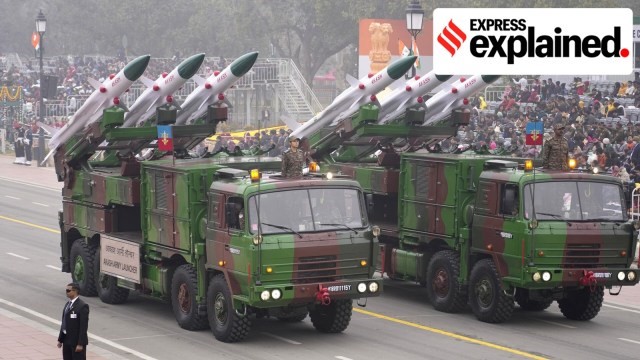
Operation Sindoor marked a significant leap in India's military and technological prowess, not only achieving its strategic objectives but also demonstrating the operational maturity of Made-in-Indiadefence systems. The operation was characterised by a multi-layered approach involving precision strikes, air defence, unmanned systems, and advanced surveillance tools—most of which were indigenously developed.
Precision and Navigation Capabilities
One of the defining features of Operation Sindoor was the pinpoint accuracy of strikes deep inside Pakistan and Pakistan-occupied Kashmir. Specific terrorist camps and infrastructure were destroyed with minimal collateral damage, underlining India’s commitment to responsible military engagement. This precision was enabled by a combination of advanced guidance systems and real-time data from space-based and ground-based assets.
India's indigenous Navigation with Indian Constellation (NavIC) system, offering positional accuracy of 10–20 cm, played a pivotal role. High-resolution satellites such as Cartosat, RISAT, and EOS provided real-time imagery, allowing sub-metre targeting. These capabilities are a result of sustained investments by DRDO and ISRO and reflect the prioritisation of guidance and navigation as a critical technology domain in DRDO’s 2023 R&D roadmap.
Lethality and Advanced Weapon Systems
The destruction caused during Operation Sindoor also demonstrated the high lethality of Indian weapon systems. Deep penetration warheads, advanced fusing mechanisms, and powerful propulsion systems—developed under the Integrated Guided Missile Development Programme—were central to the operation’s success. The likely use of the BrahMos missile, equipped with state-of-the-art guidance and propulsion, underscores the maturity of indigenous missile technology.
Emerging technologies such as Directed Energy Weapons (DEWs), including laser-based systems, were reportedly deployed to neutralise incoming drones. DEWs have been a priority sector for the Defence Ministry since 2022, and DRDO showcased them during the 2025 Republic Day Parade.
Integrated Air Defence and Radar Systems
A critical success factor in Operation Sindoor was India’s ability to neutralise almost every aerial threat, including drones and missiles. This was achieved through a combination of imported and indigenous systems. The S-400 Triumph, along with DRDO-developed radars like Rajendra, Rohini, LLTR, and low-level 3D radars, formed a robust air defence network. These systems enabled accurate detection, tracking, and interception of aerial threats.
Cutting-edge R&D continues in radar technologies, including AI-powered signal processing, stealth detection, and foliage-penetrating radars, which will further enhance India’s battlefield awareness and response capability.
Role of Unmanned Systems
For the first time in an India-Pakistan conflict, drones played a decisive role. Indian UAVs executed deep strikes into Pakistani territory, while enemy drone swarms were largely neutralised. India also deployed upgraded Bofors guns and SAMAR systems to counter low-flying threats. The success of unmanned platforms indicates a paradigm shift towards hybrid warfare, with manned-unmanned teaming becoming a future norm.
However, to sustain this capability, India must strengthen its domestic manufacturing base, ensure secure raw material supply chains, and foster collaboration between industry, academia, and the armed forces.
Conclusion:
Operation Sindoor represents a watershed moment in India’s defence preparedness. It validated years of indigenous R&D and affirmed India’s self-reliant defence posture. As warfare evolves, India’s ability to synergise space, cyber, and kinetic capabilities with unmanned platforms will be critical in ensuring strategic deterrence and national security.