
Hanamkonda’s Thousand Pillar Temple
- 09 May 2026
In News:
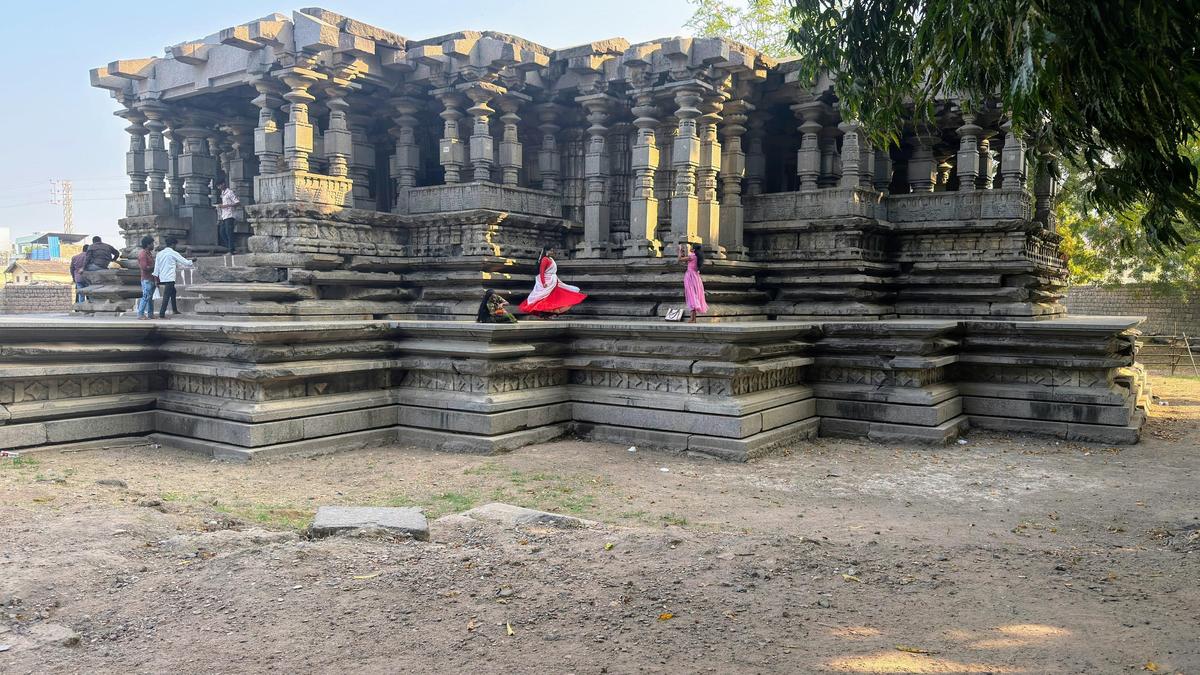
The Archaeological Survey of India (ASI) has achieved a monumental milestone by completing the 42-year-long restoration of the 12th-century dance pavilion (Kalyana Mandapam) at the Thousand Pillar Temple in Hanamkonda, Telangana. This meticulous reconstruction, which involved dismantling and reassembling the structure piece-by-piece, has not only revived a ransacked heritage site but also brought the ingenious "Sandbox Technology" of the Kakatiya era back into the global spotlight.
Hanamkonda’s Thousand Pillar Temple: A Trikutalaya Marvel
- Constructed in 1163 AD by the Kakatiya ruler Rudra Deva, the Thousand Pillar Temple is a masterpiece of medieval Indian architecture. It is a Trikutalaya—a triple-shrine temple—dedicated to the troika of Lord Shiva, Vishnu, and Surya Deva.
- Located in the historic city of Warangal, the temple is renowned for its star-shaped architecture, a design that provided greater surface area for the intricate carvings that characterize the Kakatiya style. While the temple is famous for its namesake "thousand pillars," the name actually derives from the sophisticated vertical carvings on many columns that create the visual illusion of multiple pillars.
- A major highlight of the temple complex is the monolithic Nandi. Carved from a single block of black basalt stone, this massive sculpture has also undergone recent restoration to repair its tail and folded leg, returning it to its original grandeur.
The Fall and Rise of the Kalyana Mandapam
The dance pavilion has endured a turbulent history. It was largely ransacked and damaged during the conquest by Ulugh Khan in 1323-24, leading to centuries of neglect. Over time, the structure suffered from foundational failure, causing it to sink into the earth. The restoration process was a complex "jigsaw puzzle" of stone, requiring modern engineers to re-learn the ancient geotechnical techniques used by the Kakatiyas to ensure the structure would remain stable for centuries to come.
Kakatiya-era Sandbox Technology: Ancient Earthquake Engineering
The most significant aspect of the temple’s durability is the use of Sandbox Technology, an indigenous geotechnical technique that predates modern seismic isolation methods.
How the Sandbox Works: Instead of building on conventional hard-rock foundations, Kakatiya engineers dug deep pits which were filled with a specific mixture:
- Primary Material: Fine sand.
- Binding Agents: A cocktail of lime, jaggery (unrefined sugar), and karakkaya (black myrobalan fruit).
This mixture created a flexible yet firm base. When the heavy stone pillars and beams were raised on this "sandbox," the foundation acted as a giant shock absorber.
Scientific Advantages:
- Seismic Resilience: During an earthquake, the sand acts as a cushion. Vibrations lose their intensity as they pass through the sand before reaching the stone structure. Laboratory tests indicate that this method can reduce vibration impact by nearly 60%.
- Unmatched Longevity: While modern rubber-based earthquake dampers degrade within 40 years, sand weathers at an incredibly slow rate. This technology has allowed Kakatiya monuments, including the UNESCO-listed Ramappa Temple, to survive for over 800 years.
- Sustainability: The technique is highly cost-effective and environmentally friendly, utilizing naturally available materials rather than industrial synthetics.