
Cell Broadcast System (CBS)
- 06 May 2026
In News:
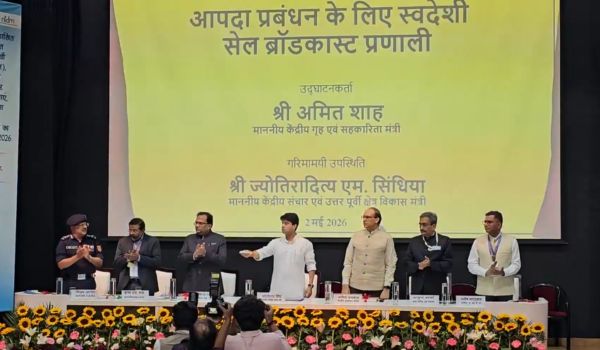
In a significant stride toward a "Disaster Resilient India," the Ministry of Communications recently launched the indigenously developed Cell Broadcast System (CBS). Developed by the Centre for Development of Telematics (C-DOT) in collaboration with the National Disaster Management Authority (NDMA), this technology marks a paradigm shift from a reactive to a proactive disaster management framework.
What is the Cell Broadcast System (CBS)?
The Cell Broadcast System is a mobile communication technology that allows the government to send critical, un-queued emergency alerts to all mobile devices within a specific geographical area. Unlike traditional Point-to-Point SMS, CBS is a one-to-many service.
- Developer: Centre for Development of Telematics (C-DOT).
- Protocol: Based on the Common Alerting Protocol (CAP), a global standard recommended by the International Telecommunication Union (ITU).
- Integration: It is integrated with the SACHET platform (India’s National Disaster Alert Platform), which consolidates alerts from various agencies like IMD, CWC, and INCOIS.
Core Mechanism: How it Works
CBS functions by broadcasting messages from a central platform to designated Base Transceiver Stations (BTS) or cell towers. These towers then transmit the alert to every active handset within their signal radius.
- No Queuing: Unlike SMS, which is delivered individually and can be delayed by network congestion, CBS messages are delivered to millions of users simultaneously.
- Network Independence: It does not require the recipient’s phone number or internet connectivity. As long as a phone is connected to a cell tower, it will receive the alert.
- Override Capabilities: The alerts bypass "Silent" or "Do Not Disturb" modes, appearing as a pop-up with a distinct loud siren and vibration to ensure immediate attention.
Key Features of the Indigenous CBS
|
Feature |
Deion |
|
Precise Geo-Targeting |
Alerts can be narrowed down to a single cell tower, a neighborhood, or scaled to an entire state. |
|
Multilingual Support |
Alerts are disseminated in English, Hindi, and local regional languages to ensure inclusivity. |
|
Accessibility |
Includes a "Read-Aloud" capability for the visually impaired and distinct tones for the hearing impaired. |
|
Device Compatibility |
Works across all generations of mobile technology, from 2G to 5G. |
|
Data Privacy |
Since it is a broadcast and does not require phone numbers, it does not track or store personal user data. |
CBS vs. Traditional SMS: A Comparative Analysis
- Bandwidth Efficiency: SMS uses the signaling channel which can crash during emergencies due to high traffic; CBS uses a dedicated broadcast channel.
- Speed: SMS is delivered in a "store and forward" manner (queuing), whereas CBS is "near real-time."
- Targeting: SMS targeting depends on the database of phone numbers; CBS targets anyone within the physical reach of a radio cell.
Significance for India’s Disaster Management
- Zero Lead Time Disasters: Highly effective for "now-casting" events like flash floods, lightning strikes, landslides, and gas leaks where every second counts.
- Technological Sovereignty: By developing this indigenously, India joins a select group of nations (like the USA and Japan) with homegrown emergency alert capabilities, reducing dependency on foreign vendors.
- Last-Mile Connectivity: Ensures that even the most remote populations with basic handsets receive life-saving information.
- Strengthening National Security: Provides a verified, official channel for government-to-citizen communication, which helps in curbing rumors and panic during crises.