
Metamaterials
- 07 May 2026
In News:
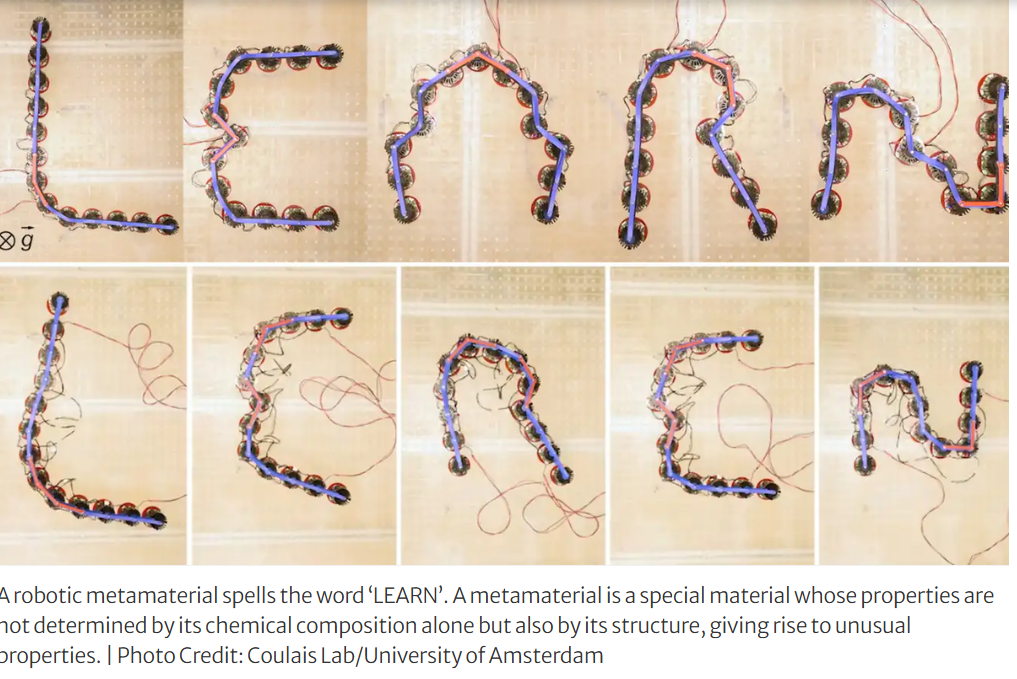
In a pioneering study published in Nature Physics in April 2026, researchers from the University of Amsterdam and across Europe have engineered synthetic metamaterials capable of "learning" and autonomously adapting their physical shape. By mimicking the adaptive behaviors of living organisms without a centralized processor or "brain," this breakthrough introduces the concept of embodied intelligence to materials science.
Core Technology: Structure Over Chemistry
Unlike traditional substances, metamaterials derive their properties from their engineered physical geometry rather than their chemical makeup.
- The Architecture: The material consists of chains of identical motorized hinges connected by an elastic skeleton.
- Hardware-Based Learning: Instead of relying on external software, each unit features a microcontroller that senses rotation and stores movement history. This allows the material to perform "reflex actions" and learn through direct physical interaction with its environment.
Key Mechanisms of Physical Adaptation
The research highlights three specialized physical behaviors that allow the material to "evolve":
- Contrastive Learning Scheme: The material utilizes a hardware-based contrastive learning mechanism. It compares different physical states—such as a "clamped" target shape versus a "free" spontaneous state—and adjusts its internal torque and stiffness until it achieves the desired configuration.
- Non-Reciprocity: This metamaterial breaks the standard laws of symmetry in physics. It responds differently based on the direction of the input. For example, a nudge from the left may result in a different bending pattern than a nudge from the right, allowing the material to discover multiple pathways to a final shape.
- Bistable Units: The inclusion of units that can exist in two stable states allows the material to switch and store shapes with minimal energy expenditure, effectively giving the material a "physical memory."
Strategic Significance and Applications
The ability of a material to learn, forget, and relearn shapes has transformative potential across several high-tech sectors:
- Soft Robotics: Enables "brainless" locomotion where robots can crawl, roll, or grab objects by adapting to unpredictable terrain without complex central programming.
- Biomedical Engineering: Development of adaptive prosthetic limbs and implants that can physically "learn" to adjust to a patient’s specific movements and anatomical changes.
- Intelligent Infrastructure: Smart materials that autonomously stiffen or change shape in response to environmental stresses like wind, vibration, or seismic activity.
- Distributed Systems: Swarm-like robotic systems where each component adapts independently, enhancing overall system resilience.
Current Challenges and Limitations
While a milestone in material physics, the technology currently faces several hurdles:
- Scalability: The system presently relies on relatively large hardware components and microcontrollers, making miniaturization a key future objective.
- Fabrication Complexity: Designing non-reciprocal and bistable structures requires highly specialized laboratory setups, hindering immediate mass production.
- Environmental Durability: The long-term reliability of these motorized hinges and elastic skeletons under real-world weather and stress conditions remains to be tested.