
Methane Alert and Response System
- 07 May 2026
In News:
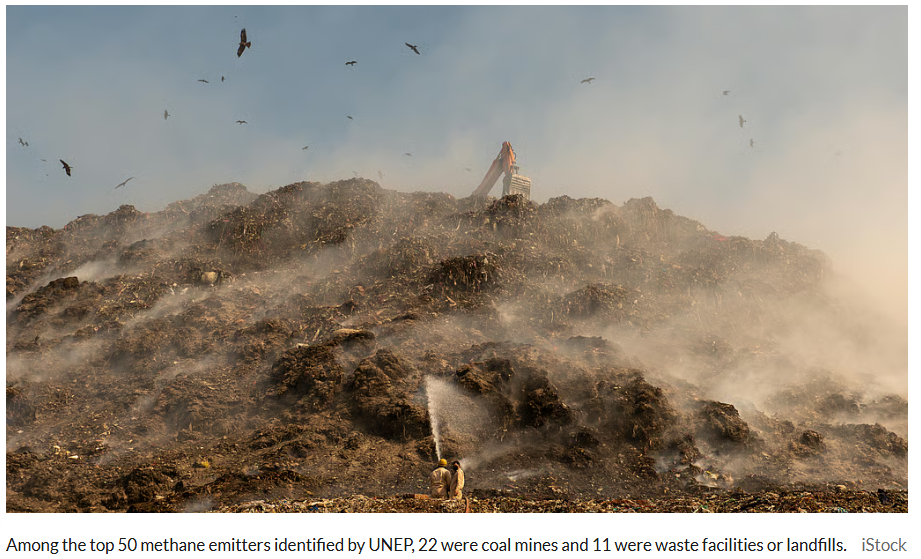
In a significant expansion of global climate surveillance, the United Nations Environment Programme (UNEP) recently announced that its Methane Alert and Response System (MARS) will now monitor emissions from coal mines and waste facilities. This expansion follows reports identifying specific high-emission sites, including Indian landfills, as among the world’s top methane emitters.
What is the Methane Alert and Response System (MARS)?
MARS is a sophisticated "data-to-action" platform integrated into the International Methane Emissions Observatory (IMEO). It represents the world's first public satellite-based system designed to detect and notify stakeholders of massive methane leaks in near real-time.
- Genesis: Announced at COP27 in November 2022, MARS began its pilot phase in January 2023. It serves as a technical engine to support the goals of the Paris Agreement and the Global Methane Pledge.
- Expansion: Initially focused solely on the oil and gas industry, the system now encompasses the coal and waste sectors, recognizing their substantial contribution to global warming.
Operational Framework: How MARS Functions
The system operates through a four-stage cycle designed to ensure that satellite data translates into atmospheric improvement:
- Detection: Utilizing high-resolution satellite imagery, MARS scans the globe to identify "super-emitter" events—large-scale, human-caused methane plumes.
- Notification: Once a major source is identified, the system alerts the relevant national governments and private companies responsible for the site.
- Response: Notified stakeholders are encouraged to investigate and mitigate the leak, shifting from a passive observation model to an active intervention model.
- Tracking: MARS monitors the site to verify whether corrective actions have been taken, providing a transparent record of progress and collaboration.
International Methane Emissions Observatory (IMEO)
Launched during the G20 Leaders Summit in 2021, the IMEO acts as the overarching body that gathers and reconciles methane data. It creates a "single version of the truth" by integrating information from four primary sources:
- Scientific Studies: Direct measurement-based research.
- Satellite Data: Primarily through the MARS framework.
- Industry Reporting: Specifically the Oil and Gas Methane Partnership 2.0 (OGMP 2.0), which is UNEP’s flagship program involving companies committed to transparent emissions reporting.
- National Inventories: Official data submitted by individual countries.
Strategic Significance for Climate Governance
Methane is a potent greenhouse gas with a global warming potential over 80 times that of carbon dioxide over a 20-year period. Addressing methane is considered the "fastest way" to slow down temperature rise in the short term.
- Accountability and Transparency: MARS removes the "invisibility" of methane leaks. By making data public, it creates reputational and environmental incentives for companies to fix leaks promptly.
- Addressing the Waste Sector: The inclusion of landfills and waste facilities is particularly relevant for rapidly urbanizing nations like India. Landfills often experience spontaneous fires and constant methane discharge due to organic waste decomposition.
- Support for Global Pledges: It provides the technical verification needed for the Global Methane Pledge, which aims to reduce global methane emissions by at least 30% from 2020 levels by 2030.
Challenges and the Path Ahead
While MARS provides the "alert," the "response" remains voluntary. The effectiveness of the system depends on:
- National Cooperation: Governments must be willing to act on the data provided by UNEP.
- Technology Gap: Distinguishing between natural methane seeps and human-caused leaks in complex topographies requires high-precision instrumentation.
- Infrastructure Investment: In sectors like waste management, capturing methane requires significant capital investment in "Waste-to-Energy" plants and scientific landfill capping.