
Citizenship (Amendment) Rules, 2026
- 04 May 2026
In News:
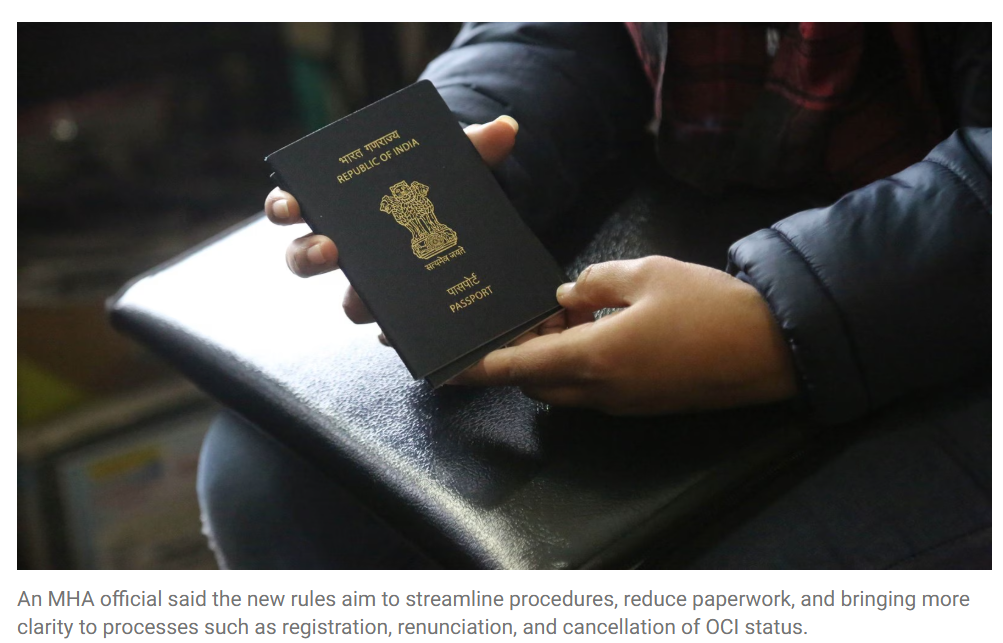
The Union Ministry of Home Affairs notified the Citizenship (Amendment) Rules, 2026 on 30 April 2026 (effective 1 May), marking the most significant overhaul of the Overseas Citizen of India (OCI) framework since the scheme began in 2006.
Background
The OCI scheme draws its authority from Sections 7A–7D of the Citizenship Act, 1955. It grants foreign nationals of Indian origin a lifelong multiple-entry visa and parity with NRIs in economic, educational, and cultural matters — but not citizenship. India's Constitution prohibits dual citizenship, a distinction these rules now sharpen. The 2026 amendment replaces the earlier hybrid paper-and-digital system with a fully electronic architecture and closes a loophole that let some families maintain both an Indian passport and a foreign passport for minor children.
Key Provisions
1. Ban on dual passports for minors: A new proviso to Rule 3 explicitly bars a minor from simultaneously holding an Indian passport and the passport of any other country. The earlier system only required parents to declare their child did not hold a foreign passport at birth registration — a gap now firmly shut.
- Families must choose: retain the Indian passport or wait until the child turns 18 to apply for OCI.
- Non-compliance can result in the OCI being deemed cancelled, even without physical surrender of the card.
2. Introduction of electronic OCI (e-OCI):Applicants may now receive an electronic OCI credential alongside, or in place of, the familiar physical blue booklet. A centralised, real-time registryallows immigration officers to verify OCI status instantly at airports and seaports.
3. Fully online applications — mandatory
All OCI services — registration (Form XXVIII, Section 7A), renunciation (Form XXXI), and cancellations — must now be filed exclusively through ociservices.gov.in. Physical submissions and couriered forms have been abolished.
- Processing time is expected to fall from 6–8 weeks to approximately 15 working days.
- Existing cardholders must update new passport details within 3 months of issuance; late updates attract a USD 25 fine.
4. Biometric integration with fast-track immigration:Applicants must consent to share biometric data, enabling automatic enrolment in the Fast Track Immigration – Trusted TravellerProgramme (FTI-TTP). This links OCI holders to e-gate corridors at major airports, reducing immigration queuing times for the Indian diaspora.
5. Strengthened appellate mechanism:Appeals against rejected OCI applications are now routed to an authority one rank higher than the original decision-maker, ensuring a defined and fairer right of hearing.
Significance
- Constitutional alignment: The dual-passport ban for minors closes a regulatory gap and brings OCI practice in line with India's constitutional prohibition on dual nationality.
- Digital governance: The shift aligns with the Digital India agenda — eliminating paperwork, reducing discretion, and enabling real-time verification.
- Diaspora convenience: e-OCI and biometric fast-tracking materially ease airport immigration for the ~4.5 million OCI cardholders worldwide.
- Privacy concerns: Mandatory biometric collection may face scrutiny under the right to privacy (Puttaswamy, 2017) and the Digital Personal Data Protection Act, 2023.
- Implementation challenge: The online-only mandate places pressure on portal reliability, especially for diaspora applicants in time zones far from India.
OCI is not dual citizenship. OCI holders carry only a foreign passport and enjoy specified parity rights — they cannot vote, hold constitutional offices, or purchase agricultural land in India.