
Whitley Awards
- 04 May 2026
In News:
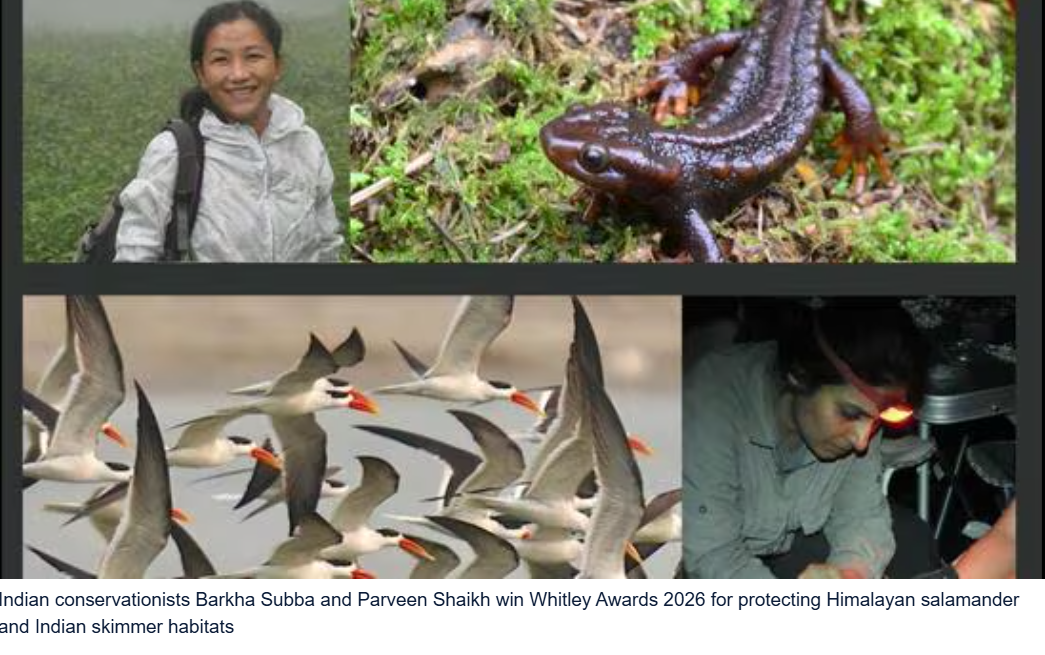
In a proud moment for Indian biodiversity conservation, two conservationists—Parveen Shaikh and Barkha Subbahave been honored with the prestigious Whitley Awards 2026. These awards recognize their pioneering grassroots efforts to protect two of India’s most threatened wetland-dependent species: the Indian Skimmer and the Himalayan Salamander.
The Whitley Awards: The "Green Oscars"
The Whitley Awards are among the world's most coveted prizes for environmental conservation, often referred to as the “Green Oscars.”
- Granting Body: Established by the UK-based charity Whitley Fund for Nature (WFN).
- Focus: The awards specifically target grassroots conservation leaders working in the Global South, providing them with the resources to scale up local solutions to the global biodiversity crisis.
- Support: Each winner receives £50,000 in project funding over a one-year period, alongside international recognition and networking opportunities.
Pioneering Conservation: The Indian Skimmer
- Parveen Shaikh, associated with the Wildlife Conservation Trust, has been awarded for her efforts in the Chambal River landscape.
About the Species:
- The Indian Skimmer (Rynchops albicollis) is a unique waterbird belonging to the Laridae family. It is distinguished by its peculiar feeding mechanism, where it flies low and "skims" the water surface with its elongated lower mandible to catch fish.
- Distribution & Habitat: While it is found across India, Bangladesh, and Pakistan, the Chambal River remains its most critical stronghold in India. It prefers large, sandy, lowland rivers and lakes.
- Conservation Status: Currently listed as Endangered on the IUCN Red List.
- Threats: The species faces severe pressure from habitat loss, sand mining, and the fluctuation of water levels due to dam management, which can wash away nesting sites on sandy banks.
Safeguarding Ancient Lineages: The Himalayan Salamander
Barkha Subba has been recognized for her work in the Eastern Himalayas, specifically focusing on the ecological and cultural protection of the Himalayan Salamander.
About the Species:
- The Himalayan Salamander (Tylototriton verrucosus) is a primitive, lizard-like amphibian. Despite its appearance, it lacks scales and possesses the permeable skin characteristic of amphibians.
- Biology: These creatures can grow up to 17 cm and live for about 11 years. They exhibit philopatry, meaning they return to their exact natal sites to breed. This trait makes them exceptionally sensitive to any degradation of their specific wetland habitats.
- Distribution: It is endemic to the Darjeeling region of India, as well as parts of Nepal and Bhutan.
- Cultural Connection: Interestingly, the wetlands utilized by these salamanders are often considered sacred by local communities, associated with indigenous deities and rituals.
- Conservation Status: Listed as Vulnerable by the IUCN.