
Mission Drishti by GalaxEye
- 05 May 2026
In News:
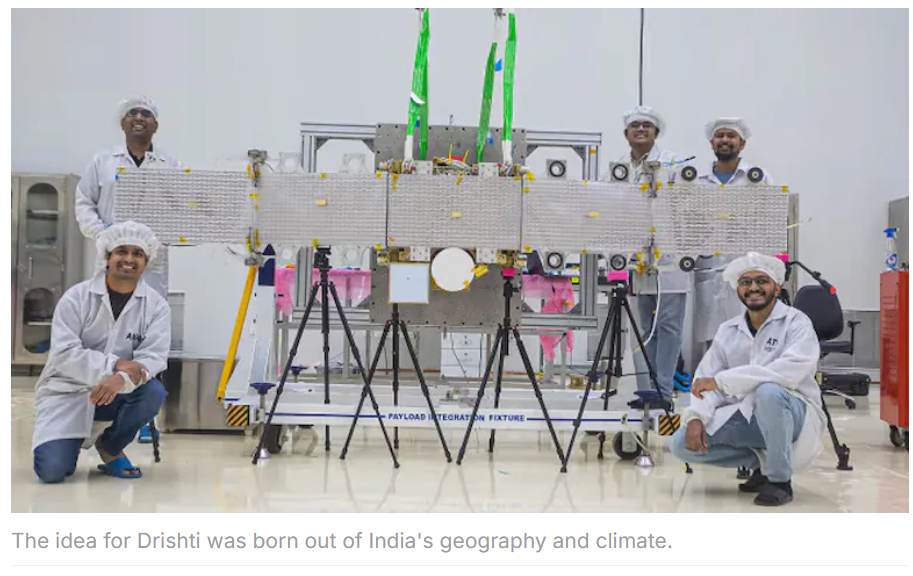
In a milestone for the Indian private space sector, Bengaluru-based startup GalaxEye has successfully launched ‘Mission Drishti’, the world’s first OptoSAR satellite. Launched aboard a SpaceX Falcon 9 rocket from Vandenberg, California, this mission represents a paradigm shift in Earth observation (EO), moving beyond the limitations of traditional imaging to provide high-clarity, all-weather data.
The Innovation: OptoSAR Technology
The core of Mission Drishti lies in its unique OptoSAR platform—the first of its kind globally. Traditional satellites typically use either optical sensors (which rely on sunlight) or radar (which can be difficult to interpret). Mission Drishti integrates both on a single platform:
- Synthetic Aperture Radar (SAR): An active sensor that can "see" through thick cloud cover, smoke, and total darkness.
- Electro-Optical (EO) Sensors: Provide high-resolution, intuitive visual details in various spectral bands.
By fusing these two datasets, the satellite provides "analysis-ready" imagery. This fusion eliminates the need for complex, time-consuming post-processing, allowing decision-makers to access fused data that is inherently aligned.
Technical Specifications and Launch Details
Mission Drishti is a testament to India's growing indigenous space-tech capabilities, supported and facilitated by IN-SPACe (Indian National Space Promotion and Authorization Center).
- Mass and Scale: At 190 kg, it holds the distinction of being India’s largest privately developed Earth observation satellite.
- Orbit: It operates in a Sun-synchronous Low Earth Orbit (LEO) at an altitude of approximately 500 km.
- Resolution and Spectrum: The satellite offers a spatial resolution of 1.2 to 3.6 meters. It operates across multiple spectral bands, including X-Band (SAR), PAN (Panchromatic), RGB, NIR (Near-Infrared), Coastal Blue, and Red Edge.
- Revisit Frequency: The satellite is designed for high-frequency monitoring, capable of revisiting the same geographic location every 4 days.
Strategic Significance for India and Global Stakeholders
The deployment of Mission Drishti addresses critical gaps in current orbital monitoring, particularly for tropical regions:
1. All-Weather Capability:Standard optical satellites are often rendered ineffective by cloud cover. For a country like India, which experiences heavy monsoons and frequent cloud cover, OptoSAR ensures uninterrupted surveillance and data collection throughout the year.
2. Dual-Use Applications:As a dual-use satellite, its data serves both civilian and strategic sectors:
- National Security & Defense: Monitoring borders and maritime boundaries regardless of lighting or weather conditions.
- Disaster Management: Real-time assessment of floods or cyclones where clouds typically obstruct conventional satellites.
- Environmental & Infrastructure: High-resolution monitoring for urban planning, agriculture, and red-edge sensing for vegetation health.