
India’s 1st Green Methanol Production Plant
- 04 May 2026
In News:
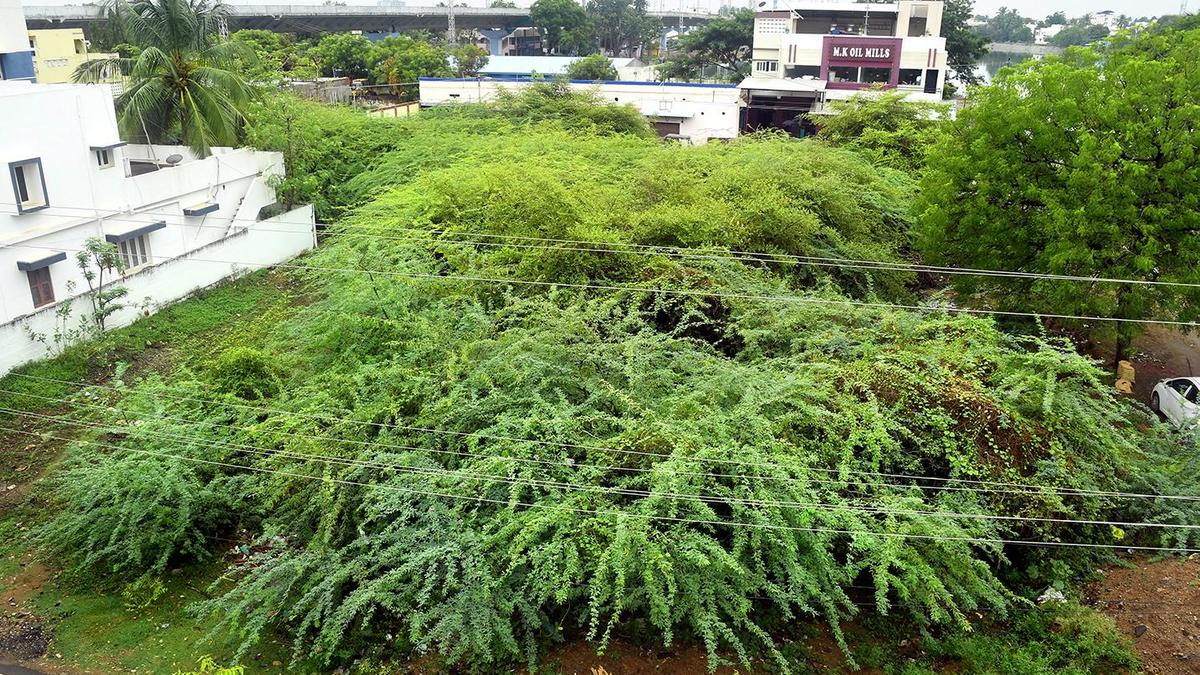
Prosopis juliflora — the invasive shrub that has degraded Kutch's Banni grasslands for decades — is set to become the feedstock for India's first green methanol production plant, bridging ecological restoration with clean energy.
Background
The Mexican-origin shrub Prosopis juliflora — known locally as gandobaval in Gujarat, vilayatikeekar in North India, and velikathan in Tamil Nadu — was first introduced by the British in the 1920s to green Delhi, and again by Gujarat's forest department in 1961 to check the advancing salt desert in the Rann of Kutch. Over decades, it spread aggressively across the Banni grasslands, crowding out native species and degrading one of India's most ecologically sensitive landscapes. Listed among the top 100 invasive species in the world, its removal has long been a conservation priority. India's first green methanol plant now proposes a productive use for this ecological liability.
About the Project
The plant and process
The facility, sited at the Deendayal Port Authority (DPA) in Kandla, will produce five tonnes of green methanol per day in its demonstration phase. The production follows a two-step pathway:
- Step 1 — Gasification (Ankur Scientific, Vadodara): Juliflora biomass is heated in the absence of oxygen, converting it into syngas — a mix of hydrogen (H?), carbon monoxide (CO), and CO?. Once the reaction begins, it sustains its own heat, requiring only about 10–15 litres of oil for a half-hour startup.
- Step 2 — Methanol synthesis (Thermax Energy, Pune): The syngas is catalytically converted into methanol, a liquid fuel suitable for ocean-going ships.
The plant will also be certified to run on other agricultural residues such as bagasse and cotton stalk, which could potentially displace up to a third of India's oil imports at maximum scale.
Why juliflora makes a good feedstock
- It is a hardwood with high density and a strong energy profile.
- Low acid content makes it technically well-suited for gasification.
- Its removal simultaneously serves Gujarat's ecological restoration goals — the state government already wants the species cleared.
Commercially viable plants will need to scale up to 100–500 tonnes per day. The Kandla project is explicitly a demonstration unit to prove the technology and build the business case.
Green Methanol — Key Facts
Methanol is conventionally produced from fossil fuels — natural gas or coal gasification — and used in shipping as a cleaner replacement to bunker oil. Green methanol differs fundamentally in its feedstock and carbon profile:
- Produced from biomass (bio-methanol) or green hydrogen (e-methanol), making it a renewable fuel.
- Reduces vessel CO? emissions by up to 95% and NOx by up to 80%, while eliminating sulphur oxides and particulate matter entirely.
- Overall lifecycle GHG reduction of 60–95% compared to conventional fossil methanol.
- E-methanol — produced using green hydrogen — represents the highest-purity form but currently costs around USD 2,000 per tonne vs. USD 700–800 for bio-based green methanol.
Policy and Regulatory Context
IMO and international shipping obligations
The International Maritime Organization's 2023 GHG Strategy mandates net-zero emissions from international shipping by or around 2050. The European Union has already begun levying charges on ships entering EU ports without a minimum share of green fuel — a regulatory pressure that is directly driving demand for green methanol in the near term.
India's policy alignment
- India amended its shipbuilding financial assistance policy in August 2023 to offer a flat 30% subsidy for vessels propelled by green fuels, including methanol, ammonia, and hydrogen.
- The government is developing "green ports" along India's western coast, for which facilities like the Kandla plant would supply fuel.
- The project supports India's broader push to reduce fossil fuel import dependence and meet its climate commitments under the Paris Agreement.
Cost challenge
Conventional methanol from natural gas costs approximately ?30 per kg under normal conditions, rising to ?70–80 during supply disruptions. Green methanol at USD 700–800 per tonne remains uncompetitive on price alone, making regulatory penalties the primary commercial driver for now. Scaling to 100–500 tonnes per day is considered the threshold for cost viability.
Significance
- Ecological: Converts a damaging invasive species into an economic resource, incentivising large-scale removal of juliflora from vulnerable grassland ecosystems.
- Energy: Advances India's green fuel production capacity and reduces dependence on imported bunker oil and fossil methanol.
- Maritime: Positions Indian ports as compliant with emerging IMO green fuel mandates, enhancing competitiveness of the shipping sector.
- Technological: Demonstrates indigenous gasification-to-methanol technology developed by Indian firms (Thermax and Ankur Scientific), with potential for replication at scale.
- Limitation: Grid electricity still powers the plant's motors and controls; for stricter carbon-intensity compliance, this must eventually come from renewables.