
India–New Zealand Free Trade Agreement
- 29 Apr 2026
In News:
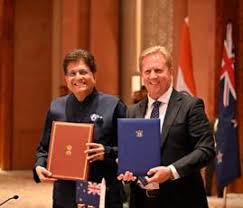
India and New Zealand signed a landmark Free Trade Agreement (FTA) at Bharat Mandapam, New Delhi. Concluded in a record nine months, this pact represents India’s 9th agreement with advanced economies, covering nearly 70% of global GDP. The deal is a "next-generation" partnership aimed at doubling bilateral trade to USD 5 billion within five years, while securing a massive USD 20 billion investment commitment from New Zealand over the next 15 years.
1. Trade in Goods: Unprecedented Market Access
The FTA provides a significant competitive edge to Indian exporters, particularly in labor-intensive sectors like textiles, leather, gems, and engineering goods.
- 100% Duty-Free Access for India: New Zealand will grant immediate duty-free access to all Indian exports. This removes previous peak tariffs of up to 10% on items like ceramics, carpets, and auto components.
- Duty-Free Inputs for Manufacturing: India secures zero-duty access to key industrial inputs such as wooden logs, coking coal, and metal scrap, which will lower production costs for domestic manufacturers.
- Calibrated Access for New Zealand: India has liberalized 70.03% of its tariff lines (covering 95% of trade value). While 30% of lines see immediate duty elimination, others will undergo phased reductions over 3 to 10 years.
2. Protection of Sensitive Sectors & Agriculture
A core pillar of the agreement is the "Productivity to Prosperity" model, which balances market opening with the protection of rural economies.
- The Exclusion List: To shield domestic farmers, India has kept 29.97% of tariff lines out of the deal. This includes all dairy products (milk, cheese, yogurt), sensitive vegetables (onions, peas, corn), sugar, edible oils, and arms/ammunition.
- Tariff Rate Quotas (TRQ): For specific high-demand items like Apples, Kiwifruit, and Manuka Honey, India will allow limited imports through a TRQ system. These are tied to Agriculture Productivity Action Plans, ensuring that New Zealand provides technical support to Indian farmers in exchange for market access.
- Centres of Excellence: The pact establishes partnerships for research, better planting material, and cold-chain logistics to improve Indian orchard management and food safety.
3. Services, Talent, and Mobility
This FTA marks a "first" in many categories regarding the movement of professionals and students.
- Temporary Employment Entry (TEE): A dedicated quota of 5,000 visas (up to 3 years) has been created for Indian professionals. This specifically includes AYUSH practitioners, yoga instructors, Indian chefs, and professionals in IT, healthcare, and engineering.
- Student Mobility: New Zealand has removed numerical caps on Indian students.
- Work Rights: Students can work 20 hours per week during studies.
- Post-Study Rights: 3 years for STEM Bachelor’s/Master’s graduates and 4 years for Doctoral scholars.
- Working Holiday Visas: 1,000 young Indians (annually) can access 12-month multiple-entry visas for global skill acquisition.
4. Strategic and Regulatory Breakthroughs
- USD 20 Billion Investment: A binding commitment from New Zealand to invest in India's infrastructure, renewable energy, and startups, backed by a "Rebalancing Clause" to address any shortfalls.
- Pharma Fast-Track: Market entry for Indian pharmaceuticals is accelerated by recognizing global standards (like US FDA/EMA), reducing duplicative inspections and costs.
- Geographical Indications (GI): New Zealand will amend its laws within 18 months to protect iconic Indian GIs (like Basmati rice or Darjeeling tea) beyond just wines and spirits.
- Traditional Knowledge & AYUSH: A first-of-its-kind chapter promotes Ayurveda, Yoga, and traditional wellness systems on a global scale.
5. India–New Zealand Relations: Strategic Context
The relationship has evolved from shared Commonwealth history to a modern strategic partnership in the Indo-Pacific.
- Indo-Pacific Alignment: New Zealand is aligning with India’s Indo-Pacific Oceans Initiative (IPOI) to counter regional maritime challenges and ensure a rules-based order.
- Economic Diversification: For New Zealand, the "Opening Doors to India" policy is a strategic move to reduce economic over-reliance on China.
- Diaspora: The Indian diaspora makes up 6% of New Zealand's population, acting as a vital bridge for "Track II" diplomacy.
Challenges to Overcome
Despite the optimism, the bilateral relationship faces hurdles:
- Strategic Ambivalence: New Zealand’s heavy economic dependence on China sometimes limits its geopolitical alignment with India.
- Security Frictions: The presence of pro-Khalistan elements in New Zealand remains a point of concern for Indian sovereignty.
- Transactional Views: Transitioning the relationship from a "labor and education market" to a deep-tech and defense partnership remains a work in progress.