
Holocene Fossil Discovery in Thoothukudi
- 29 Apr 2026
In News:
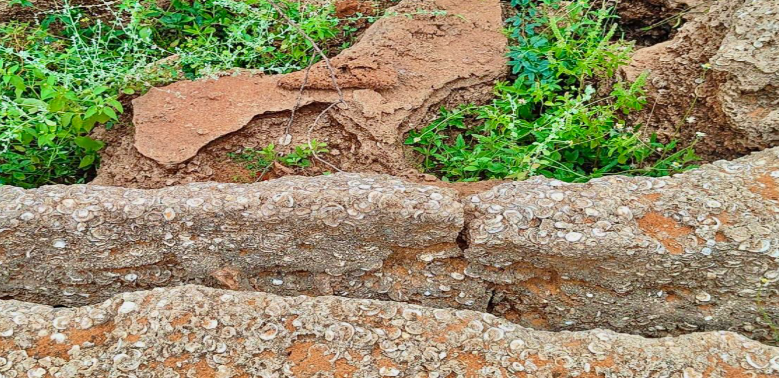
In a landmark paleontological discovery, a significant fossil bed dating back to the middle-to-late Holocene period (approximately 8,000 to 12,000 years ago) has been unearthed in the Panaiyur area of Thoothukudi district, Tamil Nadu. This discovery, revealed in late 2025 and scientifically validated in early 2026, marks the first documented fossil bed in the Thoothukudi region and a vital addition to India’s Quaternary fossil record.
The Discovery and Scientific Response
The site was initially exposed by torrential rains in 2023, which caused significant soil erosion and revealed buried sedimentary layers.
- Identification: Following a request from the local administration, the Zoological Survey of India (ZSI) conducted a swift and thorough field survey between January 5 and 10, 2026.
- Findings: Scientists collected 104 fossil specimens, primarily comprising marine invertebrate organisms such as bivalves (clams, oysters) and gastropods (snails).
- Geological Context: The fossils are embedded in sedimentary formations consisting of condensed sandstones and lateritic red soils. The presence of features like submarine canyons and water channels within these layers suggests a complex coastal history.
The Holocene Epoch: Context and Characteristics
The Holocene is the current geological epoch, the second part of the Quaternary Period (which also includes the preceding Pleistocene).
- Timeline: It spans roughly the last 11,700 years, beginning after the Earth’s last major ice age.
- Post-Glacial Transition: This epoch is defined by the melting of massive ice sheets, leading to a global sea-level rise (estimated at 35 meters in its early phase) and the stabilization of a warmer, tropical climate.
- The Anthropocene Link: Often associated with the rise of modern wildlife and the flourish of human agriculture and permanent settlements, the Holocene represents the environmental stage upon which human civilization developed.
Scientific Significance of the Panaiyur Discovery
This discovery is of immense value for reconstructing India’s paleoclimatic and biological past.
1. Paleoenvironmental Reconstruction: The marine fossils discovered are located 5 to 7 kilometers inland from the current coastline. This serves as critical evidence of past sea-level fluctuations, indicating that the area was once submerged. The assemblage points toward a shallow-marine to estuarine setting with warm, tropical temperatures and moderate water circulation.
2. Environmental Continuity: The species found in the fossil bed show a striking similarity to modern marine fauna in the Gulf of Mannar. This suggests a high degree of environmental continuity over the last 12,000 years, helping scientists understand how regional ecosystems remained stable or responded to historical climate shifts.
3. Enhancing the Quaternary Record: Quaternary fossil sites in southern India are relatively rare. The Panaiyur find fills a significant gap in the national inventory, providing high-resolution data on Holocene sedimentology, including bioturbation (organism burrowing) and cross-stratification (layering by currents).