
Cabinet Approves Establishment of ‘Third Launch Pad’ at ISRO's Sriharikota Facility
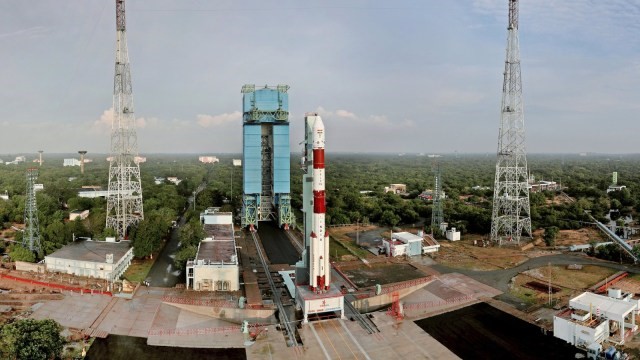
- 16 Jan 2025
In News:
The Union Cabinet, has approved the establishment of a Third Launch Pad (TLP) at the Satish Dhawan Space Centre (SDSC), located at Sriharikota, Andhra Pradesh. This project marks a significant step in enhancing India’s space capabilities and will support the Next Generation Launch Vehicles (NGLV) for ISRO’s evolving space exploration programs.
Key Features of the Third Launch Pad
The TLP will be built with an adaptable design, capable of supporting NGLV and LVM3 vehicles with semi-cryogenic propulsion. The launch pad will also serve as a standby for the Second Launch Pad (SLP) at Sriharikota. This addition will help ISRO meet its growing launch capacity needs, particularly for future human spaceflight missions and space exploration projects. It will facilitate higher launch frequencies, thus boosting the Indian space ecosystem.
Implementation Strategy and Timeline
The Third Launch Pad is planned to be developed within 48 months (4 years), with the total cost pegged at ?3984.86 Crore. The development will involve maximized industry participation and will utilize existing infrastructure at the launch complex. The project will also leverage ISRO’s experience gained from establishing the earlier launch pads.
The Importance of the Third Launch Pad
The TLP is designed to support the Next Generation Launch Vehicles (NGLV), a key part of ISRO’s vision for space exploration. The facility will not only accommodate heavier vehicles but will also ensure standby capacity for the Second Launch Pad (SLP). Its strategic location at Sriharikota ensures several advantages:
- Proximity to the Equator: This offers a substantial increase in payload capacity due to the additional push provided by the Earth's rotation.
- Safety and Accessibility: The site is free from major international maritime or airline routes, ensuring a safe flight path.
- Geographical Advantage: The launch pad is situated on the eastern coast, enabling launches in an easterly direction, maximizing the benefits of Earth’s rotational speed.
Future Plans for Indian Space Exploration
The establishment of the Third Launch Pad is crucial for the expanded vision of India’s space program, particularly in line with the Amrit Kaal period. ISRO aims to achieve ambitious milestones, such as the Bharatiya Antariksh Station (BAS) by 2035 and an Indian Crewed Lunar Landing by 2040. The NGLV will play a pivotal role in these plans, with features like:
- A three-stage vehicle and reusable first stage.
- Semi-cryogenic propulsion, using refined kerosene and liquid oxygen, which will increase payload capacity by three times at 1.5 times the cost of current vehicles.
The Role of Sriharikota in India’s Space Program
Sriharikota, the hub of ISRO’s launch operations, has been integral to India’s space exploration. Currently, the Indian Space Transportation Systems rely on two operational launch pads:
- First Launch Pad (FLP): Established over 30 years ago for PSLV and SSLV missions, FLP continues to support Polar Satellite Launch Vehicle (PSLV) and Small Satellite Launch Vehicle (SSLV) launches.
- Second Launch Pad (SLP): Built primarily for GSLV and LVM3 vehicles, SLP also serves as a standby for PSLV. Over its 20 years of operation, SLP has supported several national missions, including Chandrayaan-3, and is preparing for the Gaganyaan missions.
Cabinet approves Flood Management and Border Areas Programme (FMBAP) for the period 2021-26
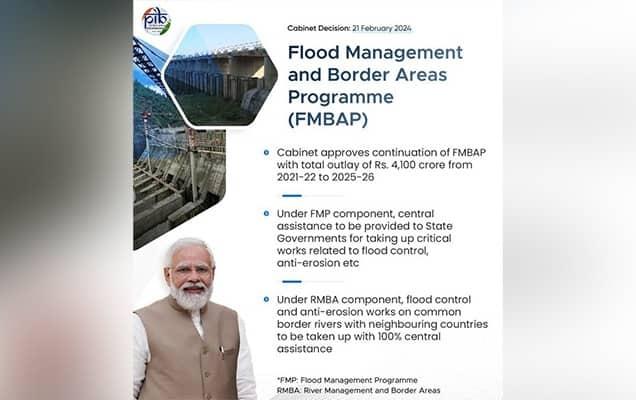
- 22 Feb 2024
Why is it in the News?
Recently, the Union Cabinet approved the continuation of “Flood Management and Border Areas Programme (FMBAP)” with a total outlay of Rs. 4,100 crore for a period of 5 years from 2021-22 to 2025-26.
About the Flood Management and Border Areas Programme (FMBAP):
- The FMBAP Scheme is being implemented throughout the country for effective flood management, erosion control and anti-sea erosion and to help in maintaining peace along the border.
- The scheme benefits towns, villages, industrial establishments, communication links, agricultural fields, infrastructure etc. from floods and erosion in the country.
- The catchment area treatment works will help in the reduction of sediment load into rivers.
- The Scheme aims at the completion of the ongoing projects already approved under FMP.
The Scheme has two components:
- Under the Flood Management Programme (FMP) component of FMBAP with an outlay of Rs. 2940 crore, central assistance will be provided to State Governments for taking up critical works related to flood control, anti-erosion, drainage development and anti-sea erosion, etc.
- The pattern of funding to be followed is 90% (Centre): 10% (State) for Special Category States (8 North-Eastern States and Hilly States of Himachal Pradesh, Uttarakhand and UT of Jammu & Kashmir) and 60% (Centre):40% (State) for General/ Non-Special Category States.
- Under the River Management and Border Areas (RMBA) component of FMBAP with an outlay of Rs. 1160 crore, flood control and anti-erosion work on common border rivers with neighbouring countries including hydrological observations and flood forecasting, and investigation & pre-construction activities of joint water resources projects (with neighbouring countries) on common border rivers will be taken up with 100% central assistance.
- The Scheme has the provision of incentivizing the States which implement flood plain zoning, recognized as an effective non-structural measure for flood management.
Importance:
- While the primary duty of flood management lies with the State Governments, the Union Government actively promotes and advocates for the adoption of modern technology and innovative approaches.
- Additionally, projects executed under the RMBA component serve to safeguard critical installations of security agencies and border outposts situated along border rivers from the perils of floods and erosion.
- Furthermore, the scheme includes provisions for incentivizing states that implement flood plain zoning, a recognized and effective non-structural measure for flood management.
Pradhan Mantri Matsya Kisan Samridhi Sah-Yojana (PM-MKSSY) (PIB)

- 09 Feb 2024
Why is it in the News?
Recently, the Union Cabinet approved the Pradhan Mantri Matsya Kisan Samridhi Sah-Yojana (PM-MKSSY), a sub-scheme under the Pradhan Mantri Matsya Sampada Yojana.
About Pradhan Mantri Matsya Kisan Samridhi Sah-Yojana:
- Implemented as a Central Sector Sub-scheme within the broader framework of the PMMSY, this initiative aims to bolster the fisheries sector.
- Funding: With an estimated outlay of Rs. 6,000 crore, the scheme comprises 50% public finance, including contributions from the World Bank and the AFD, and the remaining 50% anticipated investment from beneficiaries and the private sector.
- Duration: Operational for four years from FY 2023-24 to FY 2026-27, spanning all States and Union Territories.
Intended Beneficiaries:
- Fishers, Fish (Aquaculture) Farmers, Fish workers, Fish Vendors or such other persons directly engaged in the fisheries value chain.
- Micro and Small enterprises in the form of Proprietary Firms, Partnership Firms and Companies registered in India, Societies, Limited Liability Partnerships (LLPs), Cooperatives, Federations, Village Level Organizations like Self Help Groups (SHGs), Fish Farmers Producer Organizations (FFPOs) and Startups engaged in fisheries and aquaculture value chains.
- FFPOs also include Farmer's Producer Organizations (FPOs).
- Any other beneficiaries that may be included by the Department of Fisheries, Gol as targeted beneficiaries.
Aims and objectives of PM-MKSSY:
- Gradual Formalization of the unorganized fisheries sector through self-registration of fishers, fish farmers and supportive workers under a National Fisheries Sector Digital Platform including the creation of work-based digital identities of fish workers for improved service delivery.
- Facilitating access to institutional financing fisheries sector micro and small enterprises.
- Providing a one-time incentive to beneficiaries for purchasing aquaculture insurance.
- incentivising fisheries and aquaculture microenterprises through performance grants for improving fisheries sector value-chain efficiencies including the creation and maintenance of jobs.
- Incentivising micro and small enterprises through performance grants for the adoption and expansion of fish and fishery product safety and quality assurance systems including the creation and maintenance of jobs.
Uniform Civil Code (Indian Express)

- 05 Feb 2024
Why is it in the News
The Uttarakhand Cabinet on Sunday approved the final draft of the Uniform Civil Code (UCC) without any changes, a day before the state Assembly convenes for a special session to take up the Bill.
What is Uniform Civil Code (UCC)?
- A Uniform Civil Code signifies a unified legal framework for the entire country, applicable across all religious communities concerning personal matters like marriage, divorce, inheritance, and adoption.
- The objective is to replace the current fragmented personal laws that govern interpersonal relationships within different religious communities.
Constitutional Framework:
- Article 44 of the Constitution mandates the State to strive for a Uniform Civil Code applicable to all citizens.
- Positioned in Part-IV as a Directive Principle, Article 44, while not justiciable, serves as a fundamental governance guideline.
- These principles, outlined in Article 37, provide overarching ideas for the State to consider in policy formulation and law enactment.
Current Landscape of Personal Laws:
- In the Concurrent list of the Constitution, matters such as marriage, divorce, and inheritance fall under both Parliament and state legislature jurisdictions.
- Hindu personal laws have been codified into four parts since 1956, while Muslim laws, not codified per se, draw from religious texts.
- Christians, Zoroastrians, and Jews are governed by their own personal laws. Goa stands as an exception, following the Portuguese Civil Code.
Need for Uniform Civil Code:
- A UCC aims to establish equal status for all citizens, addressing the inconsistency and lack of uniformity in personal laws across different religions.
- This inconsistency, conflicting with Article 14's Equality before the Law guarantee, often results in gender disparities.
Challenges and Criticisms:
- While advocating equality, the UCC concept raises concerns about potential clashes with the Right to Freedom of Religion (Article 25).
- Critics argue that separate personal laws uphold the right to practice one's religion, particularly crucial for minorities.
- Striking a balance, the Law Commission's 2018 report suggests preserving diversity in personal laws while ensuring alignment with fundamental rights.
The Way Forward:
- Encouraging a progressive mindset through education, awareness, and sensitization is vital for understanding the spirit of the UCC.
- Simultaneously, discriminatory personal laws should be amended or abolished.
- The Law Commission recommends codifying different personal laws to derive universal principles prioritizing equity, rather than imposing a blanket Uniform Civil Code
Animal Husbandry Infrastructure Development Fund (PIB)
- 02 Feb 2024
Why is it in the News?
The Union Cabinet chaired by Prime Minister Shri Narendra Modi approved the continuation of the Animal Husbandry Infrastructure Development Fund (AHIDF) to be implemented under the Infrastructure Development Fund (IDF) with an outlay of Rs.29,610.25 crore for another three years up to 2025-26.
About the Animal Husbandry Infrastructure Development Fund:
- This initiative operates as a Central Sector Scheme aimed at incentivizing investments from various entities, including individual entrepreneurs, private companies, MSMEs, Farmer’s Producers Organizations (FPOs), and Section 8 companies.
- These investments are directed towards establishing infrastructure for:
- Dairy processing and value addition
- Meat processing and value addition
- Animal feed plants
Objectives:
- Facilitating the expansion of milk and meat processing capacity and diversification of products, thereby granting unorganized rural milk and meat producers greater access to organized markets.
- Enhancing price realization for producers and ensuring the availability of quality milk and meat products for domestic consumers.
- Promoting exports and elevating the sector's contribution to export revenue.
- Providing quality concentrated animal feed to cattle, buffalo, sheep, goat, pig, and poultry, ensuring balanced rations at affordable prices.
- The Government of India offers a 3% interest subvention for a period of 8 years, including a two-year moratorium, for loans covering up to 90% of the investment.
- These loans are accessible from scheduled banks, the National Cooperative Development Corporation (NCDC), NABARD, and NDDB.
- Notably, government entities and cooperatives are excluded from availing benefits under this scheme.
What is Animal Husbandry?
- Animal husbandry encompasses the controlled cultivation, management, and production of domestic animals, with a focus on enhancing desirable qualities through breeding.
- It serves as a vital branch of agriculture dedicated to animals raised for various purposes such as meat, fibre, milk, and other products.
- This involves day-to-day care, selective breeding, and the overall management of livestock.
- In India, animal husbandry plays a crucial role in the livelihoods of many farmers, offering significant self-employment opportunities, particularly for landless labourers, small and marginal farmers, and women.
- The sector contributes to providing affordable and nutritious food to millions of Indians through the production of meat, eggs, milk, and other essential items.
- Additionally, it serves as a valuable source of raw materials such as hides, skins, bones, blood, and fat.
- Animals are often regarded as the best insurance against natural calamities like drought, famine, and other adversities, providing a degree of stability to farmers in unpredictable conditions.
Cabinet clears PRITHVI initiative for ease of research in earth sciences (Indian Express)

- 06 Jan 2024
Why is it in the News
The government Friday approved an initiative that will give it the flexibility to pursue research and use funds allocated to five different sub-schemes related to earth sciences over a five-year period.
About the PRITHVI Scheme:
- The PRITHVI Scheme is an initiative by the Ministry of Earth Sciences (MoES) designed to deepen our understanding of the Earth and its essential indicators.
- With a substantial allocation of Rs 4,797 crore spanning 2021-26, this comprehensive initiative aims to significantly advance research, modeling, and service delivery in critical domains like weather, climate, oceans, and polar regions.
- The scheme amalgamates five existing sub-schemes:
- Atmosphere and Climate Research-Modelling Observing Systems and Services (ACROSS)
- Ocean Services, Modelling Application, Resources and Technology (O-SMART)
- Polar Science and Cryosphere Research (PACER)
- Seismology and Geosciences (SAGE)
- Research, Education, Training, and Outreach (REACHOUT).
- Collectively, these programs strive to deepen our comprehension of Earth's vital signs and translate scientific knowledge into practical services for the benefit of society, the environment, and the economy.
Objectives:
- A primary aim of PRITHVI is to enhance and sustain long-term observations across the atmosphere, ocean, geosphere, cryosphere, and solid earth.
- This facilitates the recording and monitoring of vital signs and changes within the Earth System.
- The scheme places emphasis on developing predictive models for weather, ocean, and climate hazards while advancing our understanding of climate change science.
- Exploring polar regions and high seas is a significant aspect, targeting the discovery of new phenomena and resources.
- The scheme underscores the development of technology for exploring and sustainably harnessing oceanic resources for societal applications.
Implementation:
- Various components of the PRITHVI scheme are interdependent, executed in an integrated manner through the collective efforts of the institutes under the MoES.
Fast Track Special Court (FTSC) (The Hindu)

- 30 Nov 2023
Why is it in the News?
The Union Cabinet recently gave its approval for the three-year extension of fast-track courts that are specifically used to handle sexual offense cases.
About Fast Track Special Court (FTSC):
- The Fast Track Special Court (FTSC) initiative started in August 2019 as a centrally sponsored scheme to handle cases related to rape and the POCSO Act.
- Originally planned for one year, it got extended to March 2023, and now it's extended further until March 2026 with a financial allocation of Rs. 1952.23 crore from the Nirbhaya Fund.
- These specialized courts, totaling 761, including 414 exclusive POCSO Courts, operate across all States and Union Territories.
- The Department of Justice, Ministry of Law & Justice, oversees their implementation.
- The primary aim is to expedite justice, offering quick relief to victims and reinforcing the nation's commitment to ending sexual and gender-based violence.
- The expected outcomes of this scheme are significant.
- They include a substantial reduction in pending cases related to Rape & POCSO Act, providing swift access to justice for victims through improved facilities and expedited trials, and reducing the burden on the judicial system by managing the number of cases effectively.