
50th Anniversary of Sikkim’s Integration with India
- 01 May 2026
In News:
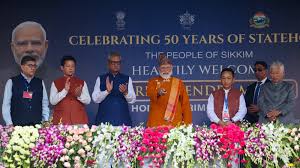
The 50th year of Sikkim’s statehood marks a historic milestone in India’s democratic journey. Celebrating its integration in 1975, the "Land of the Peaks" has transitioned from a protectorate Himalayan kingdom to a national vanguard of ecological sustainability. During the closing ceremony in Gangtok, the Prime Minister emphasized that Sikkim’s organic model now serves as the blueprint for "Viksit Bharat" (Developed India).
Historical Evolution and Integration (1642–1975)
Sikkim’s journey into the Indian Union is a unique chapter in constitutional history, marked by a gradual transition from monarchy to democracy.
- The Chogyal Monarchy: From 1642, Sikkim was ruled by the Namgyal dynasty. During the British era, the Treaty of Tumlong (1861) established it as a British protectorate, while the Calcutta Convention (1890) demarcated its sensitive border with Tibet.
- The Protectorate Era (1947–1974): Upon India's independence, the Indo-Sikkim Treaty of 1950 maintained Sikkim’s autonomy while vesting India with responsibility for its defense, external affairs, and communications.
- The Transition Phases:
- Associate State (1974): Responding to popular democratic fervor, the 35th Constitutional Amendment Act created a unique "Associate State" status, the only instance in Indian history.
- Full Statehood (1975): Following a public referendum where 97.5% voted for integration, the 36th Constitutional Amendment Act officially established Sikkim as the 22nd State of India on May 16, 1975.
Constitutional Safeguards: Article 371F
To preserve the distinct socio-cultural fabric of the region, Article 371F was inserted into the Constitution.
- Legislative Protection: It safeguards "old laws" of Sikkim and restricts land ownership to indigenous residents to prevent demographic shifts.
- Fiscal Autonomy: Under this article and Section 10(26AAA) of the Income Tax Act, native Sikkimese residents are exempt from central income tax on earnings generated within the state, honoring the terms of the 1975 merger.
The "Sikkim Model": Global Pioneer in Organic Farming
In 2016, Sikkim became the world’s first 100% organic state. This transition was not merely agricultural but a holistic shift in governance recognized by the UN FAO Future Policy Gold Award (2018).
Strategic Significance of the Model:
- Ecological Balance: By banning chemical fertilizers, the state has halted groundwater contamination and protected critical pollinators.
- Climate Resilience: Organic soil structures exhibit higher carbon sequestration and water-holding capacity, vital for the fragile Himalayan ecosystem.
- Economic Livelihoods: The "Sikkimese Premium" allows farmers to command higher market prices, while the "100% Organic" tag has catalyzed wellness-based eco-tourism.
Geography and Strategic Biodiversity
Sikkim’s location makes it one of India’s most strategically vital and ecologically dense regions.
- The Teesta River System: Often called the lifeline of Sikkim, the Teesta (a tributary of the Brahmaputra) and the Rangit drain the state. The management of Teesta waters remains a focal point in Indo-Bangladesh hydro-diplomacy.
- Strategic Borders & Passes: Bordered by Nepal, Bhutan, and China (Tibet), it hosts critical passes like Nathu La and Jelep La, which are essential for border trade and national security.
- Kanchenjunga National Park: Inscribed as India's first UNESCO Mixed World Heritage Site (2016), it honors both the natural biodiversity and the cultural sacredness of Mt. Kanchenjunga—India’s highest peak.
- Endemic Fauna: The state is a stronghold for the Red Panda (State Animal), Snow Leopard, and Blue Sheep.