
e-SafeHER
- 15 Apr 2026
In News:
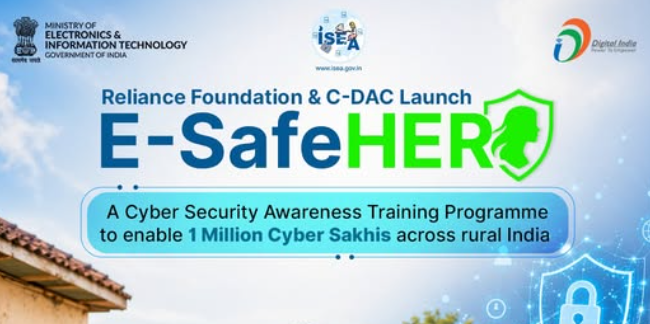
In a major stride toward a "Cyber Secure Bharat," the Ministry of Electronics and Information Technology (MeitY) has launched e-SafeHER. This specialized cybersecurity training initiative is designed to empower one million women across rural India by 2029, ensuring that the rapid expansion of digital access is matched by robust digital security.
Overview and Institutional Framework
- The e-SafeHERprogramme addresses the critical awareness gap for rural women who are increasingly entering the digital economy.
- It operates as a strategic partnership under MeitY’s larger Information Security Education and Awareness (ISEA) framework.
- The initiative is a collaborative effort involving several key stakeholders. While MeitY serves as the nodal ministry, the Centre for Development of Advanced Computing (C-DAC), Hyderabad, acts as the technical partner, leading the development of technical content and localized training modules.
- To ensure grassroots reach, the Reliance Foundation serves as the implementation partner, leveraging its extensive community network to deliver the programme on the ground.
Core Objectives
The programme is built around three primary pillars:
- Safe Digital Participation: Enabling women to navigate the digital ecosystem securely and protecting them from rising risks such as financial fraud and identity theft.
- Economic Empowerment: Building the necessary confidence for women to utilize digital platforms for banking, micro-enterprises, and online livelihoods.
- Grassroots Integration: Extending the national cybersecurity framework to the remotest regions of India through a gender-responsive and sustainable model.
Key Features of the Initiative
- The Cyber Sakhi Model: At the heart of the programme is a peer-led, community-based model. It identifies and trains local women to become "Cyber Sakhis" (Cyber Friends). These women act as peer educators, translating complex technical concepts into relatable advice for their local communities.
- Leveraging Social Capital through SHGs: Rather than building new infrastructure, e-SafeHER utilizes the existing network of Self-Help Groups (SHGs). This allows the initiative to penetrate deep into rural regions and foster trust, as the training is delivered by familiar faces within established social circles.
- Multilingual and Localized Content: To overcome literacy and language barriers, C-DAC has developed audio-visual modules adapted into multiple Indian languages. This localization ensures that the training is accessible to women regardless of their formal educational background.
- Phased Implementation and Scaling: The programme follows an evidence-based scaling strategy. It is initially being implemented in Madhya Pradesh and Odisha, with insights from these regions serving as a blueprint for national expansion. The goal is to reach the one-million-women milestone over a three-year horizon.
- Blended Learning for Behavioral Change: The initiative combines structured technical training with community-based interventions. By focusing on blended learning, the programme aims for measurable behavioral shifts, such as the adoption of secure password practices and the ability to identify phishing attempts.