
TheridionHimalayana
- 30 Apr 2026
In News:
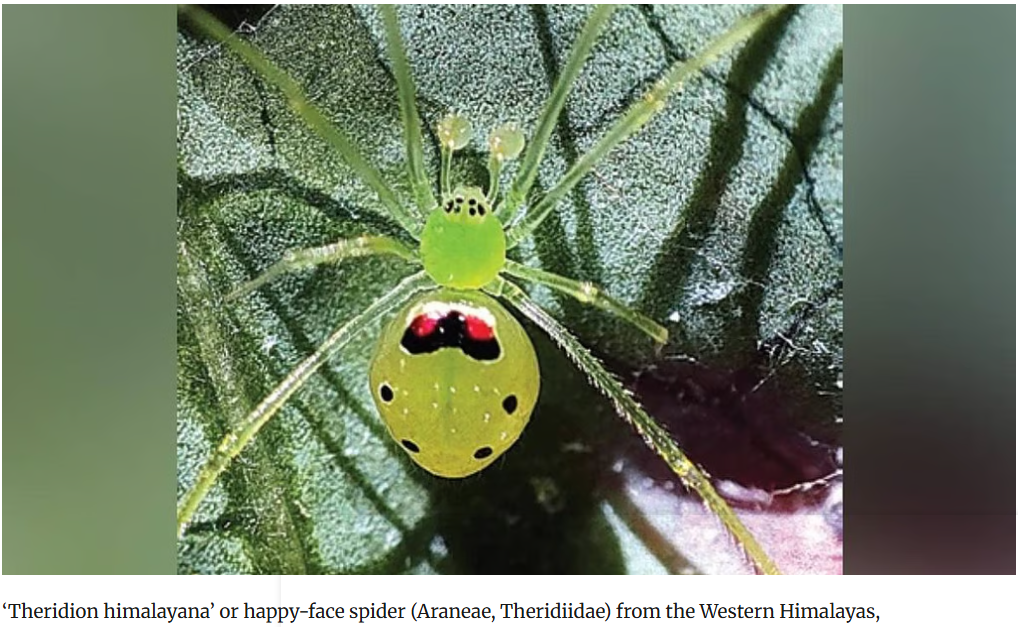
In a significant addition to India’s Himalayan biodiversity, a team of scientists, including experts from Odisha, has discovered a new species of spider named Theridionhimalayana. Found in the high-altitude landscapes of the Western Himalayas, this discovery highlights the ecological richness of the region and the complex evolutionary traits of the Theridiidae family.
Classification and Distinctive Features
Theridionhimalayana is categorized as a "happy-face spider" due to the striking patterns on its abdomen that resemble a smiling human face. It belongs to the Theridiidae family, commonly known as cobweb spiders or tangle-web spiders.
1. Extreme Polymorphism
One of the most remarkable characteristics of this species is its polymorphism. Both males and females exhibit a vast array of physical variations.
- 32 Different Morphs: Scientists have identified 32 distinct color variations (morphs).
- Facial Patterns: These patterns consist of dots in shades of red, black, and white, arranged in different configurations to mimic a "smiling" appearance.
2. Unique Reproductive Anatomy
The species is distinguished from its relatives by its specialized reproductive structures:
- Copulatory Ducts: These are notably long and strongly curved. They project forward and run nearly parallel before bending downward at their distal ends.
- Fertilization Ducts: In contrast, these are short and thin, pointing upward and spreading apart in a characteristic V-shape.
Ecological Role and Importance
The discovery of Theridionhimalayana is not just a taxonomic milestone but also an indicator of forest health.
- Biological Pest Control: The species preys primarily on small flies and various forest insects. By maintaining the balance of these populations, it plays a vital role in natural insect control within the Himalayan ecosystem.
- Potential Pollinator: Preliminary observations suggest that the species may serve as a crucial pollinator for specific high-altitude plants, a role that is relatively rare among spiders and requires further research.