
40 years of the Chernobyl Disaster
- 28 Apr 2026
In News:
April 2026 marks the 40th anniversary of the Chernobyl disaster, an event that remains the most expensive man-made catastrophe in human history. With total costs exceeding $700 billion over four decades, the accident serves as a somber benchmark for the risks inherent in nuclear power when engineering flaws meet human error.
The Catastrophe: What Happened at Unit 4?
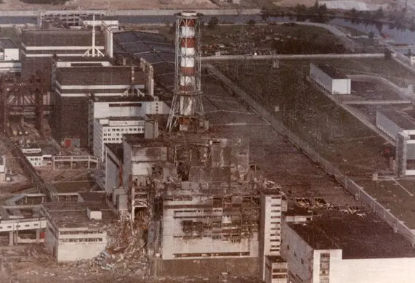
On the night of April 25–26, 1986, technicians at the Chernobyl nuclear power station—located near Pripyat in the former Soviet Union (present-day Ukraine)—initiated a safety experiment on the Unit 4 RBMK reactor. The goal was to test if the cooling pumps could still function during a power outage using the residual energy from a spinning turbine.
The experiment triggered a sequence of catastrophic failures:
- Design Vulnerabilities: The RBMK reactor was a graphite-moderated system with a critical flaw: it lacked a containment structure. In modern nuclear plants, this thick concrete and steel shell acts as a final physical barrier to prevent the escape of radiation during a meltdown.
- The Explosion: The chain reaction surged out of control, causing a massive steam explosion that blew the heavy lid off the reactor. Approximately 3.5% of the nuclear fuel was immediately dispersed into the atmosphere.
- The Graphite Fire: A subsequent fire in the graphite moderator burned for several days, acting as a chimney that sent plumes of radioactive isotopes high into the air, eventually spreading across Ukraine, Belarus, Russia, and reaching as far as Scandinavia.
Human and Environmental Toll
The scale of the disaster necessitated an unprecedented humanitarian and logistical response.
- Mass Displacement: Within 36 hours, the industrial town of Pripyat was evacuated. Ultimately, around 200,000 people were permanently relocated as their homes became part of a contaminated landscape.
- Environmental Impact: Nearly 150,000 square km of land across Eastern Europe was contaminated. Today, a 30-kilometer Exclusion Zone remains around the plant, where human habitation is strictly restricted due to high levels of soil radiation.
- Health Crisis: The health consequences were profound and long-lasting. Between 1991 and 2005, authorities documented at least 5,000 cases of thyroid cancer specifically in children who were exposed to radioactive iodine through contaminated milk and air.
Containment and Current Status
To prevent further leakage, the remains of Unit 4 were initially encased in a temporary concrete "sarcophagus." In recent years, this was replaced by the New Safe Confinement, a massive, arch-shaped steel structure designed to entomb the radioactive debris for the next century, allowing for the eventual stable decommissioning of the site.