
Giant Malabar Squirrel
- 04 Jun 2026
In News:
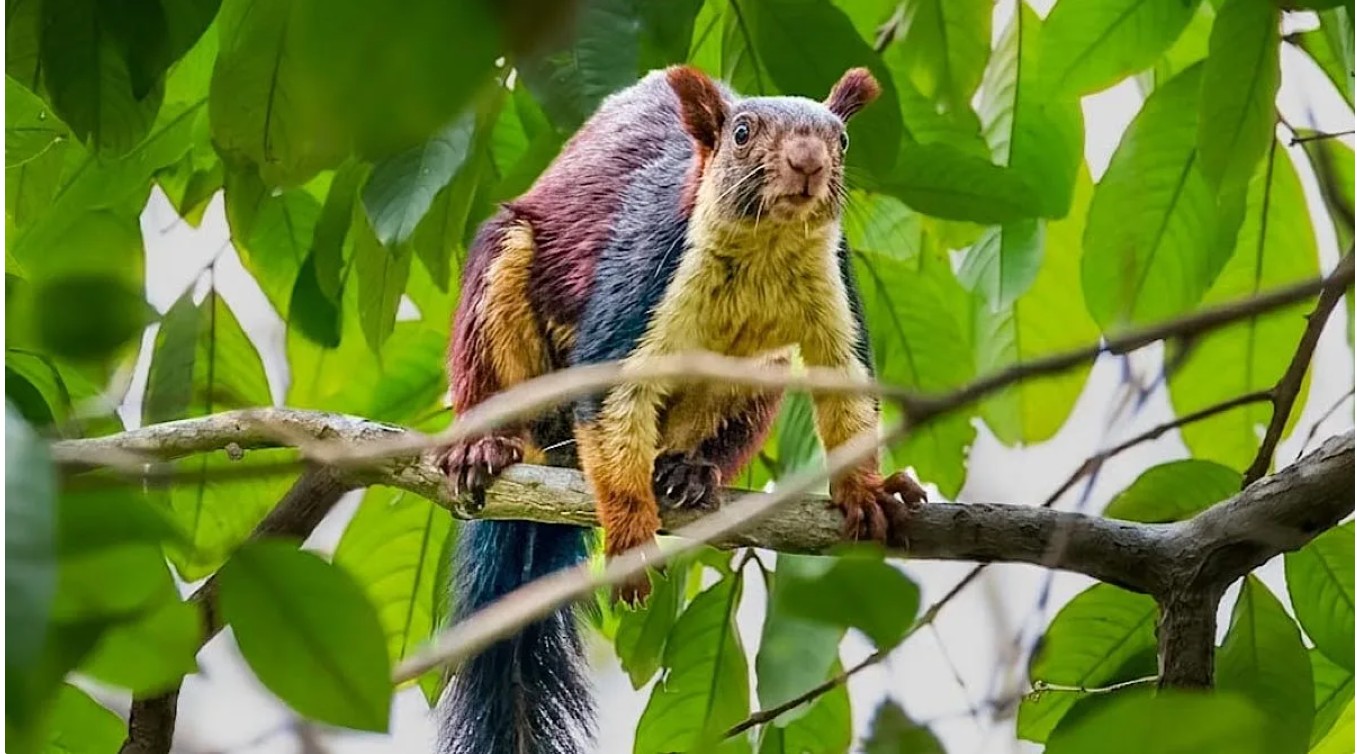
The recent sighting of a Giant Malabar Squirrel in the Devpur forest areaof Chhattisgarh's Barnawapara forest has drawn attention to one of India's most striking and largest arboreal mammals.
About the Giant Malabar Squirrel
- The Giant Malabar Squirrel, also known as the Indian Giant Squirrel, is a large, multicoloured tree squirrel endemic to India. Its scientific name is Ratufa indica, and it is considered one of the largest squirrel species in the world.
- The species is predominantly distributed across the Western Ghats, Eastern Ghats, and the Satpura Range, inhabiting tropical deciduous, semi-deciduous, and evergreen forests at elevations ranging from 180 to 2,300 metres.
- It is also the State Animal of Maharashtra, where it is popularly known as Shekru.
Habitat and Behaviour
- The Giant Malabar Squirrel is a highly arboreal species, spending most of its life in the forest canopy. It moves with remarkable agility, often leaping between trees over distances of up to six metres. Instead of descending to the ground frequently, it relies on interconnected tree canopies for movement and survival.
- The species generally takes shelter in tree hollows and constructs nests high above the ground. Unlike many other squirrels, it is usually solitary, coming together mainly during the breeding season.
- An interesting defensive behaviour displayed by the species is that when threatened, it often remains motionless or flattens itself against a tree trunk rather than attempting to flee immediately. This camouflage strategy helps it avoid predators.
Physical Characteristics
- The Giant Malabar Squirrel is renowned for its striking appearance and vibrant colouration. Its body length ranges from 254 to 457 mm, while the tail is usually longer than the body itself.
- The species exhibits multiple colour patterns, typically featuring combinations of:Black, Brown, Deep red or maroon, Cream or dirty white patches.
- Other notable features include:pink lips and nose, Bright brown eyes, Short rounded ears, Large powerful claws, expanded inner paws adapted for gripping tree bark and branches.
- Its long, bushy tail is generally light brown with a creamy-white tip, aiding balance while navigating the forest canopy.
Ecological Importance
- As a canopy-dwelling herbivore and frugivore, the Giant Malabar Squirrel plays an important role in forest ecosystem functioning. By feeding on fruits, seeds, flowers, bark and nuts, it contributes to seed dispersal and supports forest regeneration.
- Its presence is also considered an indicator of healthy forest ecosystems with well-connected tree canopies and adequate habitat quality.
Conservation Status
The Giant Malabar Squirrel is currently classified as "Least Concern" on the IUCN Red List, indicating that its population remains relatively stable across its range. However, localized threats such as:Habitat fragmentation, Deforestation, Forest fires, Infrastructure development, can affect populations in specific regions.
The recent sighting in Chhattisgarh highlights the importance of conserving forest corridors and monitoring wildlife populations beyond their traditionally recognized habitats.
Piprahwa Relics
- 01 May 2026
In News:
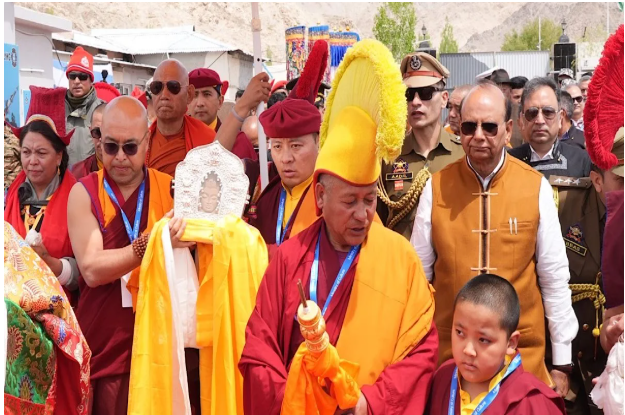
Leh recently emerged as a focal point of spiritual and historical significance as it hosted the sacred Piprahwa relics of Gautam Buddha. This landmark event, marked by the arrival of the relics in Ladakh, represents a rare confluence of faith and history. Carried via a special Indian Air Force aircraft and received with state honors, the exposition marks the first time these "AA" category antiquities have been moved from their original place of preservation for domestic exposition within India, following several high-profile international tours to nations like Thailand, Mongolia, and Vietnam.
Historical and Archaeological Context
The Piprahwa Relics are among the most authentic and significant archaeological links to the mortal remains of the Buddha. Their history is rooted in the late 19th century:
- Discovery (1898): The relics were unearthed by William Claxton Peppé, a British colonial engineer, at the Piprahwa Stupa in the Basti district of Uttar Pradesh.
- Identification of Kapilavastu: Archaeological evidence from the site associates Piprahwa with ancient Kapilavastu, the capital of the Shakya kingdom where Siddhartha Gautama spent his formative years before his Great Renunciation (Mahabhinishkramana).
- The Brahmi Inion: A critical find was a sandstone coffer containing crystal caskets. One casket bore an inion in the ancient Brahmi , explicitly linking the contents to the Shakya clan. This epigraphic evidence suggests the remains were enshrined by the Buddha’s own kinsmen around the 3rd century BC.
- Later Excavations (1971–1977): Subsequent excavations by the Archaeological Survey of India (ASI) led by K.M. Srivastava uncovered further steatite caskets containing 22 sacred bone fragments. These are currently preserved at the National Museum in New Delhi.
Legal Status and Repatriation
The trajectory of these relics reflects India’s evolving policy on heritage management and cultural diplomacy:
- The Treasure Trove Act, 1878: Under colonial law, the British Crown claimed Peppé’s original find. While some bones were presented to King Chulalongkorn of Siam (Thailand), a significant portion of the gems and ornaments remained in private hands or were moved to the Indian Museum in Kolkata.
- Antiquity Classification: In modern India, the Piprahwa relics are classified as ‘AA’ antiquities. This legal designation under the Antiquities and Art Treasures Act prohibits their sale and strictly regulates their movement, reflecting their "inestimable" value to national heritage.
- Modern Repatriation (2025-2026): In a significant victory for cultural restitution, a collection of associated gems and artifacts that had remained with the Peppé family for 127 years was repatriated to India. This was achieved through a unique public-private partnership involving the Government of India and the Godrej Industries Group, successfully preempting a planned auction in Hong Kong.
Socio-Cultural and Strategic Significance
The exposition in Ladakh transcends religious ritual, touching upon several key themes relevant to the Indian state:
- Cultural Diplomacy: The movement of these relics to various Buddhist-majority nations serves as a pillar of India’s "Act East" policy, utilizing "Soft Power" to strengthen ties with the Global South and Southeast Asia.
- Regional Integration: The ceremony in Leh, attended by the Lieutenant Governor and senior monastic leaders (including Drukpa Thuksey Rinpoche), underscores the integration of Himalayan Buddhist culture into the broader national narrative.
- The 2569th Buddha Purnima: The timing of the exposition, coinciding with Buddha Purnima, highlights the continuity of the Dhamma in the region, drawing thousands of devotees and global attention to the Dharma Center in Leh and Zanskar.