
Skill Development Under Vibrant Villages Programme
- 26 Apr 2026
In News:
The strategic landscape of India’s border management has undergone a paradigm shift, moving from a purely security-centric approach to one that integrates socio-economic development with national defense. Central to this vision is the Vibrant Villages Programme (VVP), a flagship initiative designed to transform border areas from isolated peripheries into self-reliant, well-connected "first villages."
Genesis and Expansion: VVP to VVP-II
Initially launched in 2023 to address developmental gaps in villages along the China border, the initiative has seen a massive scale-up. Recently, the Union Cabinet approved VVP-II, expanding the scheme's footprint significantly. Unlike typical developmental projects, VVP-II is a 100% centrally funded Central Sector Scheme.
The program now spans across a vast geographical arc including Arunachal Pradesh, Assam, Bihar, Gujarat, Himachal Pradesh, Jammu and Kashmir, Ladakh, Manipur, Meghalaya, Mizoram, Nagaland, Punjab, Rajasthan, Sikkim, Tripura, Uttarakhand, Uttar Pradesh, and West Bengal. This expansion reflects the government's commitment to securing the entire length of India’s international borders through community empowerment.
The Socio-Economic Mandate: Skill-Led Growth
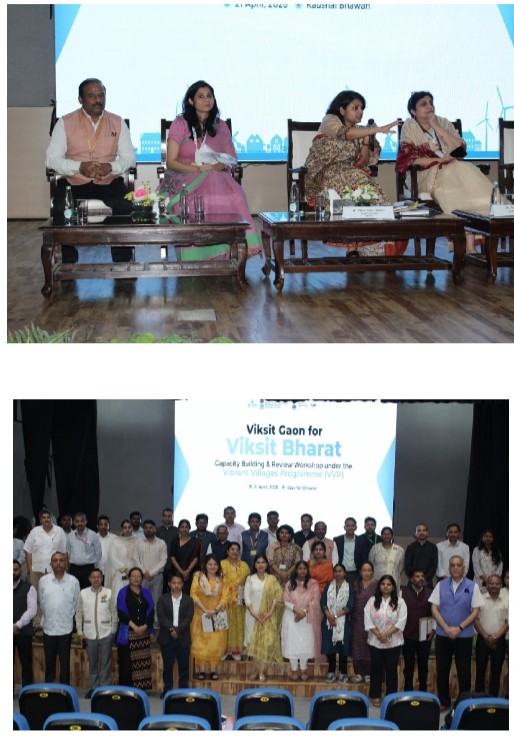
A critical pillar of the VVP is the integration of skill development with regional economic needs. The Ministry of Skill Development and Entrepreneurship (MSDE) has taken a proactive role by organizing capacity-building workshops to accelerate development in these remote regions.
The focus is on demand-driven, locally relevant skilling. By identifying the specific economic potential of each border cluster—whether in high-altitude agriculture, local handicrafts, or adventure tourism—the MSDE ensures that training translates into sustainable livelihoods. This "bottom-up" approach promotes innovation and peer learning, ensuring that the youth in these areas become active participants in the regional economy rather than being forced to migrate to urban centers.
Security Through Prosperity: The "Eyes and Ears" Strategy
From a national security perspective, the VVP addresses a critical vulnerability: the security vacuum created by out-migration. When border populations leave their ancestral lands due to lack of opportunities, it leads to demographic changes that can be exploited by adversarial elements.
By creating sustainable livelihood opportunities, the Ministry of Home Affairs (MHA) aims to:
- Prevent Migration: Retaining the population ensures a continuous human presence in strategically sensitive zones.
- Intelligence Gathering: Empowering local residents makes them the "eyes and ears" of the Border Guarding Forces (BGF). A prosperous, loyal community is the first line of defense against illicit activities and trans-border crimes.
- Trust Building: The MHA emphasizes culturally sensitive outreach. This ensures that security agencies and local communities work in tandem, fostering a sense of national belonging and mutual trust.
Infrastructure and Saturation: The "Viksit Gaon" Vision
The VVP operates on the principle of saturation of government schemes. This involves ensuring that every household in the identified 662 villages has access to basic amenities—electricity, clean water, digital connectivity, and healthcare.
These villages are being developed as "growth centres" through:
- Strengthened Infrastructure: Improving all-weather road connectivity and telecommunications to bridge the digital and physical divide.
- Economic Assimilation: Linking local products to national markets to ensure that the economic benefits of India's growth reach the last mile.
- Cultural Integration: Encouraging border tourism to showcase the unique heritage of these regions, thereby strengthening their cultural ties with the rest of the country.