
Ru-Soam Bridges
- 03 May 2026
In News:
UNESCO partnered with the Government of Sikkim supported by Airbnb to formally document Ru-Soam, the traditional cane bridges of the Lepcha community, and nominate them for UNESCO's Intangible Cultural Heritage (ICH) list.
What is Ru-Soam?
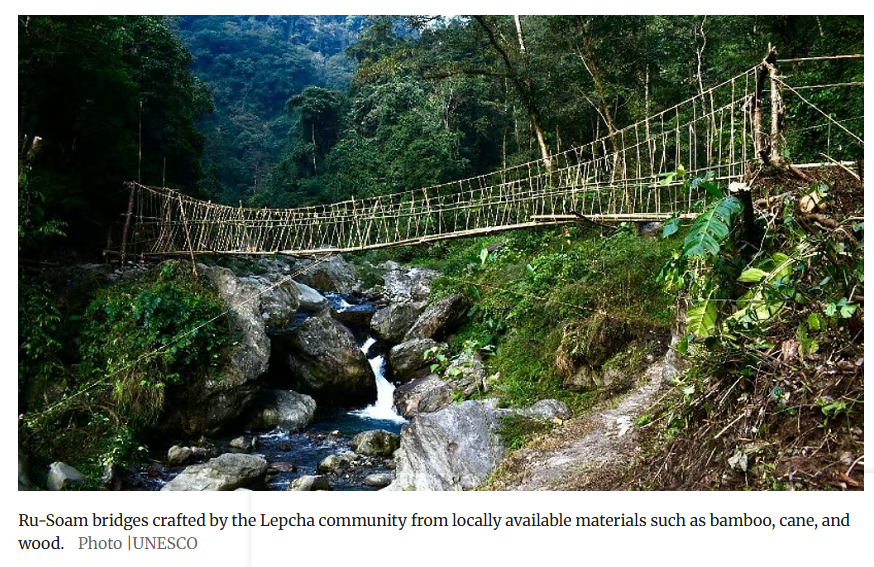
Ru-Soam are traditional suspension bridges built by the Lepcha community of Sikkim, found primarily in the Khangchendzonga Biosphere Reserve (Dzongu Tribal Reserve, North Sikkim). In the Lepcha language, 'Ru' means cane or rattan and 'Soam' means bridge. Regarded as one of the oldest suspension bridge traditions in the Eastern Himalaya, British botanist Joseph Dalton Hooker documented them in the 19th century as "works of art."
Structural Features
The bridge rests on two parallel cane cables (soamgyang) anchored to trees at both ends. Cane loops called ahool serve as handrails, while bamboo planks (soamgur) form the walkway. Bridges span over 100 metres and hang 30 metres above rivers, supporting 2–3 persons at a time. Construction is led by master craftsmen (Soam-nokbu) alongside ritual specialists (Bongthing), with knowledge passed entirely through oral tradition.
The critical engineering advantage is flexibility — the bridge sways and absorbs flood force rather than rigidly resisting it, a property decisive during recent Himalayan disasters.
Climate Resilience
During the 2023 South Lhonak Lake GLOF (Glacial Lake Outburst Flood), modern bridges across the Teesta basin were destroyed, cutting off Dzongu for weeks. Several Ru-Soam bridges survived and sustained critical connectivity for villages and relief operations. A 2024 cloudburst repeated the pattern — modern infrastructure failed while communities rapidly rebuilt cane bridges, restoring access within days. Scholar Sonam R. Lepcha, in a study published in the journal Pleione, documented how these bridges became lifelines for the region.
About Khangchendzonga:
Declared UNESCO World Heritage Site in 2016 (Mixed Category) — India's first Mixed World Heritage Site. Part of the World Network of Biosphere Reserves since 2018.