
Nilgiri Tahr
- 28 Apr 2026
In News:
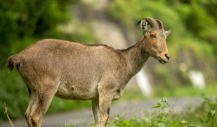
In a major cross-border conservation effort, the Tamil Nadu Forest Department, in collaboration with Kerala, has commenced the third synchronized Nilgiri Tahr survey. This scientific census is a critical component of Project Nilgiri Tahr, aimed at safeguarding the only mountain ungulate in southern India and understanding the ecological health of the high-altitude Western Ghats.
Biological Profile and Ecological Significance
The Nilgiri Tahr (Nilgiritragushylocrius) is a unique species among the 12 mountain ungulates found in India. As an endemic species to the Western Ghats, it serves as a "vital indicator species"—its population stability directly reflects the health of the fragile montane grasslands it inhabits.
- State Identity: It is the State Animal of Tamil Nadu.
- Physical Adaptation: Known for extreme agility, these ungulates are exceptionally sure-footed, allowing them to navigate steep, rocky cliffs to evade predators.
- Conservation Status: The species is currently categorized as Endangered on the IUCN Red List.
Habitat and Geographic Distribution
Historically, the Nilgiri Tahr roamed the entire length of the Western Ghats. Today, their range is restricted to a narrow 400 km stretch from the Nilgiris in the north to the Kanyakumari hills in the south.
- Altitude: They are strictly montane, favoring open grasslands at elevations between 1,200 and 2,600 meters.
- Population Strongholds:
- Eravikulam National Park (Kerala): Home to the largest single population.
- Anamalai Hills and the Nilgiris: Other significant clusters.
- Fragmentation: Due to historical habitat loss and anthropogenic pressures, the species survives in small, isolated pockets, which poses a risk to genetic diversity.
Modern Survey Methodology and Conservation Research
The current synchronized survey is timed specifically after the winter calving season. This ensures that the young "kids" are visible and can be accurately counted alongside the adults. The 2026 survey incorporates several advanced scientific interventions:
- Digital Monitoring: The Varudai mobile app is used for standardized reporting and real-time tracking, reducing human error and ensuring data transparency.
- Genetic Management: Researchers are conducting behavioral studies to evaluate the feasibility of translocation—moving individuals between fragmented pockets to prevent inbreeding and improve the gene pool.
- Health Assessment: Specific research is being directed toward the prevalence of tumors observed in certain herds, providing a baseline for the overall pathological health of the species.
Eravikulam National Park to Close From February 1 for Nilgiri Tahr Breeding Season (The Hindu)
- 31 Jan 2024
Why is it in the News?
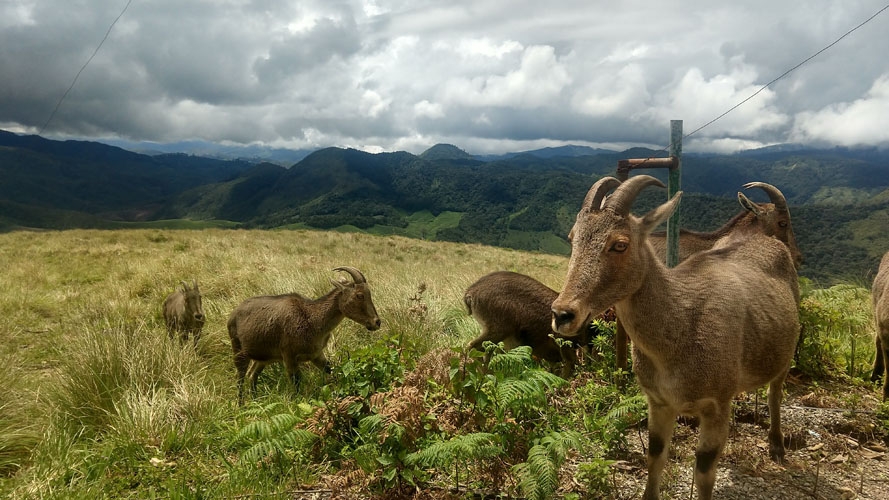
The Eravikulam National Park (ENP), the natural habitat of the Nilgiri tahr, will be closed for the calving season of the species from February 1 to March 31.
About Eravikulam National Park:
- Eravikulam National Park also known as Rajamala National Park, is located in Kerala's Idukki district.
- The park is administered under the Kerala Forest and Wildlife Department and became a National park in 1978.
- It is a 97 km2 national park located along the Western Ghats, Kerala.
- Anamudi, the highest peak in south India was located on the southern side of the park.
- This is also the land of "Neelakurinji", a flower that blooms once in twelve years.
- Wildlife in the Park: The park holds the maximum viable population of the endangered Nilgiri Tahr including other little-known fauna Nilgiri marten, ruddy mongoose, small clawed otter, dusky striped squirrel etc.
- Flora: Important flora includes Microtropis ramiflora, Actinodaphne bourdilloni, Pittosporum tetraspermium, Chrysopogon Zelanieus, Strobilanthus Kunthianus (Neela Kurinji) etc.
- Mostly the park is busted with rolling grasslands, but several patches of shola forests are also found in the upper part of the valley.
- The shola grasslands are exceptionally rich in balsams and orchids including the long thought extinct variety Brachycorythis wightii.
- The Atlas moth, the largest of its kind in the world, is seen in this park.
Key Facts about Nilgiri Tahr:
- Nilgiri Tahr is a rare mountain animal found only in the southern part of the Western Ghats.
- Scientific Name: Nilgiritragus hylocrius
- Local Name: Varayaadu
- They are famous for their ability to climb steep cliffs, which has earned them the nickname Mountain Monarch.
- It is the official state animal of Tamil Nadu.
- Distribution: Nilgiri Tahrs are mainly found in Kerala and Tamil Nadu, covering only about 5% of the Western Ghats.
- Eravikulam National Park in Kerala is home to the largest population of Nilgiri Tahrs.
- Habitat: They live in open grasslands at elevations between 1200 and 2600 meters in the South Western Ghats.
- Characteristics: Nilgiri Tahrs have a sturdy body with short, coarse fur and a rough mane.
- Both males and females have curved horns, with males having larger horns, up to 40 cm long.
- Adult males have a light grey area on their backs, known as a 'saddle,' hence the name 'saddlebacks.'
- They have a short grey-brown or dark coat.
- Conservation Status:
- IUCN Red List: Endangered
- Protected under the Wildlife (Protection) Act of India, 1972: Schedule I
Forest Department Relies on Muthuvan Tribe's Indigenous Knowledge for Nilgiri Tahr Conservation (The Hindu)
- 17 Oct 2023
Why in the News?
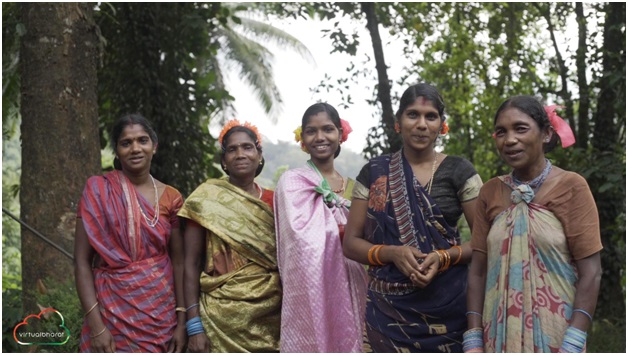
Members of the Muthuvan tribe of the Anamalai hills, who are known for coexisting with the wildlife with their traditional knowledge, have joined hands with the Tamil Nadu Forest Department for a unique task.
About the Muthuvan Tribe:
- Inhabiting the border hill forests of Kerala and Tamil Nadu, the Muthuvan tribe is distributed across this region.
- The tribe communicates in distinct dialects, identifying themselves as Malayalam Muthuvan and Pandi Muthuvan.
- Cultural Beliefs: Embracing animism and spirit worship, the Muthuvan tribe venerates forest gods and attributes the spirits of their ancestors as the initial settlers in the hill forests.
- Renowned for their harmonious coexistence with wildlife, the Muthuvan people leverage traditional knowledge to navigate their relationship with the natural environment.
- Unique Governance System - 'Kani System': Operating under the 'Kani System,' each village is overseen by a 'Kani' responsible for village administration, reflecting their distinctive form of governance.
- Traditional Medicine Expertise: Proficient in traditional medicines, the Muthuvan tribe safeguards their effective remedies, preserving and passing down this knowledge across generations.
- Occupation: Agriculture serves as the primary occupation for Muthuvan tribes, yielding various products such as ragi, cardamom, and lemongrass.
About Project Tahr:
- Project Tahr aims to enhance comprehension of the Nilgiri Tahr population through surveys and radio telemetry studies.
- The initiative focuses on reintroducing Tahrs to their historical habitat, fostering their return to natural landscapes.
- Addressing immediate threats, the project employs strategic measures to mitigate challenges facing the Nilgiri Tahr.
- A key component involves intensifying public awareness efforts to garner support and understanding for the conservation of this species.
- Project Tahr is slated for a comprehensive 5-year implementation, spanning from 2022 to 2027.
Project Nilgiri Tahr’ Launched in Tamil Nadu (The Hindu)
- 12 Oct 2023
Why in the News?
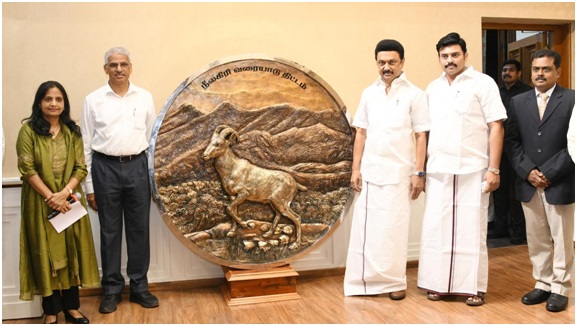
Consolidating efforts towards the conservation of Tamil Nadu’s State Animal, Chief Minister M.K. Stalin on Thursday, October 12, 2023, launched the ‘Project Nilgiri Tahr’ from the Secretariat in Chennai.
About Nilgiri Tahr:
- The Nilgiri Tahr, scientifically known as Nilgiritragus hylocrius, is an endangered mountain ungulate that is native to the southern part of the Western Ghats.
- Locally referred to as 'Varayaadu,' these creatures are renowned for their remarkable climbing abilities on steep cliffs, earning them the moniker "Mountain Monarch."
- Notably, the Nilgiri Tahr holds the distinction of being the state animal of Tamil Nadu.
Distribution:
- The current range of Nilgiri Tahrs is confined to approximately 5% of the Western Ghats in southern India, specifically in the states of Kerala and Tamil Nadu.
- The Eravikulam National Park in Kerala is home to the highest density and the largest surviving population of Nilgiri Tahrs.
Habitat:
- Nilgiri Tahrs inhabit open montane grassland habitats, thriving at elevations ranging from 1200 to 2600 meters in the South Western Ghats.
Distinctive Features:
- Characterized by a stocky body, short coarse fur, and a bristly mane, Nilgiri Tahrs exhibit sexual dimorphism, with mature males being larger and darker in colour.
- Both males and females possess curved horns, with males having larger ones measuring up to 40 cm, while females' horns reach approximately 30 cm.
- Adult males develop a light grey area or 'saddle' on their backs, leading to the term 'saddlebacks.' The species is recognized by its short grey-brown or dark coat.
Conservation Status:
- The Nilgiri Tahr is classified as Endangered on the IUCN Red List, signifying the critical need for conservation efforts.
- Additionally, it is accorded the highest protection under the Wildlife (Protection) Act of India, 1972, listed in Schedule I.