
Naval Anti-Ship Missile Short Range
- 01 May 2026
In News:
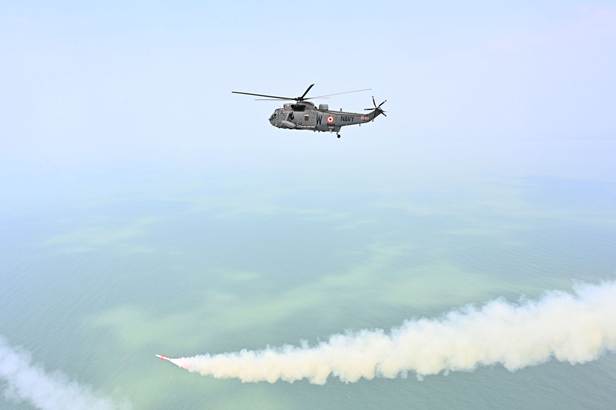
In a significant milestone for India’s maritime defense, the Defence Research & Development Organisation (DRDO) and the Indian Navy recently conducted the maiden salvo flight trial of the Naval Anti-Ship Missile-Short Range (NASM-SR). The test, carried out from a Sea King 42B helicopter at the Integrated Test Range in Chandipur, Odisha, demonstrated the weapon’s "fire-and-forget" capability. A salvo launch involves firing multiple missiles in quick succession to overwhelm an enemy’s defense systems, a capability essential for modern naval warfare.
Origins and Development
The NASM-SR is India’s first indigenously designed and developed helicopter-launched anti-ship missile.
- Replacement Strategy: It is specifically engineered to replace the aging British-origin Sea Eagle missiles, which have been the mainstay of the Navy’s Sea King fleet for decades.
- Indigenous Partnership: The project was spearheaded by the Research Center Imarat (RCI) in Hyderabad, in collaboration with several other DRDO laboratories and Indian industry partners, aligning with the "Aatmanirbhar Bharat" (Self-Reliant India) initiative.
Technical Specifications and Features
The NASM-SR incorporates several high-end technologies that enhance the precision and lethality of naval air operations:
- Propulsion and Range: The missile is powered by a solid propulsion booster and a long-burn sustainer motor, providing it with an operational range of approximately 55 kilometers.
- Navigation and Guidance: It is equipped with a state-of-the-art seeker and an Imaging Infrared (IIR) system for terminal guidance. Its navigation is supported by a Fiber-Optic Gyroscope-based Inertial Navigation System (INS) and a radio altimeter.
- Control Systems: The missile utilizes Jet-Vane Control (JVC) technology, which allows for extreme maneuverability immediately after launch, and high-bandwidth two-way data links for real-time communication.
- Tactical Advantage: The system supports all-weather, day-and-night operations. It is designed for low-level sea-skimming, a flight profile that allows the missile to fly just above the water's surface to evade enemy radar detection.
- Lethality: The missile is designed for a precise waterline hit, a critical tactical feature intended to cause maximum structural damage and flooding to hostile vessels.
Strategic Significance for the Indian Navy
The induction of the NASM-SR holds several strategic advantages for India's maritime security architecture:
- Self-Reliance in Niche Tech: By developing an indigenous helicopter-launched missile, India reduces its dependence on foreign Original Equipment Manufacturers (OEMs) for critical airborne anti-ship weaponry.
- Enhanced Maritime Domain Awareness: The ability to launch these missiles from helicopters allows the Navy to project power far beyond the visual horizon of its surface fleet, providing a quick-reaction capability against small and medium-sized enemy combatants.
- Modernization of the Air Arm: The successful salvo trials pave the way for the integration of this weapon system onto other platforms, including the Indigenously Developed Dhruv (Advanced Light Helicopter) and the MH-60R Romeo helicopters, thereby modernizing the offensive reach of the Navy’s air wing.