
Hindu Kush Himalaya
- 27 Apr 2026
In News:
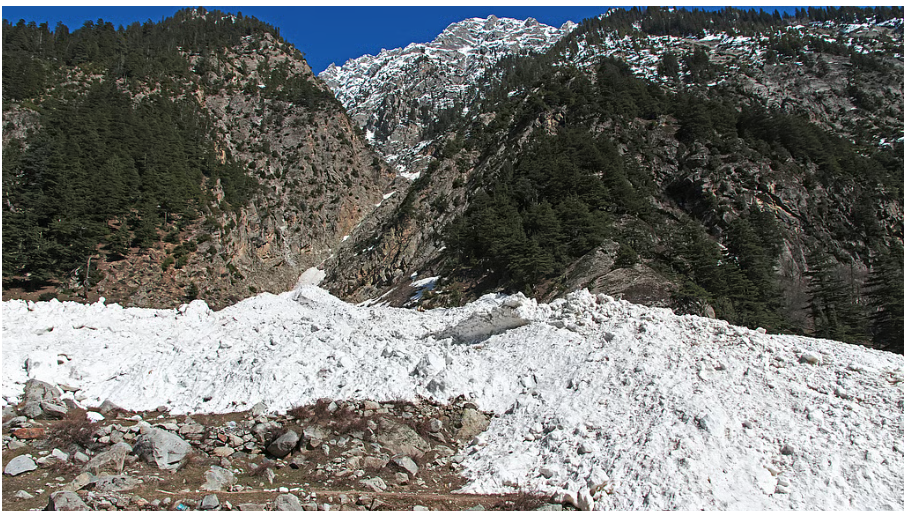
A recent report by the International Centre for Integrated Mountain Development (ICIMOD) has sounded a critical alarm for the Hindu Kush Himalaya (HKH) region. The findings reveal a record 27% drop in snow persistence—the duration for which snow remains on the ground—marking the fourth consecutive year of significant decline. This trend poses an existential threat to water security, biodiversity, and the livelihoods of nearly 2 billion people downstream.
Geographical Profile: The Water Tower of Asia
The Hindu Kush Himalaya is often referred to as the "Third Pole" because it contains the largest volume of permanent ice and snow outside the North and South Poles.
- Extent: It stretches approximately 3,500 km across eight countries: Afghanistan, Bangladesh, Bhutan, China, India, Nepal, Myanmar, and Pakistan.
- Topography: The range runs from northeast to southwest, acting as a colossal geographical divide between the Amu Darya valley to the north and the Indus River valley to the south.
- Highest Peak: The highest point is Tirich Mir (7,708 meters) located in the Chitral district of Pakistan.
- Sub-sections: The range is traditionally divided into three sections: the Eastern, Central, and Western Hindu Kush (the latter known as the B?b? Mountains).
Hydrological and Ecological Significance
The HKH region is the primary source of ten major Asian river systems:
- Amu Darya
- Indus
- Ganges
- Brahmaputra
- Irrawaddy
- Salween
- Mekong
- Yangtze
- Yellow River
- Tarim
These rivers support agriculture, energy, and industry for roughly a quarter of the global population. Furthermore, the region is an ecological powerhouse, home to four global biodiversity hotspots and a mosaic of ecosystems including glaciers, alpine meadows, wetlands, and desert vegetation in the arid inner valleys.
The Crisis: Declining Snow Persistence
Snow persistence is a vital indicator of mountain health. Unlike glaciers, which provide long-term water storage, seasonal snowmelt is the immediate driver of river flow during the spring and summer.
The ICIMOD report highlights that the current 27% decline is significantly below the historical average. This "snow drought" leads to:
- Water Scarcity: Reduced runoff affects irrigation and drinking water for downstream communities long before the monsoon arrives.
- Ecological Shift: Altered timing of snowmelt disrupts the life cycles of flora and fauna in alpine ecosystems.
- Increased Hazards: Warmer temperatures lead to unstable permafrost and a higher frequency of Glacial Lake Outburst Floods (GLOFs) and landslides.
Accelerated Glacier Loss in Hindu Kush Himalayas

- 28 Mar 2025
In News:
On World Day for Glaciers (March 21, 2025), the United Nations World Water Development Report 2025 revealed that glaciers globally are retreating at an alarming rate, with the Hindu Kush Himalaya (HKH) region witnessing the most severe impact — glacier loss accelerated by 65% between 2011–2020 compared to the previous decade.
Key Facts about Hindu Kush Himalaya (HKH) Region
- Geographical Spread: Extends over 3,500 km across 8 countries — Afghanistan, Bangladesh, Bhutan, China, India, Myanmar, Nepal, and Pakistan.
- Population Impact:
- 240 million people live in the HKH region.
- An additional 1.65 billion people downstream depend on its waters for drinking, agriculture, hydropower, and sanitation.
- Glacial Reservoir: Known as the “Third Pole” or “Water Tower of Asia”, the HKH stores more ice than anywhere outside the Arctic and Antarctic.
- River Systems: Source of 10 major river basins, including the Ganges, Indus, Brahmaputra, and Mekong.
Projected Glacier Loss (HKH and Global)
Temperature Rise (°C) HKH Glacier Volume Loss by 2100
1.5°C to 2°C 30%–50%
Above 2°C ~45% (from 2020 baseline)
- Global Glacier Loss: Mountain glaciers may lose 26%–41% of total mass globally by 2100, affecting 1.1 billion people in mountain regions.
Disaster Risks from Glacier Melt
- Glacial Lake Outburst Floods (GLOFs):
- Trigger flash floods and landslides.
- Have caused over 12,000 deaths globally in the past 200 years.
- In the HKH region alone, GLOFs are linked to over 7,000 deaths in the last 190 years.
- Risk of GLOFs may triple by 2100.
- Glacial Lakes: Rapid warming is expanding the number and area of glacier-fed lakes, increasing hazard potential.
Cryosphere and Climate Change
- Hydrological Changes: Melting glaciers alter water runoff patterns, with varied impacts across river basins — increasing monsoon runoff in some while reducing dry-season flows in others.
- Hydropower Challenges:
- Glacial melt initially boosts hydropower potential but may be offset by increased evaporation and reduced glacier mass over time.
- Many hydropower and cryptocurrency mining projects are unregulated and stress fragile mountain ecosystems.
- Mountain-Based Industries: Lithium mining in the Andes, for instance, uses up to 2,000 m³ of water per tonne, intensifying water stress.
Governance and Cooperation Gaps
- Weak Water Governance: Mountain regions, including the HKH, lack effective transboundary cooperation due to mutual distrust and poor data sharing.
- Transboundary Action Plan (HKH):
- Enhance cooperation at all levels.
- Prioritize rights and knowledge of mountain people.
- Limit global warming to 1.5°C.
- Fast-track SDG implementation in mountain areas.
- Strengthen ecosystem resilience and biodiversity.
- Promote regional data sharing and scientific collaboration.
UN Actions and Global Recognition
- International Year of Glacier Preservation (IYGP): 2025
- Decade of Action on Cryospheric Science: 2025–2034 — to advance global efforts in glacier conservation, data collection, and sustainable development in cryosphere-dependent regions.
International Centre for Integrated Mountain Development (DownToEarth)
- 06 Feb 2024
Why is it in the News?
Experts from The International Centre for Integrated Mountain Development (ICIMOD) called for ‘bold action’ and ‘urgent finance’ to prevent collapse of nature in High Mountain Asia on February 5, 2024, in the Nepalese capital of Kathmandu.
About the International Centre for Integrated Mountain Development (ICIMOD):
- The International Centre for Integrated Mountain Development (ICIMOD) is an intergovernmental knowledge and learning center dedicated to serving the communities of the Hindu Kush Himalaya (HKH) region.
- Established and inaugurated on December 5, 1983, its mission is to generate and share knowledge that informs regional policy and action, attracting investments to facilitate the transition to greener, more inclusive, and climate-resilient development.
Membership and Governance:
- ICIMOD's member countries include Afghanistan, Bangladesh, Bhutan, China, India, Myanmar, Nepal, and Pakistan.
- Its highest governing body is the Board of Governors, composed of representatives from each member country and independent members nominated by the ICIMOD Support Group based on their professional expertise and experience.
Functions and Objectives:
- The center serves the HKH region by generating and sharing information and knowledge to address critical mountain-related challenges.
- It bridges scientific research with policy formulation and practical on-the-ground implementation.
- Furthermore, ICIMOD provides a regional platform for experts, planners, policymakers, and practitioners to exchange ideas and perspectives, facilitating sustainable mountain development.
- Headquarters of ICIMOD is in Kathmandu, Nepal.
Key Facts about the Hindu Kush Himalaya (HKH) Region:
- The Hindu Kush Himalaya (HKH) region spans 3,500 km across eight countries, from Afghanistan in the west to Myanmar in the east.
- It serves as the source of ten major Asian river systems, including the Amu Darya, Indus, Ganga, Brahmaputra, and others.
- The HKH region plays a vital role in providing water, ecosystem services, and livelihoods to the people living within its boundaries.