
DPI@2047: NITI Aayog’s Strategic Blueprint for a Developed India
- 30 Apr 2026
In News:
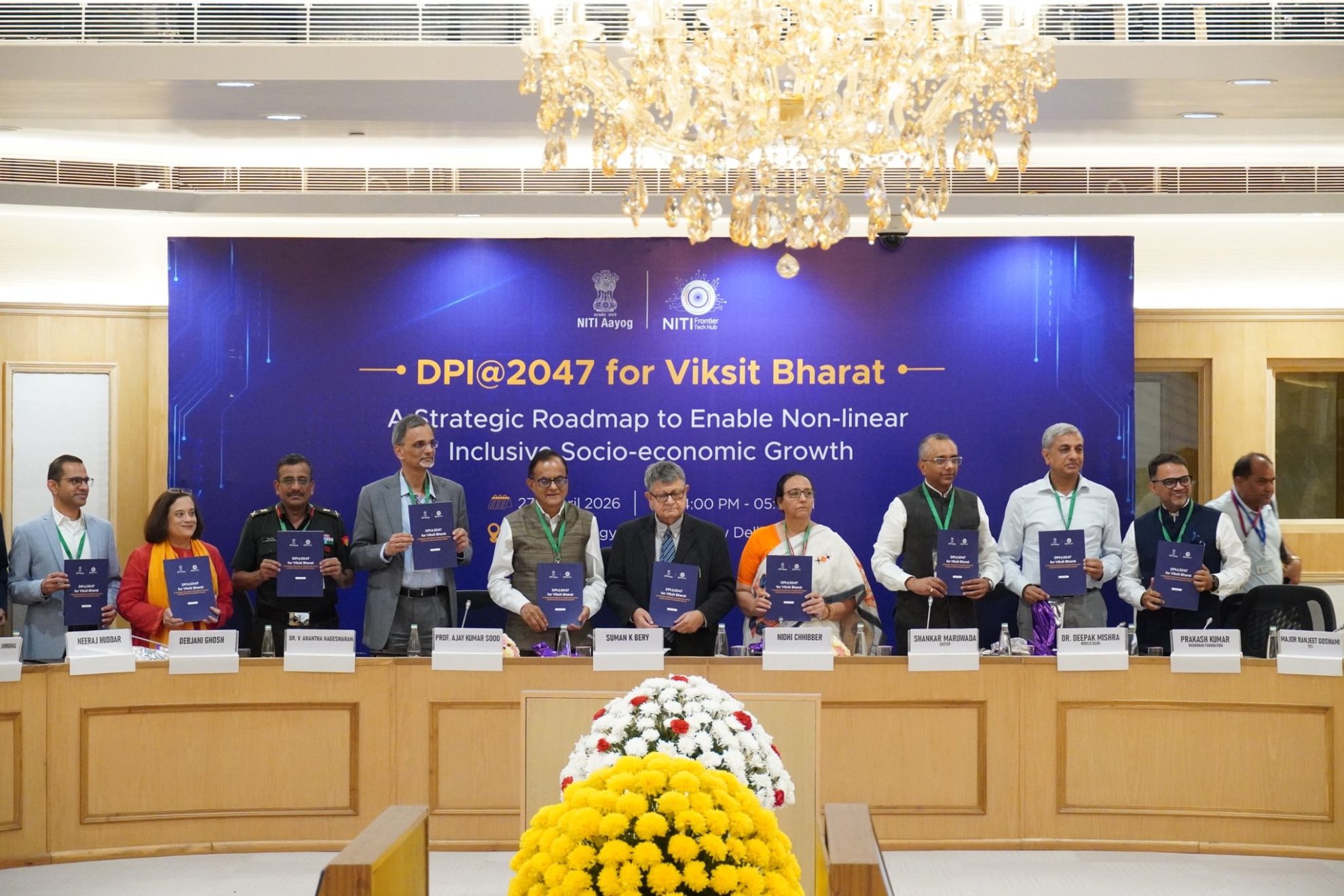
In a major step toward achieving the "Viksit Bharat" vision, NITI Aayog has launched the DPI@2047 Roadmap. Developed by the NITI Frontier Tech Hub (FTH) in collaboration with the EkStep Foundation and Deloitte, this strategic framework marks the evolution of India’s Digital Public Infrastructure (DPI).
The roadmap seeks to transition India from foundational digital inclusion (identity and payments) to a high-productivity, livelihood-led growth trajectory, aiming for a $30 trillion economy with a per capita income of $18,000 by 2047.
The Evolutionary Phasing: DPI 2.0 and 3.0
The roadmap adopts a two-phased approach to ensure non-linear, inclusive socio-economic growth:
Phase 1: DPI 2.0 (2025–2035) – "Realising Aspirations": This phase focuses on building a broad base of capable citizens by empowering livelihoods at scale. The objective is to move beyond mere welfare delivery and drive productivity in core sectors like MSMEs, agriculture, education, and healthcare. It aims to establish the mass inclusion required for a high-income society.
Phase 2: DPI 3.0 (2035–2047) – "Achieving Prosperity": The final phase envisions a compounding effect where grassroots innovation leads to sustained, high-value local economic growth across all regions. This phase will culminate in the realization of a developed India characterized by inclusive and widespread prosperity.
Core Pillars of the Roadmap
The DPI@2047 initiative rests on several strategic pillars designed to unlock economic potential:
- Mass Inclusion and Livelihoods: Expanding market access for MSMEs, improving job discovery for local talent, and enhancing the income of smallholder farmers.
- Human Capability Foundations: Achieving universal health coverage and implementing learner-centric education that utilizes local languages to eliminate learning inequities.
- Systemic Enablers: Democratizing access to credit through asset tokenization, enabling decentralized energy markets, and ensuring proactive, automated benefit delivery.
- AI-DPI Convergence: Integrating Artificial Intelligence as a "first-response assistant" to provide personalized, vernacular guidance to citizens, such as farmers and small business owners.
Economic Impact and Execution Imperatives
NITI Aayog projects that these DPI initiatives could contribute up to 4% of India’s GDP by 2030. To achieve this, the roadmap identifies four execution imperatives:
- Aggregating Demand: Using district-level programs to create a predictable pipeline for digital solutions.
- Scaling Entrepreneurship: Fostering a local ecosystem of tech entrepreneurs.
- Leveraging AI: Using AI to bridge knowledge gaps and language barriers.
- Strategic Unlocks: Utilizing open networks to expand digital transactions and unlocking data for actionable insights.
Addressing Structural Bottlenecks
Despite the potential, the roadmap identifies several challenges that must be navigated:
- Fragmented Ecosystems: A shortage of local entrepreneurs ready to meet new digital demands.
- Implementation Sinks: The risk of creating "technology looking for a problem" rather than market-driven solutions.
- Platform Dependency: Walled-garden models that exclude small providers from larger value chains.
- Knowledge Gaps: The difficulty for citizens to navigate complex digital procedures in their native languages.
Strategic Recommendations for Implementation
To ensure the success of the roadmap, NITI Aayog recommends a decentralized, state-led execution model. Solutions should be hyper-localized and context-specific, driven by states and districts.
The Aayog suggests two-year iterative transformation cycles, beginning with MSMEs and Agriculture in 2026-2027. Furthermore, India aims to establish a neutral global body by 2027 to lead international collaboration and showcase its successful DPI models to the world.